AMD’s November 2026 server processor briefing revealed a revised performance target for its forthcoming Venice-X processors. The Zen 6 design combines up to 96 CPU cores, 1,152 MB of L3 cache and a maximum boost frequency of 5.3 GHz, according to November 11 reporting by Tom’s Hardware. AMD expects the specialized chips in the second half of 2027. They are distinct from its already announced EPYC Embedded 9006 processors.
Higher frequency without sacrificing cache capacity
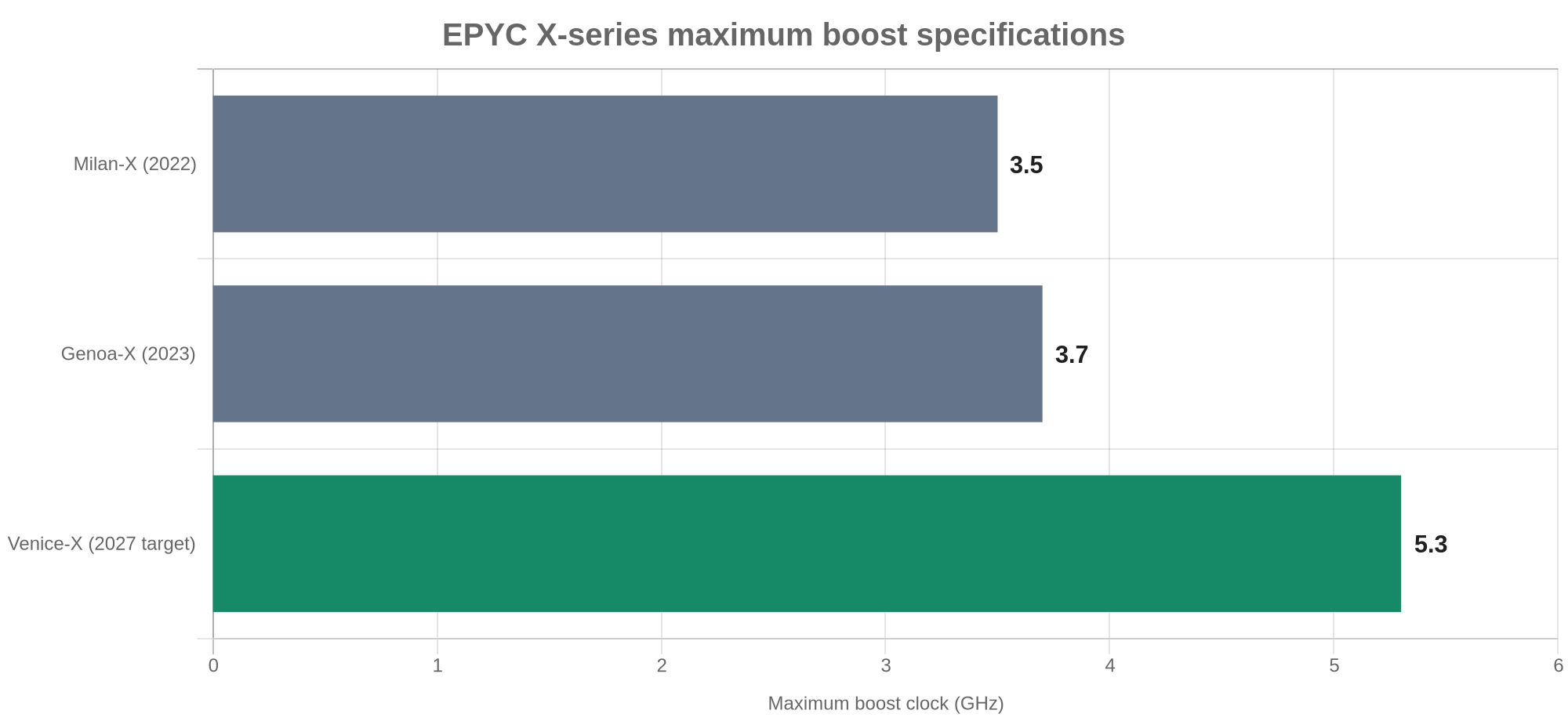
AMD’s 2022 Milan-X EPYC 7773X paired 64 cores with 768 MB of L3 cache and a maximum boost of 3.5 GHz. The 2023 Genoa-X EPYC 9684X increased the core count to 96 and cache capacity to 1,152 MB, with a maximum boost of 3.7 GHz. Venice-X retains those latter core and cache figures while targeting a 43.2% higher maximum clock frequency. The comparison concerns selected processor specifications, not measured application acceleration.
Cache reduces the need to repeatedly retrieve data from main memory. A hit allows the processor to obtain data from nearby storage, while a miss may require transactions across the memory hierarchy. Larger caches can help algorithms with working sets that repeatedly access the same information, although a program with little data reuse may gain substantially less. As our coverage of NextSilicon’s Arbel CPU explains, processor performance depends on multiple architectural mechanisms, not frequency alone.
Stacked SRAM and memory bandwidth
The Register reports that the planned Venice-X design combines 48 MB of native L3 with an additional 96 MB of stacked SRAM per compute chiplet. Eight chiplets provide the advertised 1,152 MB total. AMD’s revised stacking arrangement places SRAM beneath the compute silicon, reducing the thermal obstacle above the heat-generating cores. Advanced packaging, discussed in our semiconductor process report, remains an important manufacturing constraint.
The SP7 platform supports sixteen memory channels and PCIe 6.0. With suitable memory configurations, published theoretical memory bandwidth approaches 1.6 TB/s per socket. Actual throughput depends on access patterns, memory population and the ability of software to sustain concurrent transfers. A cache-intensive application may instead benefit from avoiding those transfers altogether.
The distinction between an engineering demonstration and a benchmark
AMD presented an electronic design automation workload comparison illustrating improved instructions per clock when using 3D V-Cache. The displayed example does not establish the performance of Venice-X: AMD did not identify the exact processors or application in the comparison reported by Tom’s Hardware. Consequently, it cannot substantiate a universal speedup for the forthcoming CPU.
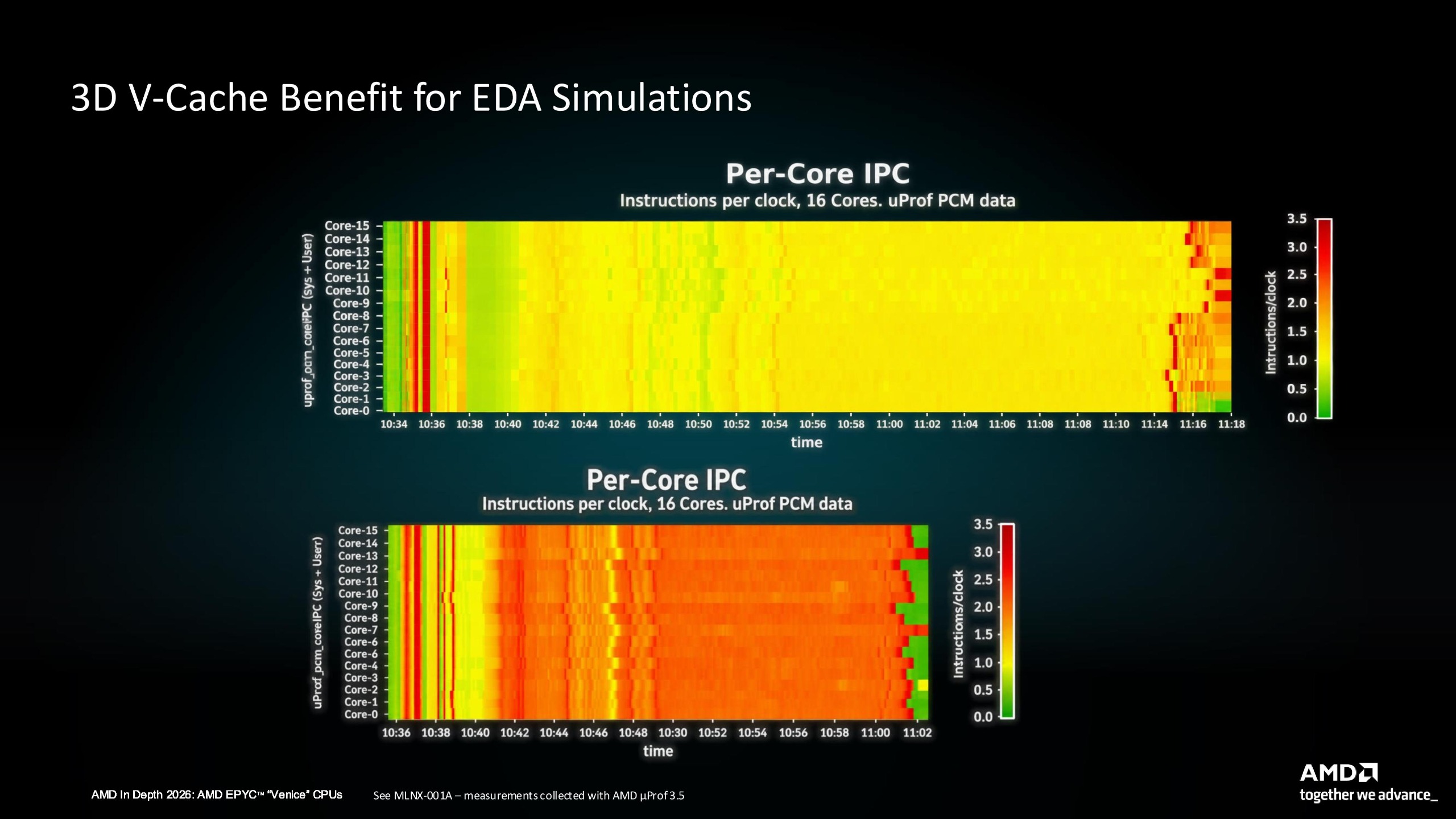
Chip verification, computational fluid dynamics and other scientific simulations can be sensitive to both memory latency and serial execution speed. Independent testing will need to examine sustained frequency, power consumption, thermal limits and workload-specific performance. AMD has not disclosed the final Venice-X model range or power specifications. Its November 10 platform update identifies the X-series as a future member of the 9006 portfolio. For additional context, the following independent overview examines the shipping Venice platform rather than the forthcoming X-series silicon.
The visual comparison uses the horizontal-bar format from our original SmartChart atlas, selected after reviewing the expanded 80-format reference. The 2027 target remains subject to revision.


Leave a Reply