
Bosch Motorsport is expanding its race-car telemetry partnership with Verizon Business after deployments at the Detroit Grand Prix and Motul Petit Le Mans. The November 18 announcement describes a system intended to maintain vehicle data connections across racing venues, including future events at Daytona and Sebring. The collaboration addresses a challenge familiar to engineers following race strategy and electrical energy management: collecting useful information from vehicles operating under rapidly changing conditions.
Two cellular connections inside a race car
Bosch’s CG 3.2 telemetry gateway supports two simultaneous cellular connections using 5G with 4G fallback. Its published specifications list four embedded SIMs, two physical SIM slots, four Ethernet interfaces, CAN-FD connectivity, 16 GB of internal storage and a 10 Hz GNSS positioning receiver. Its IP67-rated enclosure provides protection against dust and temporary immersion under specified test conditions. The gateway’s typical current consumption of 0.7 A at 13.4 V corresponds to approximately 9.38 watts. That figure represents a calculated typical electrical input, not a measured maximum under race conditions.
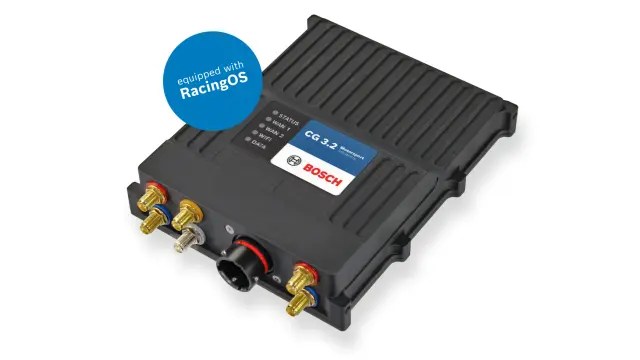
The dual connections provide an opportunity to improve resilience when a carrier experiences congestion or weak coverage. They do not guarantee uninterrupted service. Antenna placement, radio propagation, carrier availability, network configuration and the software managing the links all influence performance. Connected instrumentation also complements developments such as driver biometric monitoring, although vehicle telemetry and physiological monitoring serve different purposes.
Separating race operations from spectator traffic
Verizon’s deployment combines temporary cellular infrastructure with private network capabilities, separating operational traffic from ordinary spectator connectivity. Bosch’s RaceConnect cloud service provides a destination for vehicle information, while Verizon’s global orchestration platform uses remotely managed SIM profiles and a private access point name. Verizon describes coverage options spanning more than 140 markets; that number refers to platform reach, not racing venues with independently verified installations.
Why latency matters at racing speeds
At 200 miles per hour, a vehicle travels approximately 89.4 meters per second. During a hypothetical 100-millisecond data delay, it would cover almost nine meters. The example illustrates why timestamp accuracy, predictable delivery and data freshness matter. It is not a reported latency measurement from either company. Network engineers must distinguish transmission delay from buffering, processing and application response time, as explored in our explanation of latency and throughput.
The wider significance extends beyond motorsport. Industrial connected devices face related problems involving connectivity, remote management and resilient data collection, as illustrated by Digi’s wireless sensor acquisition. Motorsport provides a demanding environment for engineering these systems. Public disclosures establish the partnership, hardware specifications and initial event deployments, but independent measurements of packet loss, latency distributions and failover behavior would be needed to quantify its reliability improvements.
Sources
- Verizon Business announcement, November 18, 2026
- Bosch Motorsport CG 3.2 product specifications
- Light Reading: motorsport IoT connectivity
- Computer Weekly: Bosch race-day connectivity
We volunteer daily to ensure the credibility of the information on this platform is Verifiably True. If you would like to support to help further secure the integrity of our research initiative, please scan the QR code below.



Leave a Reply