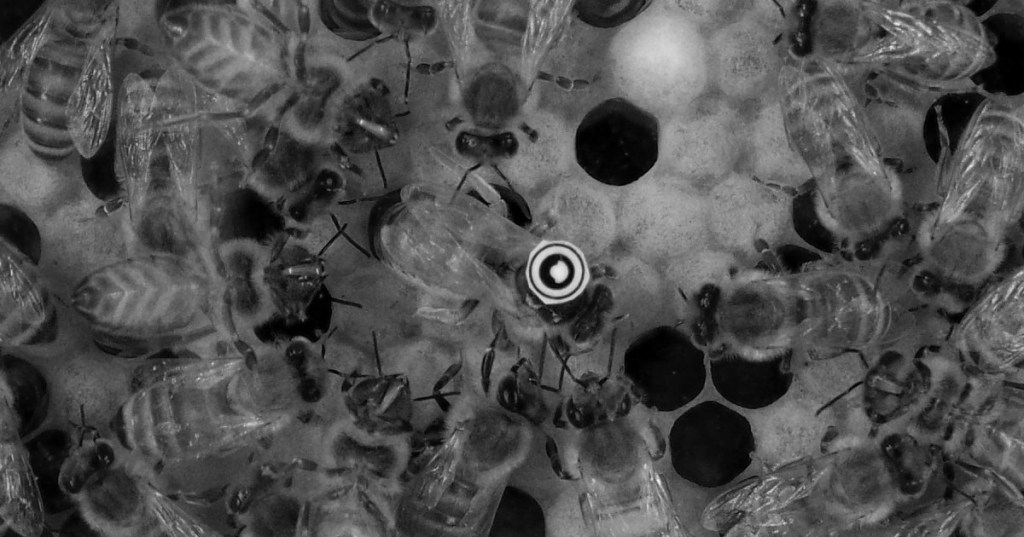
The Czech Technical University in Prague presented its RoboRoyale honeybee research to President Petr Pavel on November 25, 2026. The university’s November 26 report describes autonomous camera robots that observe a queen bee and her attendants. The project integrates robotics, computer vision and biology, applying autonomous sensing to a living environment rather than industrial workspaces such as those covered in our warehouse robotics report.
Two cameras cooperating inside an observation hive
RoboRoyale brings together researchers from Czechia, Austria, the United Kingdom and Türkiye. In the experimental facility at the University of Graz, two movable camera heads follow a marked queen across opposite faces of the honeycomb. When the queen changes sides, the system coordinates the transfer of tracking responsibility between cameras. When she remains stationary, the other camera can survey more of the comb.
The cameras use infrared illumination to limit disturbance. Computer vision extracts movement and colony activity from recorded images. Robot motion, camera positioning and consistent spatial coordinates are important because observations collected at different times must refer to the same locations. Related localization principles are discussed in our robot localization lesson. The application differs from LiDAR navigation because its primary task involves imaging the hive and tracking a biological subject.
Original research and the data pipeline
The team’s 2024 Science Robotics paper describes 23 behavioral metrics and more than 100 million images. The October 2024 university announcement reported approximately 1.4 TB of daily data streams. At a constant decimal rate, that corresponds to about 42 TB over 30 days, before additional copies and processing overhead. The publicly released research dataset and analysis code include tracking records and examples of ROS message recordings.
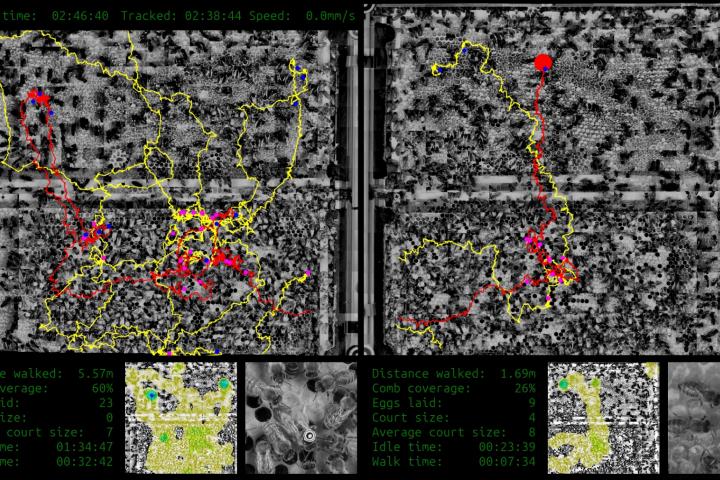
A subsequent June 2026 study describes an open-hardware observation hive, including a standardized camera and data interface. The associated hardware designs and tracking software provide materials for further investigation. The architecture illustrates the importance of reproducible sensor configurations, a concern also addressed in Croatian radar-inertial robotics research.
Mapping individual honeycomb cells
CTU reported on November 19 that researcher Dominik Eichenberger received a best-poster award at IEEE MetroAgriFor 2026 for work on automated brood surveillance, associated with SensorBees. His research presentation describes aligning repeated photographs so individual cells can be revisited over successive days. Image registration and stable cell identities allow longitudinal comparisons instead of isolated snapshots. Similar geographic registration challenges arise in satellite terrain mapping, although the physical scale is vastly different.
The demonstrated achievement is sustained observation and automated analysis. The broader RoboRoyale objective includes robotic interventions to support queen and colony health, but successful monitoring alone does not establish increased agricultural yields or improved colony survival. Controlled biological experiments would be necessary to quantify those effects. Featured image: historical infrared observation from the RoboRoyale project, credited to the project and cropped from CTU’s October 2024 release.


Leave a Reply