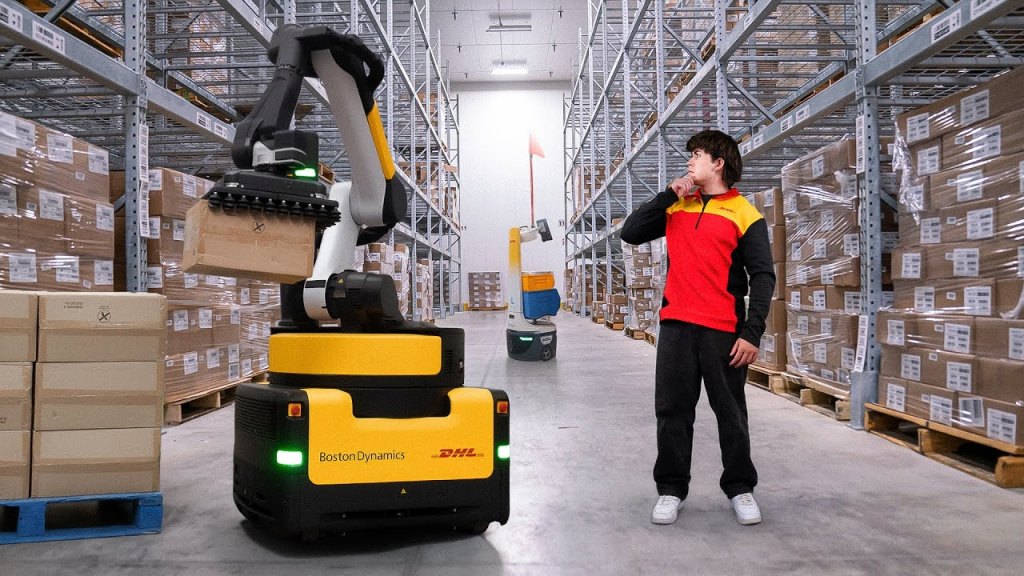
DHL Supply Chain is expanding warehouse automation from individual machines to coordinated logistics infrastructure. In a November 9, 2026 announcement, the company reported deploying more than 9,000 robots worldwide, completing over 1.5 billion robotic picks and unloading 10 million cases using Boston Dynamics’ Stretch systems. The figures demonstrate the scale of an established operation in a sector where transportation and logistics account for 47% of professional service robot sales in 2025.
From individual machines to shared infrastructure
DHL is introducing AI orchestration into operating warehouses after a proof of concept. Separately, adaptive robotics remains at the pilot stage. A workflow under evaluation links mobile transport robots, automated packaging and inventory-management software so resource assignments can reflect changing orders. The announcement does not disclose how many buildings are running the new orchestration layer or how many adaptive machines are participating.
The distinction matters because a logistics building is a coupled production system. Faster movement at one station may simply increase congestion at the next. A parcel sorter cannot process packages faster than receiving, scanning and downstream dispatch collectively permit. China Post’s trial of 45 humanoid robots in parcel induction illustrates another approach to increasing the capacity of an individual logistics process.
The bottleneck determines the throughput
Consider a hypothetical loading area where an unloading robot delivers 600 cases per hour but scanning and sorting can accept only 450. Without adjustments, inventory accumulates at 150 cases per hour, or 1,200 over an eight-hour shift. Increasing unloading capacity alone cannot eliminate the queue. Improving the downstream capacity to 600 cases per hour would lift theoretical throughput from 3,600 to 4,800 cases per shift, a 33.3% increase. The calculation illustrates a planning scenario, not measured DHL results.
Coordinated scheduling requires trustworthy information about queue lengths, available machines and charging status. Wireless connectivity, machine interfaces, network resilience and fallback procedures are therefore part of the physical infrastructure. The Soracom connectivity platform for robots highlights the communications requirements behind distributed autonomous equipment. Safety functions must remain effective even when central coordination or connectivity fails.
What the operating data still needs to show
DHL says advanced digitalization tools are present at more than 95% of its warehouses. That percentage does not establish the penetration of adaptive robotics or the new orchestration platform. Likewise, cumulative deployment and handling totals cannot establish current fleet utilization or per-robot productivity without the number of active machines and the period over which they operated.
The competitive opportunity extends beyond robot manufacturers. Providers of fleet management, industrial networking, maintenance and software integration can benefit as installations grow, a theme reflected in Rockwell Automation’s planned acquisition of AGILOX. DHL’s next milestones should be evaluated using sustained system throughput, machine availability, intervention frequency and verified safety outcomes. The established fleet is already substantial; the benefits of the next generation must still be demonstrated in sustained commercial operation.
Additional reporting: Supply Chain 24/7, November 11. Equipment context: Boston Dynamics’ DHL Stretch case study.
Featured image: official DHL warehouse robotics video thumbnail, September 2025.
We volunteer daily to ensure the credibility of the information on this platform is Verifiably True. If you would like to support to help further secure the integrity of our research initiative, please scan the QR code below.

For mobile scanning, open the article on another display and scan the QR code with a Bitcoin wallet. The voluntary donation amount is 5,000 sats. Verify the receiving address 3C9o19EH5HSiwEPyCTmEKzxhNCbo2X6TTb before sending.
BitcoinVersus.tech is not a financial advisor. This media platform reports on financial subjects purely for informational purposes.


Leave a Reply