
Cipher Digital’s remaining Bitcoin mining operation in Odessa, Texas, produced approximately 296 BTC during the third quarter of 2026. The company’s November 2 investor presentation, filed with the U.S. Securities and Exchange Commission, identifies 207 MW of total electrical capacity, approximately 11.6 EH/s of hashrate, a fleet efficiency of 17.2 J/TH and an electricity cost of about 2.8 cents per kilowatt-hour. Odessa remains an operating mine while Cipher develops infrastructure for high-performance computing customers.
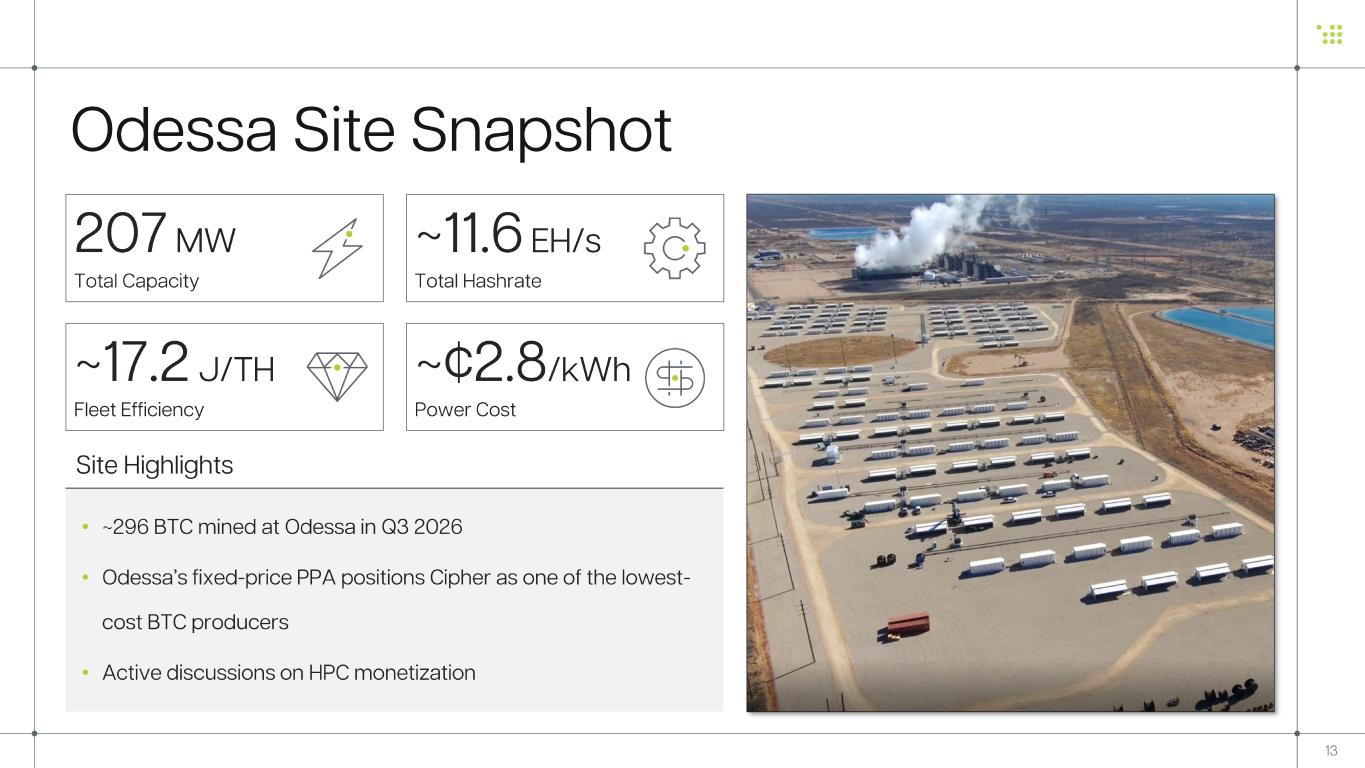
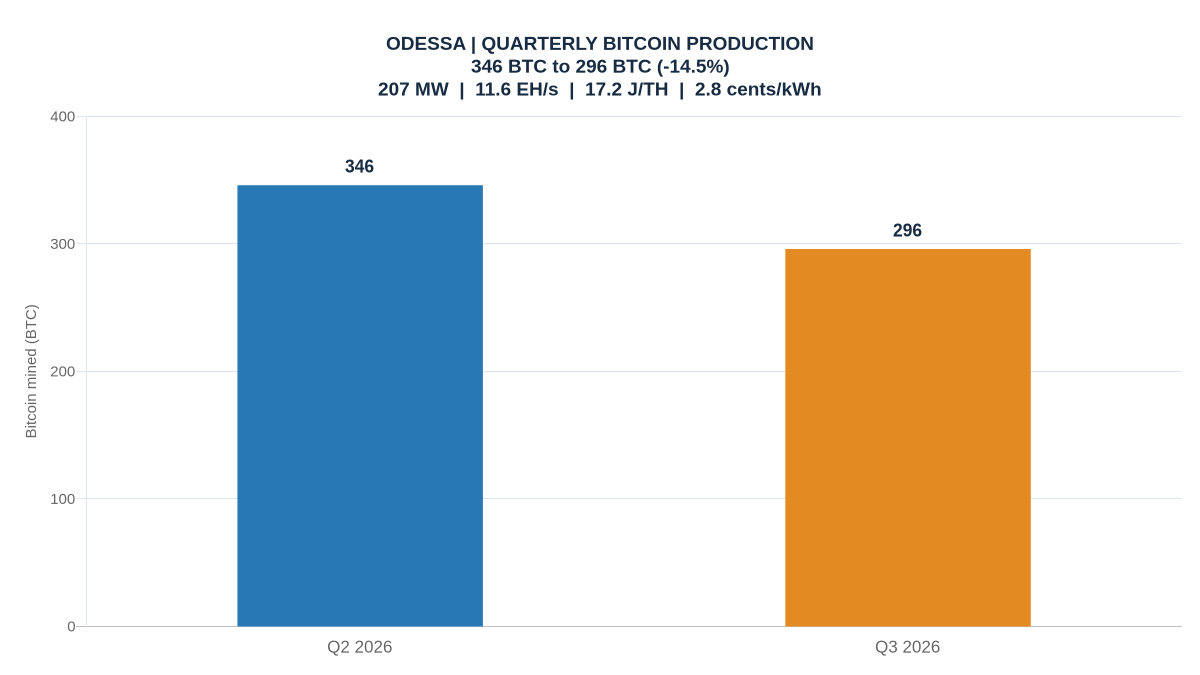
The site’s 296 BTC compares with approximately 346 BTC in the second quarter of 2026, a decrease of about 14.5%. The two presentations report the same headline hashrate and fleet efficiency. That does not establish identical average pool-side hashrate, uptime or network conditions across both quarters. Bitcoin production depends on the facility’s effective computational contribution relative to the network and the rewards distributed over the measurement period. Recent network difficulty changes illustrate the changing competitive environment.
Power economics at the machine boundary
Multiplying 11.6 EH/s by 17.2 J/TH implies approximately 199.52 MW of equipment power if both figures describe the same simultaneous operating condition. The calculation leaves a mathematical difference of 7.48 MW from the stated 207 MW site capacity. That difference is not verified spare electrical capacity: cooling, distribution losses, operating margins and the measurement boundary must be considered. Our analysis of nameplate and facility-level efficiency explains why equipment ratings cannot automatically be treated as metered power.
At the reported 2.8¢/kWh rate, one continuously operating petahash per second at 17.2 J/TH would consume 412.8 kWh per day, equivalent to approximately $11.56 in energy charges. That is a simplified electricity-only model, excluding overhead, maintenance, depreciation, financing and potential curtailment.
Revenue, costs and flexible electricity consumption
Cipher’s quarterly report attributes approximately $20.8 million in mining revenue to Odessa and identifies $14.6 million in mining cost of revenue, primarily electricity. Dividing the latter by the rounded output gives approximately $49,324 per BTC. The ratio is a reported cost-of-revenue measure, not a fully allocated production cost. Cipher separately reported $4.3 million in proceeds from selling excess contracted electricity through Luminant during the quarter. Electricity resale offers an alternative use for contracted power when market conditions warrant, rather than an additional block reward.
The company continues to explore HPC monetization at Odessa. Its earlier Barber Lake expansion and the industry’s Québec mining-to-HPC conversion plans illustrate competing uses for energized infrastructure. No new Odessa HPC lease was established by the November site snapshot. The existing mine’s reported production, power agreement and actual quarterly expenses provide a more useful operating benchmark than speculative conversion capacity.
We volunteer daily to ensure the credibility of the information on this platform is Verifiably True. If you would like to support to help further secure the integrity of our research initiative, please scan the QR code below.

For mobile scanning, open the article on another display and scan the QR code with a Bitcoin wallet. The voluntary donation amount is 5,000 sats. Verify the receiving address 3C9o19EH5HSiwEPyCTmEKzxhNCbo2X6TTb before sending.
BitcoinVersus.tech is not a financial advisor. This media platform reports on financial subjects purely for informational purposes.


Leave a Reply