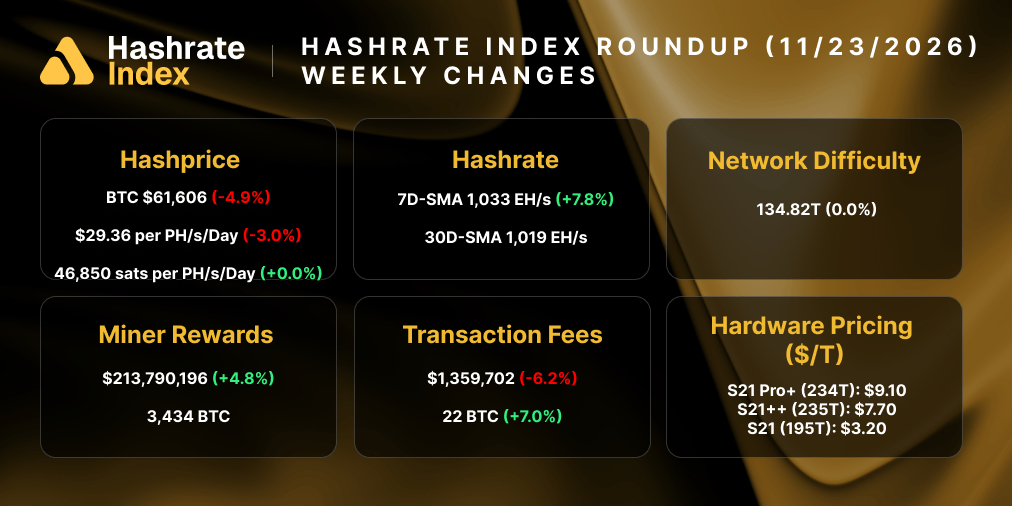
Bitcoin’s mining difficulty increased from 134.82 trillion to 145.09 trillion on November 27, 2026, at block 977,760. The 7.61% increase reverses much of the relief miners received from the November 14 reduction. CryptoSlate reported the completed adjustment, citing Mempool.space, and Flash Finance’s difficulty history records the same block and value.
The change matters because mining companies pay for electricity continuously while their expected share of Bitcoin rewards depends on the difficulty of producing valid block hashes. A higher difficulty makes each unit of computing power less productive in Bitcoin terms, assuming constant block rewards and uninterrupted operation.
Why difficulty can rise while mining profitability falls
Bitcoin adjusts its mining target every 2,016 blocks to maintain an average interval near ten minutes. When blocks arrive faster than intended across an adjustment period, the protocol raises difficulty. Profitability, however, also depends on the market price of bitcoin, transaction fees, electricity contracts and hardware efficiency. A rising difficulty does not imply rising profitability for individual operators.
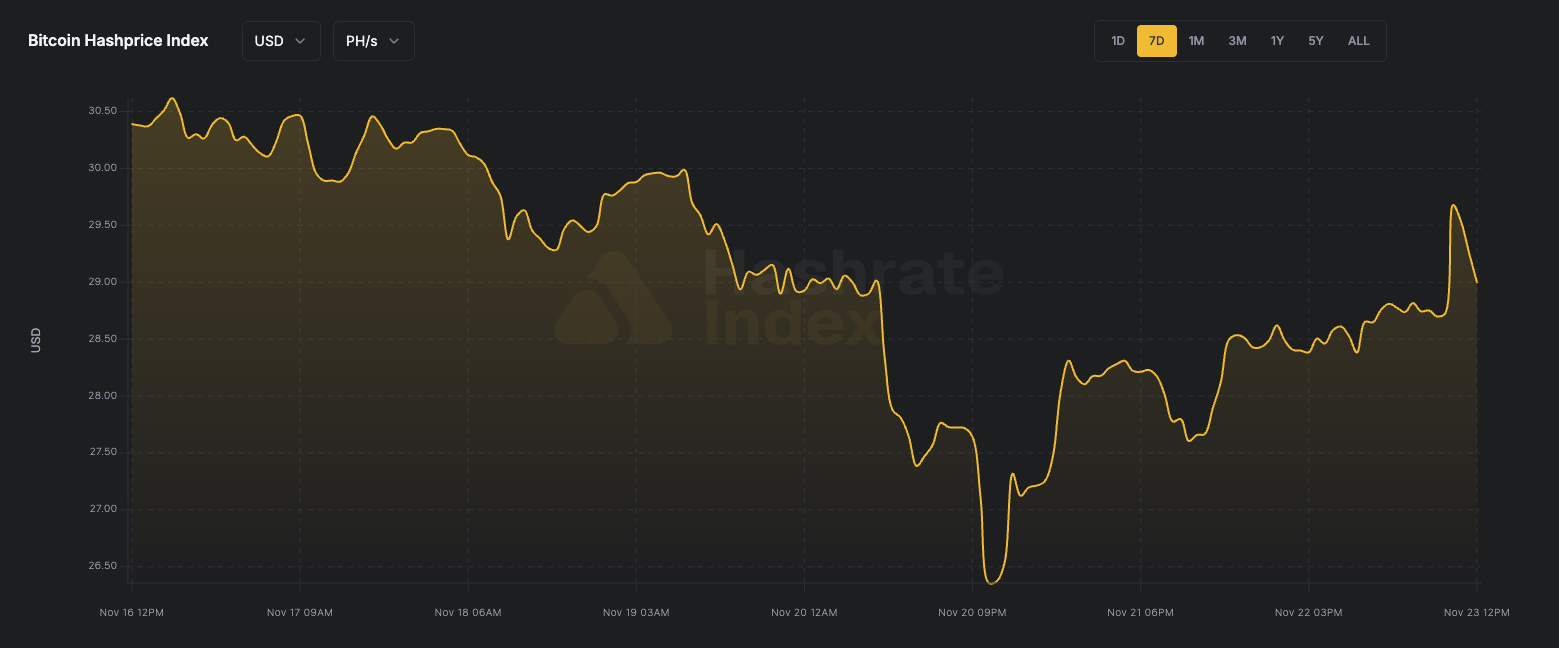
On November 23, Luxor’s Hashrate Index reported a seven-day average network hashrate of 1,033 EH/s, up from 959 EH/s the previous week. At the same time, its USD hashprice benchmark declined to $29.36 per petahash per second per day. Those measurements preceded the November 27 retarget and should not be interpreted as current post-adjustment revenue.
What a 7.61% difficulty increase means for one petahash
With bitcoin price and average block reward held constant, expected revenue per unit of hashrate varies inversely with difficulty. Dividing the previous difficulty by the new difficulty gives 134.82 ÷ 145.09 = 0.9292. That corresponds to a theoretical revenue reduction of approximately 7.08%, rather than 7.61%. Applying the ratio to the November 23 benchmark produces an illustrative hashprice of $27.28 per PH/s per day. Actual market hashprice can differ.
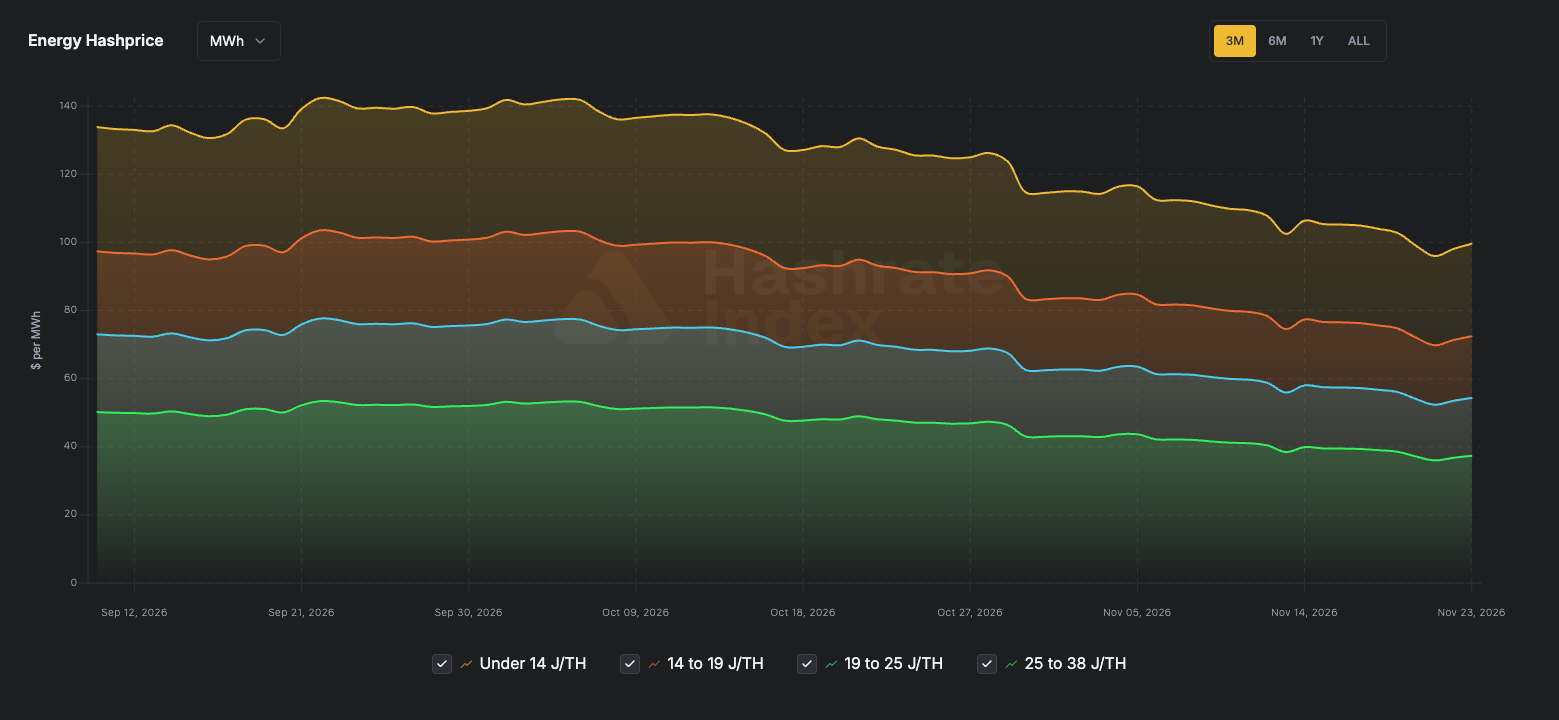
A fleet operating at 20 J/TH requires 20 kW for each PH/s of hashrate, consuming 480 kWh in 24 hours. At $27.28 in daily gross revenue, its electricity-only break-even rate would be approximately 5.68 cents per kWh. At 15 J/TH, the corresponding threshold rises to 7.58 cents; at 30 J/TH, it falls to 3.79 cents. Pool fees, cooling, labor, financing and downtime would reduce the attainable rates further.
Why fleet management becomes more important
Operators can respond through selective curtailment, hardware upgrades and changes to firmware operating points. Our reporting on Braiins continuous ASIC tuning, BitFuFu’s fleet efficiency, Canaan’s heat-recovery deployments and Bitcoin production-cost estimates demonstrates how different operating models respond to the same market conditions.
The latest retarget does not establish how many machines will be retired or whether total network computing power will decline. The next difficulty period will provide additional evidence of operator responses. For individual sites, measured wall-power efficiency and realized pool revenue remain more useful indicators than the network difficulty figure alone.
Sources: Mempool.space block 977,760; Flash Finance difficulty history; CryptoSlate, November 27; Hashrate Index, November 23. Featured graphic: Hashrate Index’s November 23 market snapshot, prior to the adjustment.
We volunteer daily to ensure the credibility of the information on this platform is Verifiably True. If you would like to support to help further secure the integrity of our research initiative, please scan the QR code below.



Leave a Reply