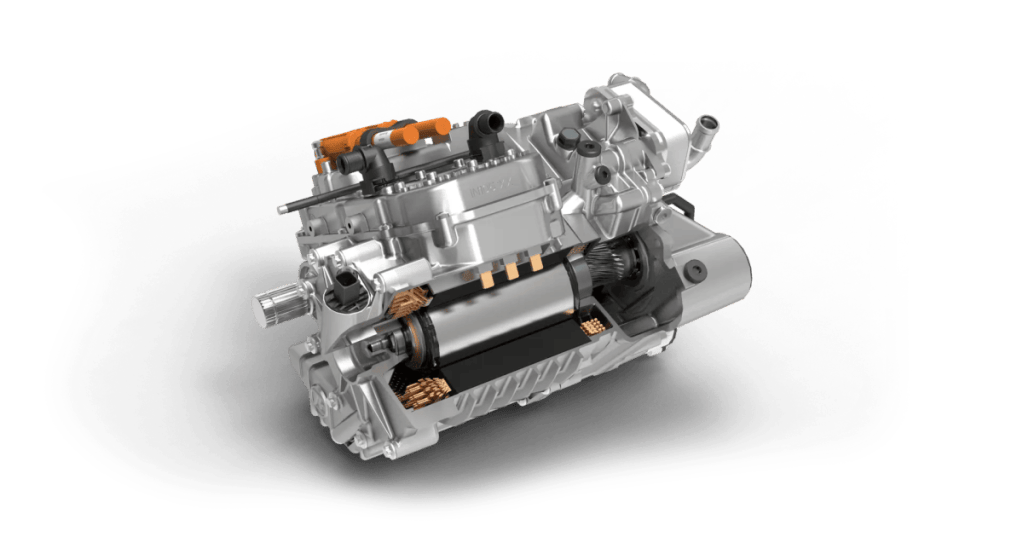
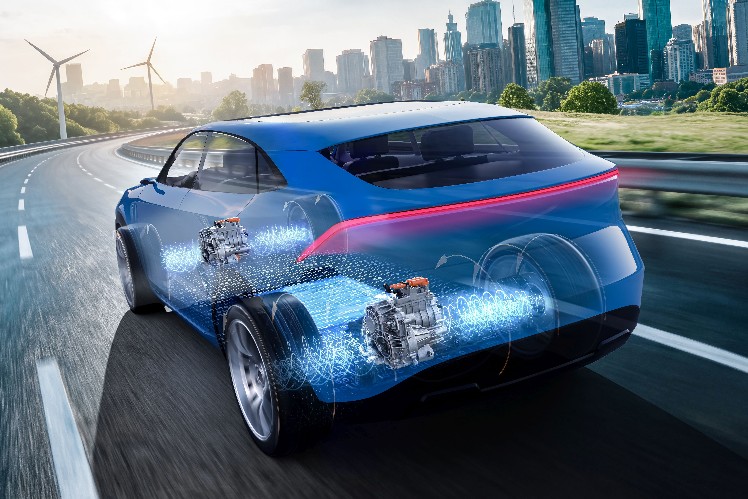
German automotive supplier ZF introduced its High Revolution Drive on November 5, 2026, describing an electric traction system that reaches 30,000 revolutions per minute while reducing the space, weight and magnetic material required to propel a passenger car. The manufacturer’s announcement identifies a 200 kW peak-output configuration incorporating an electric motor, power electronics and a two-stage reduction transmission. Production is targeted by 2030; the design is not yet a confirmed series-production drivetrain.
Why faster rotation reduces motor torque
The concept exploits a fundamental mechanical relationship: rotational power equals torque multiplied by angular velocity. At a given power, increasing rotational speed lowers the required shaft torque. A hypothetical motor producing 200 kW at 18,000 rpm develops about 106 newton-metres of torque. At 30,000 rpm, the same power corresponds to approximately 64 newton-metres, a 40% reduction. Those values illustrate the physics rather than establish measured torque at the maximum speed of either ZF drive.
Lower shaft torque can allow a smaller electromagnetic assembly, but a vehicle still requires substantial torque at its wheels. ZF uses a two-stage helical gear transmission with an approximate 18:1 reduction ratio. Ignoring losses, an 18:1 ratio multiplies input torque by 18 while dividing rotational speed by the same factor. The company reports maximum wheel torque of 3,500 Nm for the complete drive. Peak wheel torque and maximum rotor speed generally occur at different operating points, so the two maximum specifications must not be multiplied to infer power.
Smaller motor, new engineering constraints
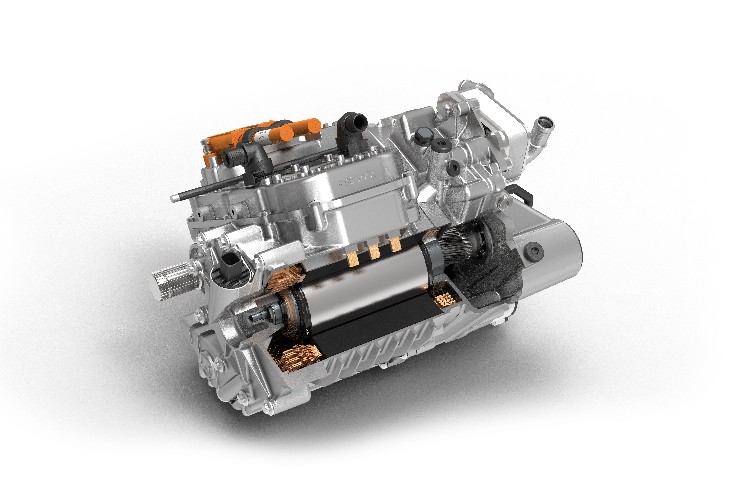
The manufacturer reports reductions of nearly one-quarter in both mass and packaging volume compared with its comparable 18,000-rpm SELECT drive, alongside a 50% reduction in magnet mass. Its product documentation reports efficiency reaching approximately 93% under the Worldwide Harmonised Light Vehicles Test Procedure. The improvements are company-reported comparisons, not independently measured results from production vehicles. New Atlas examined the design on November 20.
High rotor speeds create additional engineering constraints. Centrifugal loading increases rapidly with angular velocity, while bearing losses, lubrication, vibration and acoustic emissions become important. Alternating magnetic fields can also increase electrical losses in the rotor and stator. A compact motor must therefore be evaluated together with the inverter, cooling system and reduction gears rather than treated as an isolated component.
ZF intends to adapt the architecture for 150–200 kW passenger-car applications using 400 V or 800 V electrical systems. Related developments include Porsche’s electric 718 engineering program, BMW’s high-voltage battery communication research, our electric powertrain comparison and motor rotation lesson. The next important milestone will be independent vehicle-level validation of efficiency, durability, noise and manufacturing costs. A smaller motor does not automatically guarantee a proportionate increase in driving range.
We volunteer daily to ensure the credibility of the information on this platform is Verifiably True. If you would like to support to help further secure the integrity of our research initiative, please scan the QR code below.

BitcoinVersus.tech is not a financial advisor. This media platform reports on financial subjects purely for informational purposes.


Leave a Reply