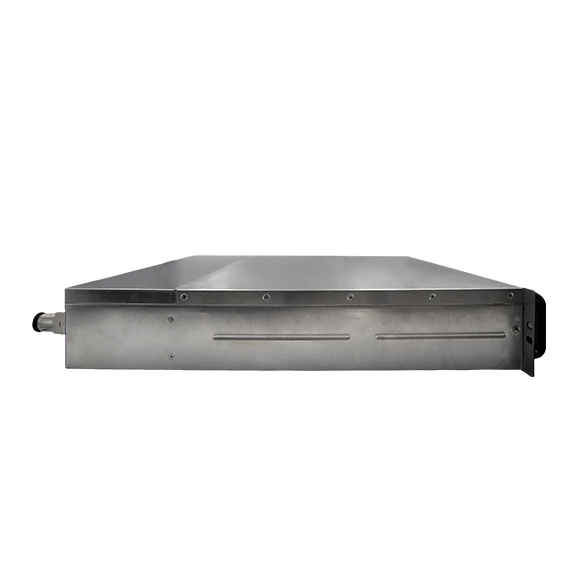
A Bitcoin mining installation can produce two valuable outputs from one electrical connection: computational work and recoverable heat. On November 25, 2026, Canaan announced two repeat orders for hydro-cooled mining equipment destined for separate Nordic district heating projects. The SEC-filed announcement identifies 430 customized Avalon A1566HA-500T units, representing 215 PH/s of rated hashing capacity.
The orders extend Canaan’s district heating portfolio to nearly 12 MW, with the company estimating potential service to nearly 8,000 homes. The earlier 8 MW installation was reported operational in September. The additional units are orders, not evidence that the expanded portfolio is already operating or heating 8,000 households.
From electrical load to hot water
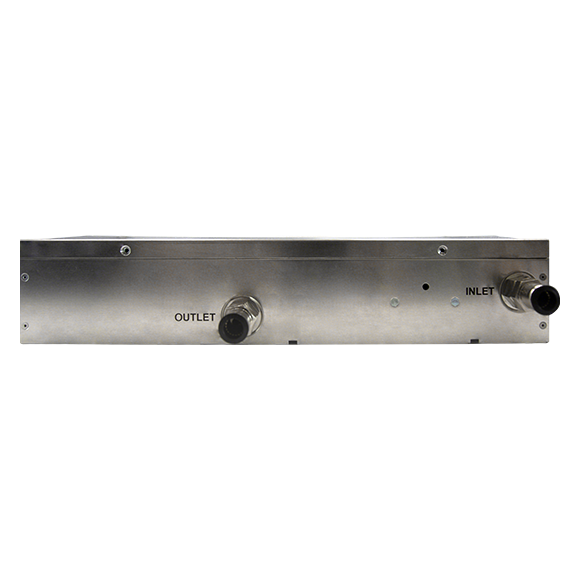
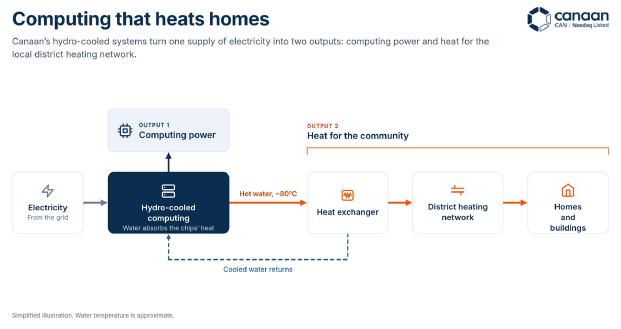
ASICs perform repeated SHA-256 hashing operations. Almost all of the electrical energy entering mining equipment eventually becomes heat. Liquid-cooled systems transfer much of that heat into circulating coolant rather than relying on high-volume airflow. A heat exchanger can then deliver thermal energy to a separate water circuit while keeping the mining coolant isolated from the district network.
Canaan says its customized equipment is designed to produce water near 80°C. Temperature matters as much as total thermal power: a district heating operator must meet the supply temperature required by buildings and the network. Where recovered heat arrives below the required temperature, heat pumps or supplementary boilers may be necessary. Our coverage of Austrian solar-powered mining heat recovery shows another application at a smaller scale.
What 430 mining machines could deliver
The hashing calculation is straightforward: 430 × 500 TH/s = 215,000 TH/s, or 215 PH/s. The standard retail A1566HA-500T listing specifies 8,064 W at the wall, which would imply approximately 3.47 MW for 430 standard machines. The same listing gives 16.8 J/TH, implying 8.4 kW at exactly 500 TH/s. The nominal figures do not perfectly reconcile, and the new orders are customized, so neither calculation establishes their measured electrical demand.
Using 3.47 MW solely as an illustrative input, continuous operation for 24 hours would consume approximately 83.2 MWh. If 85% of that input reached customers as useful thermal energy, delivered heat would be about 70.7 MWh per day. The 85% assumption is not a reported project measurement; pumps, heat exchanger losses, piping and seasonal demand affect the result.
The AI infrastructure connection
Mining and AI data centers face a common engineering problem: removing heat from dense computing equipment. Recovered heat can improve the economics of either workload where a suitable thermal customer exists. Our analysis of Empire AI’s heat-reuse plans illustrates how similar thinking is entering GPU infrastructure. Unlike mining, however, AI clusters may have strict availability and workload scheduling requirements that limit flexible power dispatch.
The commercial advantage is not free energy. Operators pay for electricity and need a reliable heat buyer, backup heating arrangements, compatible temperatures and acceptable operating costs. Other mining heat-reuse applications demonstrate why location and demand are decisive. Canaan has not disclosed the new customers’ tariffs, actual thermal recovery, installation dates or verified emissions savings. The important development is repeat procurement by existing customers, not yet a measured financial or environmental outcome.
We volunteer daily to ensure the credibility of the information on this platform is Verifiably True. If you would like to support to help further secure the integrity of our research initiative, please scan the QR code below.



Leave a Reply