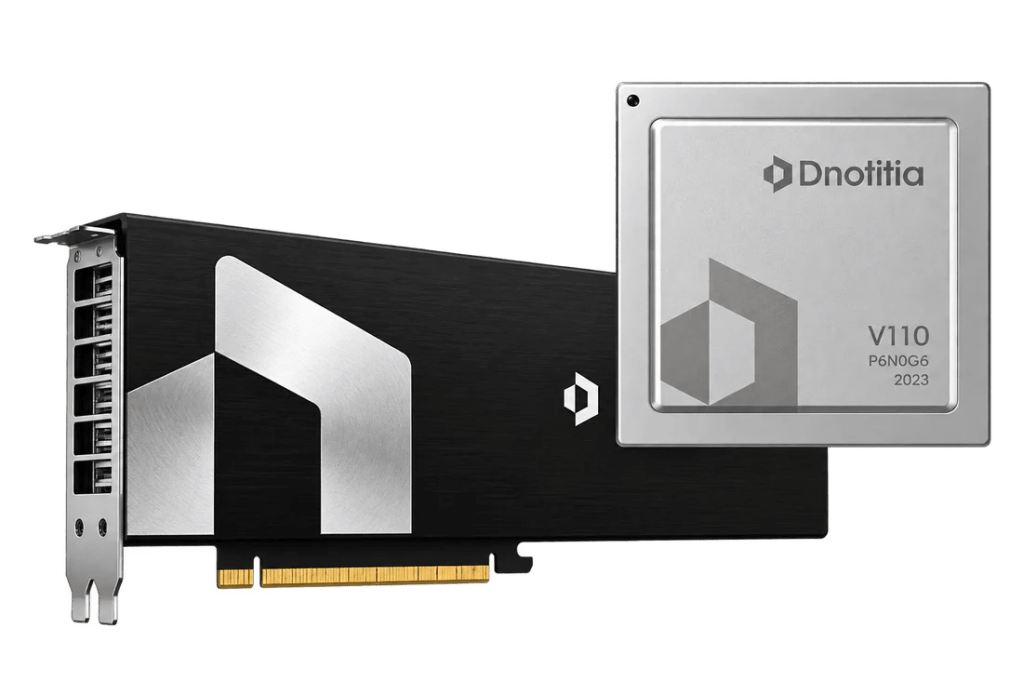
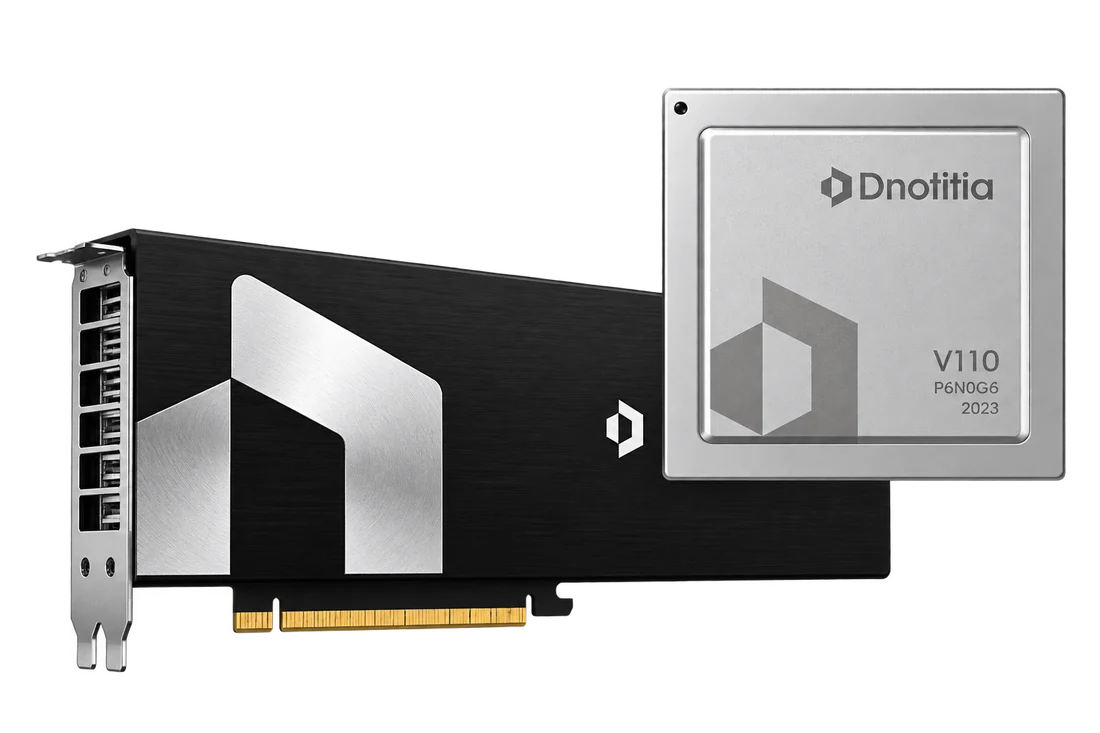
Dnotitia reported its first public live demonstration of an ASIC-based Vector Data Processing Unit (VDPU) at Supercomputing 2026 in Chicago on November 19. According to the company’s release, the accelerator processed natural-language searches over an indexed collection of roughly 2.6 million video frames. Dnotitia also reported a reduction of at least 90% in host CPU utilization against a CPU-only run of the same workload. The demonstration follows the September first-silicon milestone, rather than repeating the earlier announcement.
Why retrieval deserves dedicated silicon
A vector embedding is an ordered collection of numbers representing features of a document, image or other input. An embedding model converts a query into a vector within a compatible mathematical space, and a search system identifies nearby vectors using a distance or similarity function. The process can retrieve relevant material even when its wording differs from the query. In retrieval-augmented generation, the selected material then becomes context for a language model.
Large indexes create a different workload from dense neural-network inference. Approximate nearest-neighbor algorithms can traverse irregular data structures, fetch vectors from memory and compare candidate distances. Memory latency, bandwidth and cache behavior can constrain performance even when the arithmetic itself is straightforward. Dedicated retrieval silicon can relieve the host processor of some of the index traversal and comparison work, allowing other software to use freed CPU cycles.
Video: Dnotitia’s official VDPU hardware introduction.
Interpreting the 90% CPU reduction
A relative reduction in utilization is not equivalent to a 90% reduction in total server energy. If a CPU-only test consumed an average of 80% of the available host CPU capacity, a 90% relative reduction would leave 8% utilization under an otherwise equivalent measurement. That example is illustrative, not a disclosed benchmark result. The accelerator itself consumes electricity, and the host still performs orchestration, data movement and other services.
The Seoul Economic Daily report corroborates the reported demonstration, not an independently controlled performance test. Dnotitia separately targets roughly ten times the search performance of a dual-socket CPU server using multiple VDPU cards in one server. That target is distinct from the demonstrated CPU reduction and should not be treated as a measured production result.
Video: Dnotitia’s earlier Seahorse vector database acceleration architecture presentation, listed in its official resource archive.
The system-level test
Server engineers evaluating an accelerator should compare query throughput at a fixed recall threshold, index size, embedding dimensions, concurrent clients, p95 and p99 response times and wall-plug energy per completed query. A benchmark that allows recall to decline can appear faster while returning worse results. Likewise, a higher query rate can conceal excessive tail latency. Little’s Law provides a useful framework for relating average concurrency, throughput and latency under stable conditions.
The SC26 exhibitor listing describes the VDPU as an accelerator aimed at irregular memory access and retrieval bottlenecks. The company is evaluating integration with third-party server and storage systems. Its broader custom-silicon context includes a recurring progression from programmable hardware to a specialized implementation optimized for a defined workload.
For data center operators, the next milestones are independent comparisons, stable software integration and quantified power, performance and acquisition costs. A live ASIC demonstration establishes an important engineering milestone, but full fleet economics require more evidence.


Leave a Reply