Five vulnerabilities in Mitel MiCollab, an enterprise communications platform, entered the U.S. Cybersecurity and Infrastructure Security Agency’s Known Exploited Vulnerabilities catalog on November 25, 2026. NHS England confirmed the listings in its November 26 alert update. The developments reinforce the distinction between severity ratings and observed exploitation, a concern also examined in our SonicWall remote-access security coverage.
A conferencing service becomes an enterprise security concern
The affected component provides audio, web and video conferencing functions. Mitel’s advisory MISA-2026-0012 was first published November 16 and revised November 24 with CVE identifiers. The weaknesses involve file handling, XML processing, access control and command processing. Their consequences vary, but combining weaknesses can increase the overall impact. MiCollab 10.3 build 10.3.0.18 and earlier supported releases are affected before remediation.
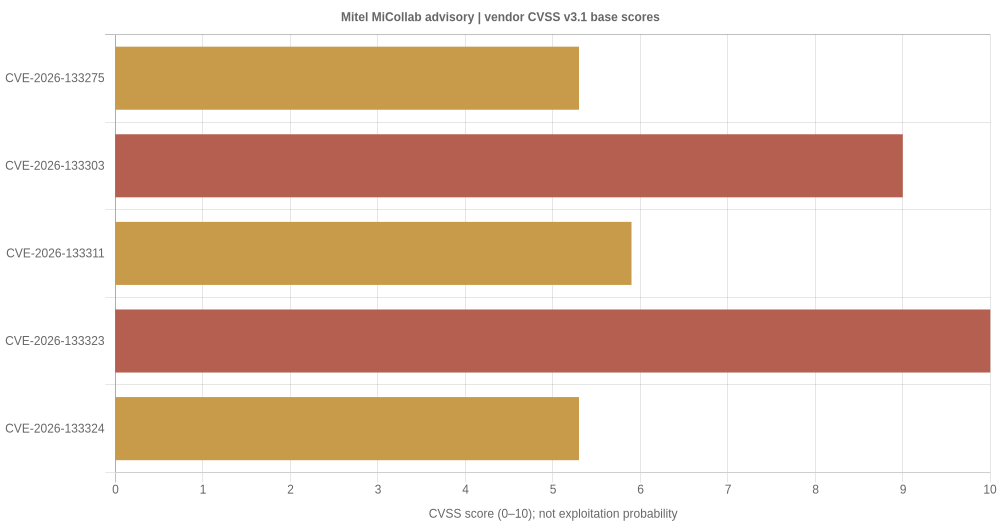
Mitel assigns scores of 5.3 to CVE-2026-133275 and CVE-2026-133324, 5.9 to CVE-2026-133311, 9.0 to CVE-2026-133303 and 10.0 to CVE-2026-133323. Three are classified as medium and two as critical. All five appear in the exploited-vulnerability catalog. A base score describes technical severity under defined assumptions rather than the likelihood of an attack against a particular organization.
Why patching does not establish that a server is clean
Researchers at Accenture APEX Labs assess with high confidence that exploitation preceded the vendor’s November 16 disclosure. Their evidence includes activity at a victim organization on November 15. A second organization’s server exhibited suspicious communications starting November 9, but researchers could not establish which vulnerability provided initial access. The distinction prevents an earlier observation from being misrepresented as confirmed exploitation of the newly disclosed flaws. Our Ivanti security report addresses similar concerns about evidence preservation and earlier compromise.
Remediation and operational validation
Mitel directs affected customers to upgrade to version 10.3.0.18 and install its security patch, or move to a later fixed release. Where immediate remediation is impossible, the vendor advises limiting external access to the affected conferencing service. Restricting unnecessary exposure is a general defense-in-depth measure, as discussed in our industrial network security guide.
Administrators should identify exposed deployments, verify patch installation, preserve relevant logs and involve incident-response personnel when suspicious activity is detected. A confirmed application-server compromise warrants investigation of connected identity systems. Service recovery should also include checks of normal calling, authentication and conferencing functionality. As with the recent GeoServer security alerts, closing vulnerabilities and determining whether attackers previously entered an environment are separate responsibilities.
We volunteer daily to ensure the credibility of the information on this platform is Verifiably True. If you would like to support to help further secure the integrity of our research initiative, please scan the QR code below.



Leave a Reply