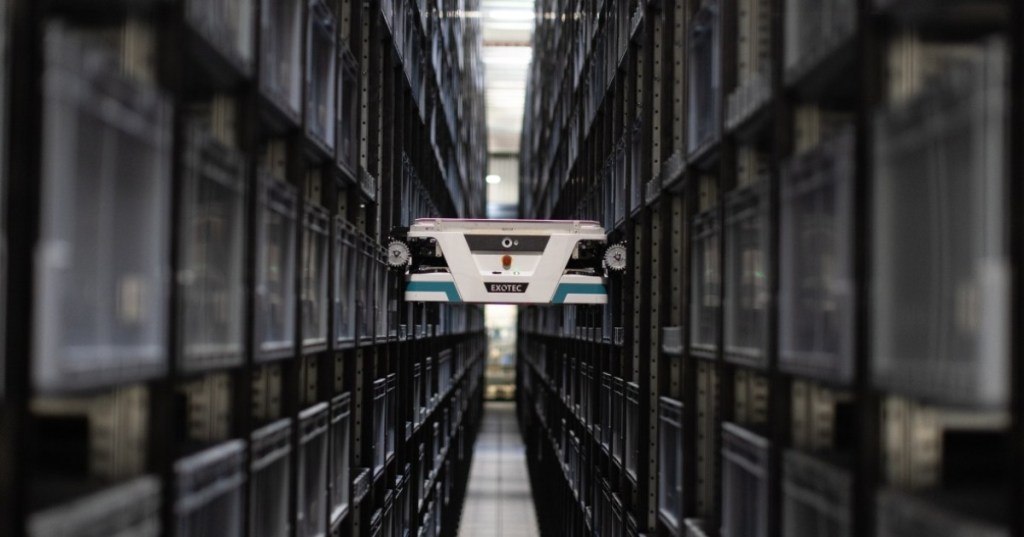
Hellmann Worldwide Logistics announced on November 25, 2026, that it will introduce Exotec warehouse robotics at Siemens Smart Infrastructure Buildings’ Nuremberg site. The project announcement identifies approximately 35,000 planned storage locations and a mid-2027 operational target. The installation follows a broader robotics adoption trend, including the large-scale warehouse automation initiatives at DHL. The Nuremberg system remains a planned installation, not a completed deployment.
Moving inventory rather than moving workers
Traditional manual picking can require employees to travel between storage aisles and fulfillment stations. A goods-to-person system instead transports inventory containers to designated workstations. Exotec’s Skypod robots navigate the storage structure and retrieve totes, reducing the need for routine walking between shelves. Workstations remain important because the system must coordinate the physical transfer of items into outbound orders. Automating transportation does not necessarily automate every picking action.
Software coordinates the physical fleet
Exotec’s Deepsky software coordinates equipment and inventory flows using operational data. Such systems must account for order priorities, vehicle availability, storage positions and workstation capacity. Moving more robots through a shared space does not automatically increase fulfillment output: travel conflicts, unavailable stations and replenishment delays can constrain the entire operation. The engineering principles behind dynamic route planning are explored in our robot path-replanning lesson.
Hellmann has managed logistics at the Siemens site since 2025. The new installation will replace substantial portions of existing warehouse equipment, while the modular design permits subsequent additions to storage and picking capacity. The companies have not disclosed the planned robot count, investment cost, throughput target or measured productivity gain. The announced storage-location count should not be interpreted as a daily order capacity.
Modularity provides options for seasonal demand
A separate Exotec announcement on November 25 illustrates the modular approach at a different facility in Massy, France. Retailer Fnac Darty operates 36 Skypod robots across 30,700 storage locations and five stations. Exotec reports normal processing of 10,000–15,000 order lines daily, with an anticipated peak capacity of 35,000 lines using 25 additional rented robots. These are supplier-reported figures for Massy, not Nuremberg performance measurements. Renting extra robots raises the fleet from 36 to 61, approximately 69.4%. The increased peak capacity is not attributable to fleet count alone. Our service robotics market analysis provides broader context for the logistics sector.
What successful commissioning will require
Commissioning in Nuremberg will require validated interfaces between inventory software, physical equipment and operating procedures. Useful acceptance measures include order accuracy, sustained throughput, availability and recovery from equipment failures. As with Bleckmann’s planned warehouse robotics adoption, the engineering challenge is integrating automation into real operations rather than simply installing machines. Mid-2027 remains a target until the system is commissioned and operational results become available.
We volunteer daily to ensure the credibility of the information on this platform is Verifiably True. If you would like to support to help further secure the integrity of our research initiative, please scan the QR code below.



Leave a Reply