A robotic hand capable of repositioning a screwdriver and manipulating an adjustable wrench does not necessarily require precision-machined fingers or expensive custom motors. Researchers at the New Jersey Institute of Technology (NJIT) have built PHD-Hand, a human-scale prototype made using accessible 3D-printing equipment and commercially available components. NJIT announced the work on November 24, 2026, and its October research preprint reports acceptance at the December IEEE-RAS Humanoids conference. While other robotic hands pursue high-frequency motor coordination, PHD-Hand tackles a different bottleneck: mechanical complexity.
Research demonstration embedded by NJIT. Watch on YouTube or view the research team’s demonstration page.
Five Digits, 15 Actuated Motions
PHD-Hand measures approximately 200 mm in length. Each digit has three independently driven motions, giving the complete hand 15 degrees of actuation. The researchers position miniature hobby servos away from the fingers and transmit their movement through linkages instead of cables. The approach reduces dependence on cable tension adjustment. In contrast to a simple gripper, independent digit movement enables changes in object orientation without releasing the entire grasp.
A Flexible Knuckle With a Rigid-Linkage Drivetrain
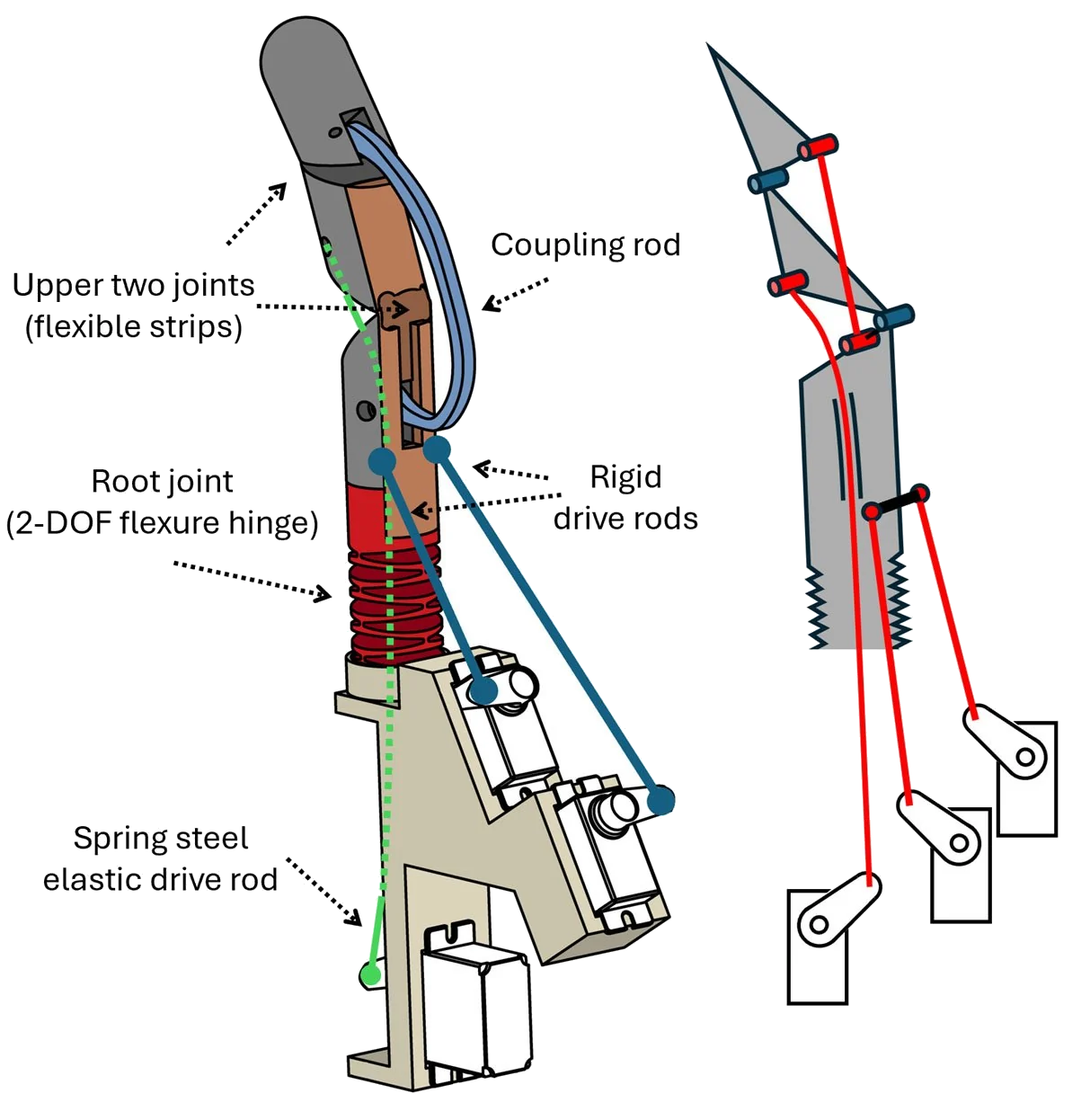
The central innovation is a printed thermoplastic polyurethane flexure at the base of each digit. Its geometry permits movement in two directions while resisting twisting. A steel rod runs through the flexure to actuate the upper finger joints together. Mechanical decoupling means bending the knuckle does not automatically change finger curl, simplifying the controller’s job. The researchers specify 18 major parts per digit on their project website. Unlike soft robotic systems built around artificial muscles, the hand combines flexible joints with mechanically driven linkages.
From Grasping to Tool Manipulation
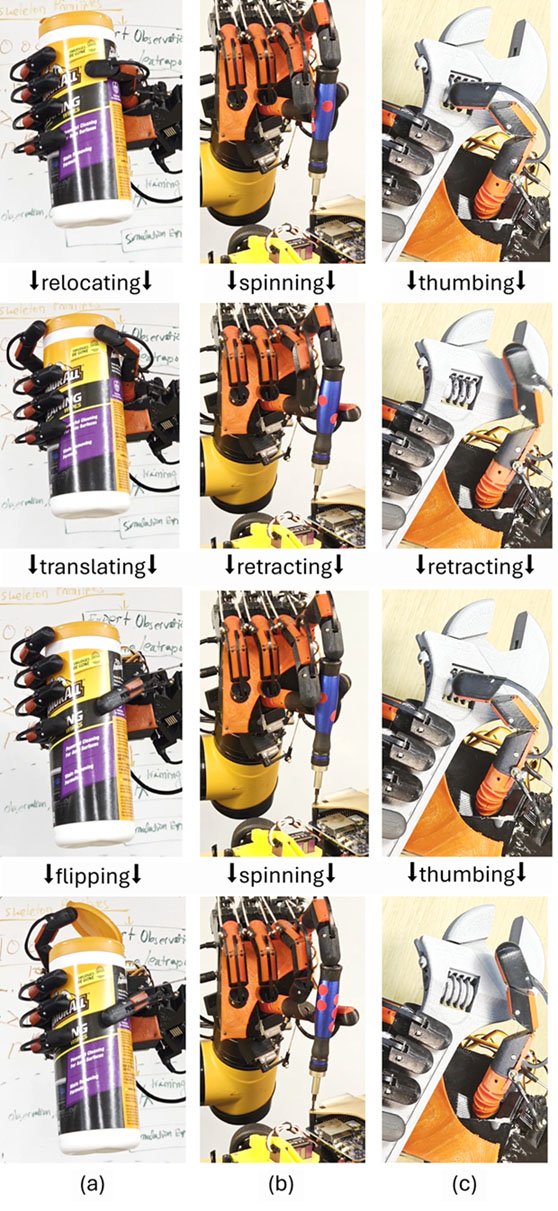
The team tested 33 grasp categories from the Feix taxonomy and documented manipulation of objects including containers and hand tools. Several grasps remained imperfect. Turning a screwdriver within the palm is especially informative because the fingers must alternate between maintaining grip and moving the tool. The prototype uses a browser control interface, with calibration and motion replay. AI-assisted software development helped generate motion sequences, but the demonstrations do not establish autonomous general-purpose dexterity. Our coverage of physical AI training infrastructure explains why reliable manipulation requires more than a successful scripted movement.
What a Sub-$650 Prototype Actually Proves
Humanoids Daily reported on November 19 that lead researcher Neel Adwani estimated the complete parts bill at less than $650. That figure does not include a production robot, engineering labor or commercial certification. About 200 hours of operation have been reported for one prototype, but systematic fatigue testing, grip-force characterization and tactile sensing remain unresolved. A design that works in a laboratory may still require substantial refinement before deployment in homes or factories.
The team plans to release CAD models, print files, software and a bill of materials. At publication, the project website still marks those packages as forthcoming. A lower hardware entry cost could widen access to experimentation, complementing projects such as OpenAMRobot’s mobile manipulation platform. The next milestone is reproducibility: independent builders must be able to assemble, calibrate and repeatedly operate the design, then measure performance under comparable conditions.


Leave a Reply