PrismML released Ternary Bonsai 2.5 27B on November 24, 2026, with improved results on coding and tool-use evaluations while retaining the weight-storage footprint of its September model. The company announcement describes a 27-billion-parameter model derived from Qwen3.8-27B. Its most compact published format occupies approximately 5.93 GB, compared with 53.8 GB for the full-precision reference. The release follows broader progress in local inference infrastructure, including llama.cpp’s transition to version 1.0.
Compressing neural-network weights
Model parameters encode learned numerical relationships. In a conventional 16-bit floating-point representation, each stored weight requires two bytes before accounting for additional metadata. Ternary compression instead restricts weight coefficients to three possible values: negative one, zero and positive one. A shared floating-point scaling factor allows groups of coefficients to represent different magnitudes. PrismML’s model card specifies groups of 128 weights and an effective storage rate of 1.76 bits per weight for its compact packing.
The reported 53.8 GB and 5.93 GB footprints imply approximately 9.07 times less weight storage, or an 89% reduction. File size does not equal peak memory consumption. The inference engine must also allocate activation buffers, attention state and other runtime resources. Longer prompts and simultaneous requests can increase memory use, as discussed in our coverage of GPU memory monitoring.
Measuring the improvement in coding agents
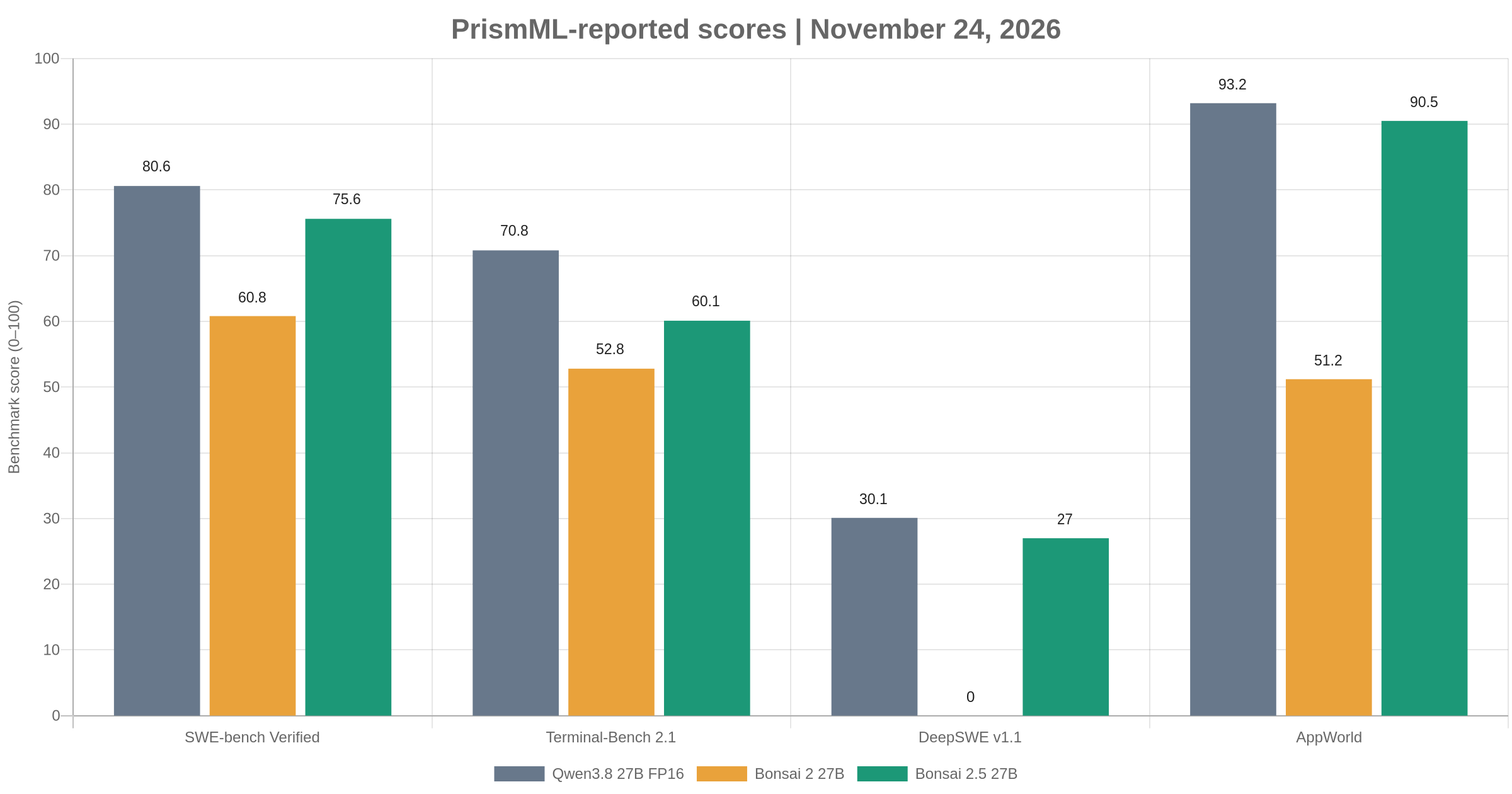
PrismML reports a SWE-bench Verified score of 75.6, compared with 60.8 for its September release and 80.6 for the full-precision model. The increase is 14.8 points, not 14.8 percent. On DeepSWE v1.1 the reported score increases from zero to 27.0. AppWorld, which assesses interactions with application tools, rises from 51.2 to 90.5. The November 25 NYU Shanghai analysis identifies the results as vendor evaluations at the highest reasoning setting, rather than independent replication.
Agentic programming requires a sequence of decisions: inspecting a repository, identifying a defect, editing the appropriate files and interpreting test output. Errors can compound across steps. Improving reliability over longer interactions can therefore be more important than increasing performance on isolated questions. The official demonstration below illustrates one regression-repair workflow; it does not establish a general success rate.
The runtime determines practical compatibility
The 5.93 GB PTQ1_0 representation requires PrismML’s modified llama.cpp runtime. A separate 7.67 GB Q2_0 variant supports sufficiently recent upstream builds. Apple hardware is supported through an MLX export. Developers should validate runtime compatibility before comparing performance across platforms, just as deployment differences matter for AMD’s local AI tooling.
The company reports generation rates of 291 tokens per second on an NVIDIA H100 and 204 tokens per second on an RTX 4090 with multi-token prediction enabled. A draft prediction head proposes additional tokens that the main model verifies. Actual application latency depends on prompt length, acceptance rates, tool execution and hardware configuration; the published figures are not universal throughput guarantees.
The Apache 2.0 weight release expands the options available for private local coding workflows, including environments such as LocalAI. Running inference locally can reduce exposure to remote model providers, but agents still need restricted filesystem access, controlled network permissions and human review of consequential changes. The relevant next milestone is independent reproduction of both accuracy and runtime resource consumption on representative workloads.


Leave a Reply