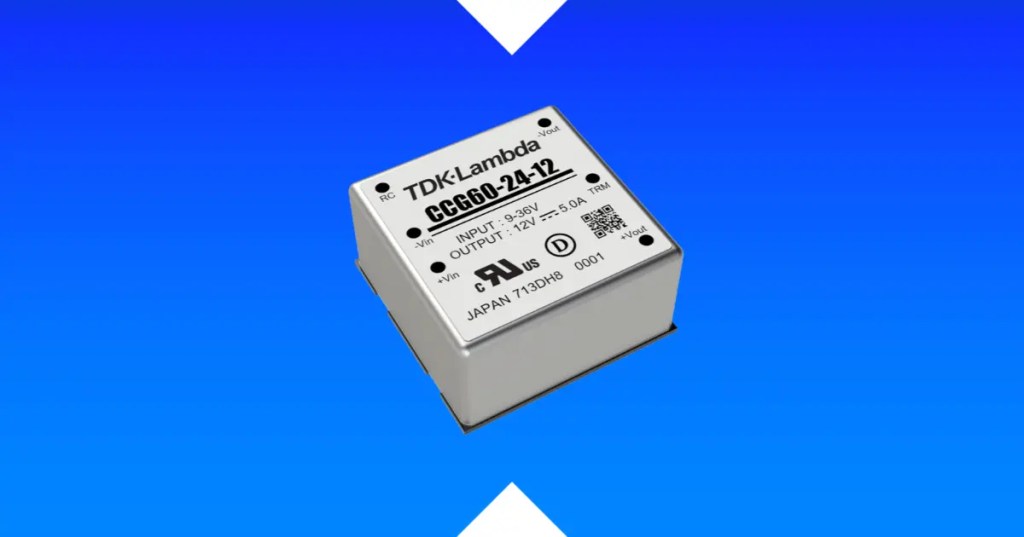
TDK introduced its TDK-Lambda CCG60 isolated DC-DC converter on November 3, 2026, doubling the maximum output rating of selected CCG30 models without increasing their nominal printed-circuit-board mounting area. The manufacturer announcement describes a 25.4 × 25.4 mm module, 13 mm tall and weighing 30 grams. The engineering challenge is delivering more usable power within a constrained package, a theme also explored in our analysis of EPC’s GaN transistor trade-offs.
Maximum power depends on output voltage
The CCG60 family accepts either 9–36 VDC or 18–76 VDC, depending on the selected input model. The CCG series datasheet lists 5 V at 12 A, 12 V at 5 A, 15 V at 4 A and 24 V at 2.5 A for the respective CCG60 variants. Each combination yields 60 W at its nominal output. The 3.3 V model is rated at 12 A, however, giving 39.6 W rather than 60 W. Engineers must select an individual part number instead of assuming the family name defines every model’s usable power.
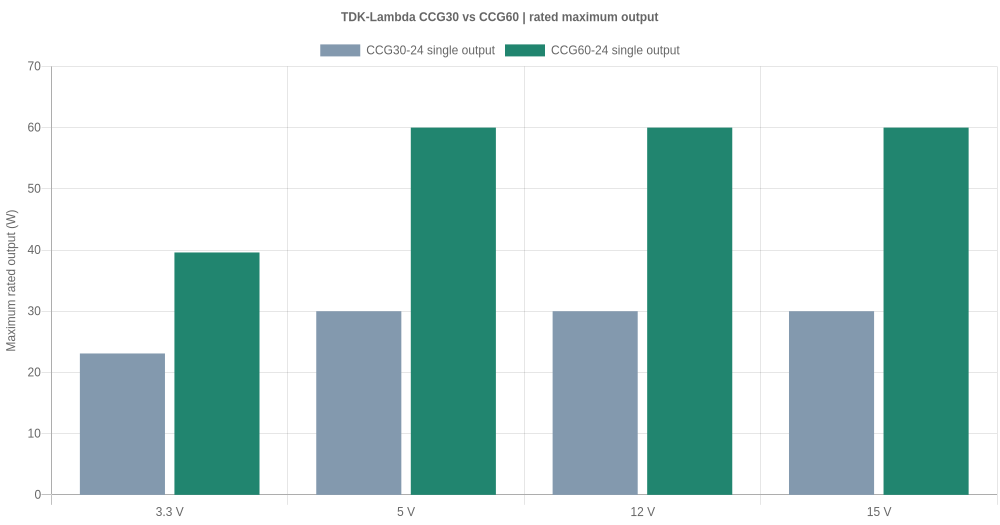
For the 12 V variants, the same nominal mounting area of 6.4516 square centimeters supports an increase from 30 W to 60 W. The calculated output-power-to-footprint ratio rises from 4.65 to 9.30 W/cm². The ratio excludes external components, routing and clearance, and is not a measure of heat flux. Thermal design also determines achievable output in switching applications, as illustrated by our GaN motor-drive coverage.
Isolation and thermal limits
An isolated converter transfers energy between input and output circuits without a direct conductive power path. The CCG60 has a specified one-minute input-to-output withstand test of 1,500 VDC, described as functional insulation. That test rating does not mean the converter accepts a continuous 1,500 V input or provides reinforced insulation. System-level safety requirements must be evaluated independently, particularly in high-voltage environments such as the 800 VDC data-hall architecture.
At an illustrative 60 W output and 93% conversion efficiency, input power would be approximately 64.52 W and internal conversion losses 4.52 W. Actual losses depend on the model, input voltage, load and temperature. TDK reports that applicable models can supply 60 W at 60°C ambient and 30 W at 85°C under specified conditions. The reduction is thermal derating, not a change in nominal electrical output voltage. Power Electronics News also reports the product’s shielding and operating temperature specifications.
Design implications
The module includes remote switching, voltage adjustment and overcurrent protection. Six-sided metal shielding supports electromagnetic compatibility but does not establish compliance for an assembled product. TDK offers a CCG family video overview for engineering context. As with other compact power modules, designers must validate the actual load, airflow, temperature, protection and electromagnetic behavior. The CCG60’s principal advance is increased rated output within the same nominal board area, subject to model-specific and environmental limits.
We volunteer daily to ensure the credibility of the information on this platform is Verifiably True. If you would like to support to help further secure the integrity of our research initiative, please scan the QR code below.



Leave a Reply