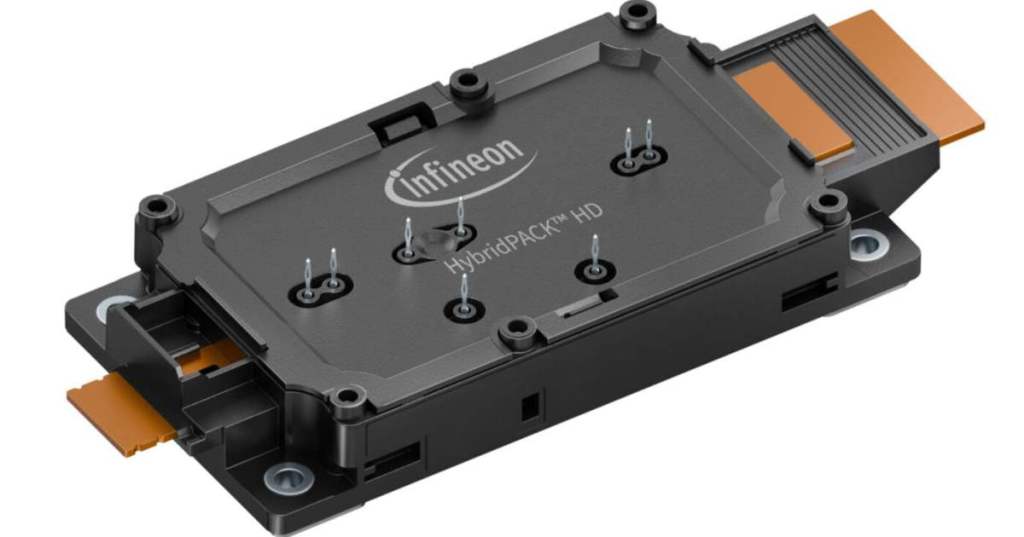
Infineon introduced a silicon carbide power module for heavy-duty electric vehicle traction inverters on November 18, 2026. Its HybridPACK HD announcement describes a family designed for output currents ranging from 500 to 1,200 amperes RMS and service-life requirements exceeding 1.2 million kilometers. The first released half-bridge module, FF01MR14A60MA2XT, targets commercial vehicles and high-power conversion equipment. The announcement describes engineering targets rather than independently demonstrated fleet longevity.
Infineon’s June 2026 automotive traction inverter presentation provides system-level context; it predates the HybridPACK HD launch. Watch directly on YouTube.
Why packaging matters in a traction inverter
Traction inverters convert battery DC into controlled AC for electric motors. High-current operation requires careful coordination of semiconductor switching, thermal management, electrical interconnections and motor control. A module that integrates power switches into a mechanically robust package can simplify assembly, although the complete inverter still needs gate drivers, protection, sensing and control electronics. Our coverage of ZF’s high-speed electric drive illustrates the demands placed on modern propulsion systems.
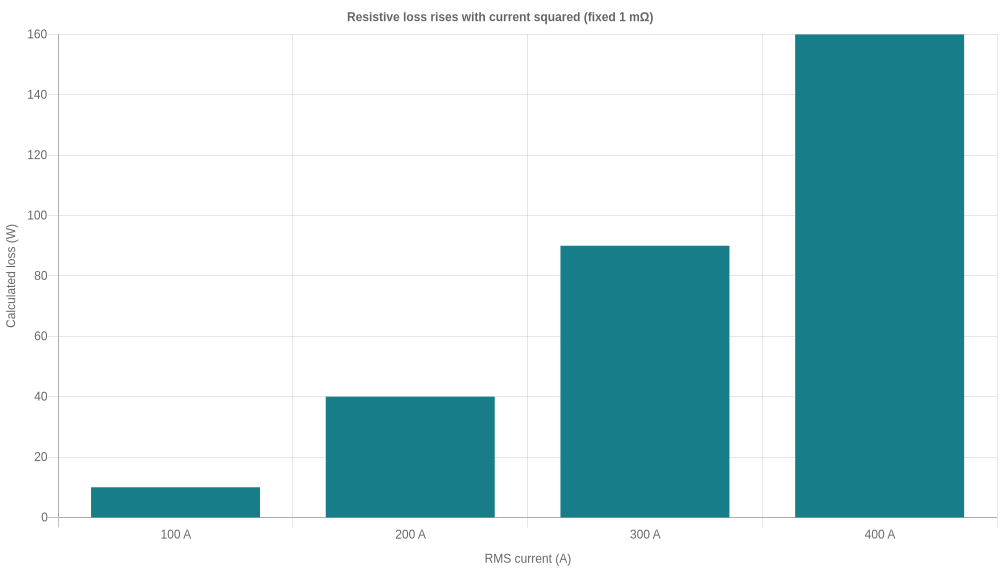
Infineon’s product specification lists 1 milliohm on-state resistance at a junction temperature of 25°C. For a simplified fixed-resistance example, a conducting path carrying 100 A RMS dissipates 10 W, whereas 400 A produces 160 W. The sixteenfold increase illustrates the quadratic relationship between current and resistive heating. Actual module losses require temperature-dependent device characteristics, switching conditions and current distribution, as explained in our GaN conduction-loss comparison.
Switching transients and insulation readiness
The company specifies 1,400 V silicon carbide MOSFETs and separately identifies the housing’s creepage and clearance design as ready for 1,500 V DC architectures. Those specifications describe different limits. Insulation readiness does not authorize a 1,500 V operating bus across a 1,400 V switch. Engineers must account for the actual circuit topology, transient overshoot and applicable device ratings. The stated low-inductance terminal design helps address switching transients, a challenge also examined in our high-frequency GaN motor drive report.
Infineon’s earlier HybridPACK Drive introduction explains the broader inverter module family, not the newly released HD variant. Watch directly on YouTube.
Reliability is a system-level requirement
The manufacturer combines sintered chip attachment, copper bonding and direct liquid cooling to address repeated thermal and mechanical stress. These measures aim to limit degradation of electrical connections and heat-transfer interfaces over extended duty cycles. The commercial launch establishes product availability, not a measured efficiency improvement or guaranteed service life for every vehicle. Industry outlet electrive reported that comparative cost and efficiency savings were not quantified.
The engineering opportunity extends beyond trucks: reliable high-current switching is also central to solid-state power infrastructure. Independent qualification data, thermal cycling results and complete inverter efficiency maps would provide the next meaningful evidence of performance.
Featured photograph: Infineon via electrive, cropped for editorial presentation.
We volunteer daily to ensure the credibility of the information on our platform is Verifiably True. If you would like to support to help further secure the integrity of our research initiative, please scan the QR code below.



Leave a Reply