
A November 26–30 hardware promotion from Solo Satoshi provides a useful snapshot of the trade-offs facing home Bitcoin miners. Four configurations range from $207.78 to $1,372 when the listed equipment and appropriate accessories are included. The lowest upfront price, cheapest capacity and lowest energy per hash belong to different machines. Our recent solo-mining census provides context for the growing market.
Compare complete configurations
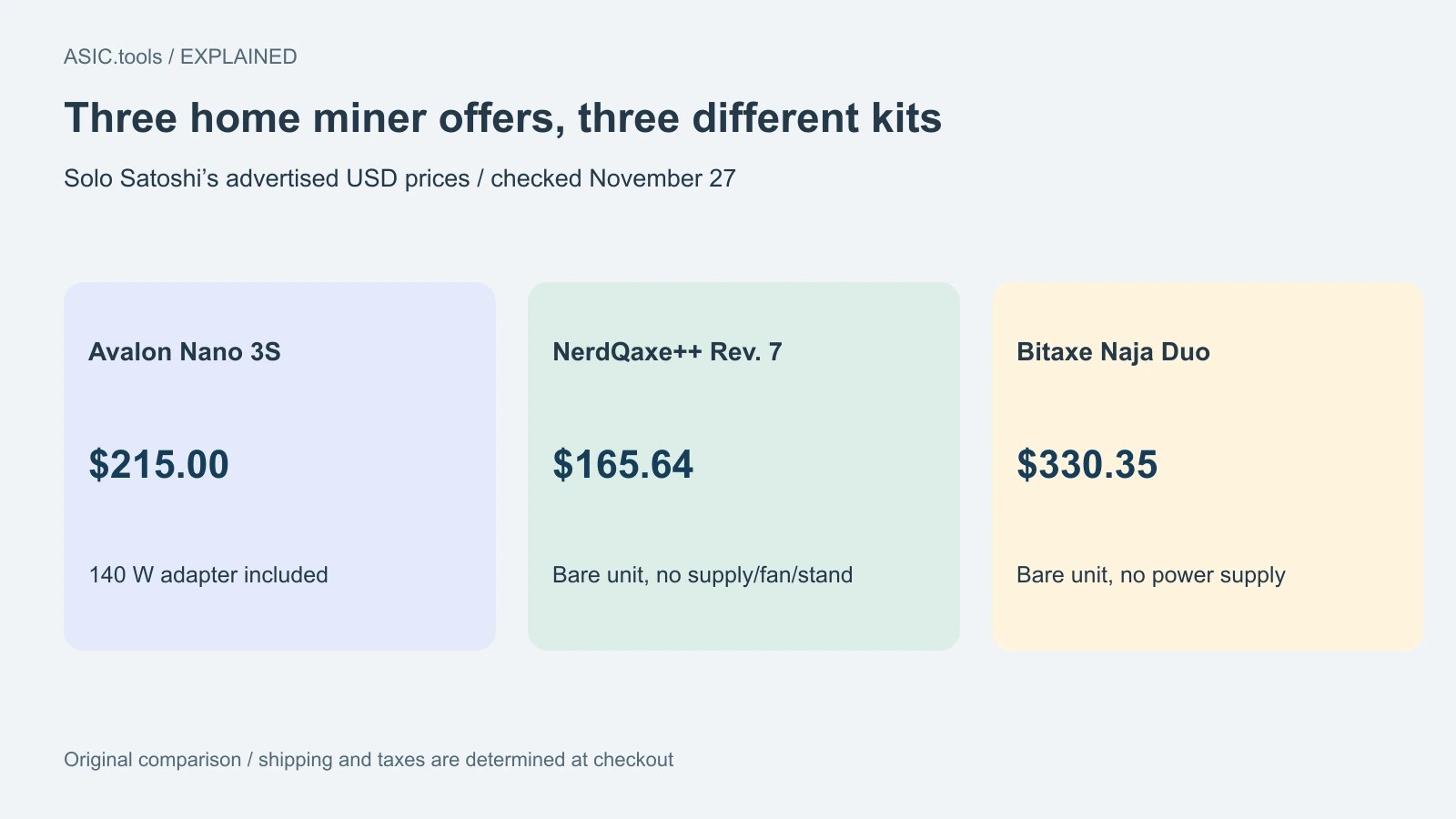
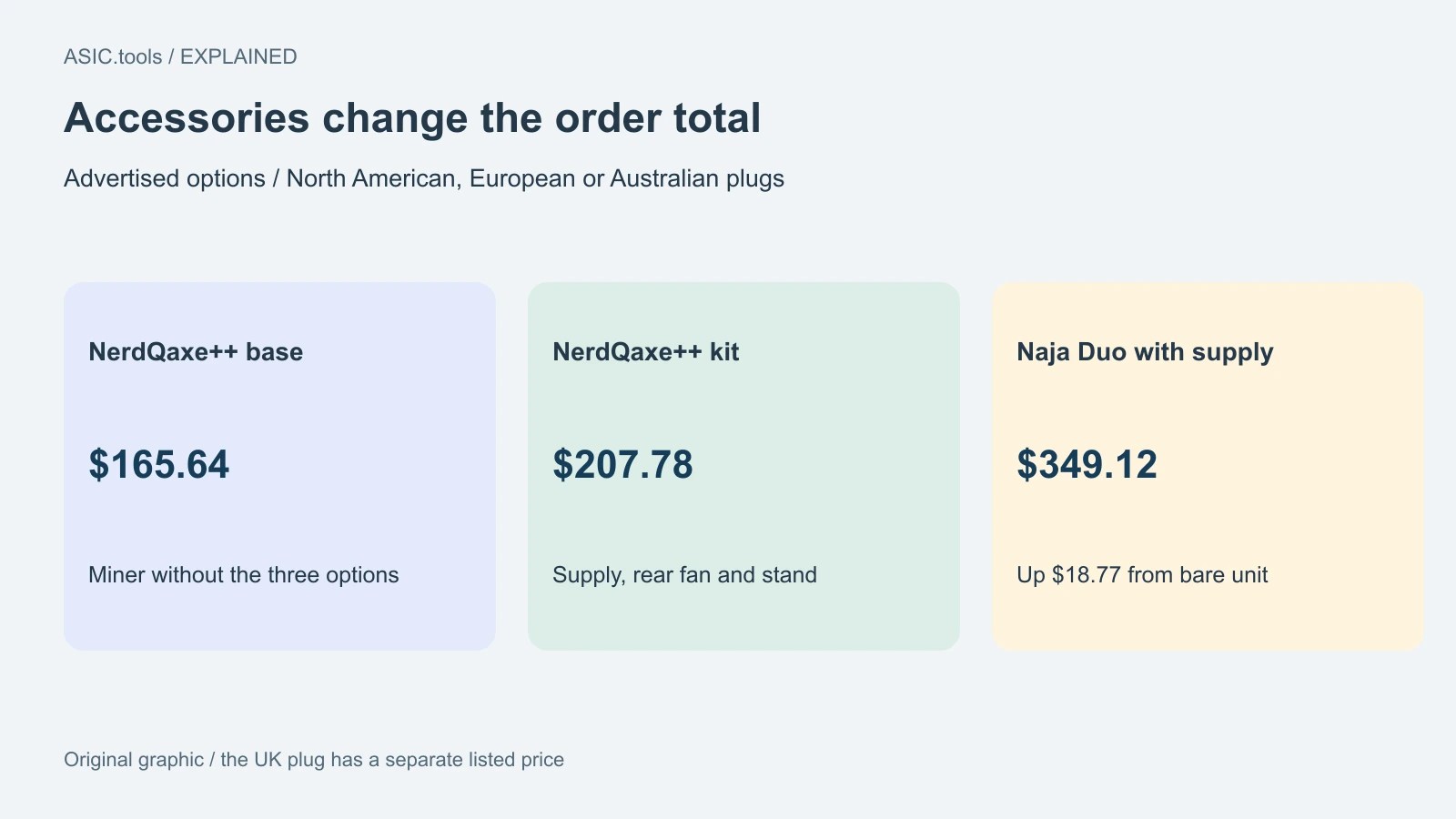
The NerdQaxe++ Revision 7 costs $165.64 without the optional supply, rear fan and stand. Adding all three brings the North American configuration to $207.78. Canaan’s Nano 3S costs $215 with its adapter. A Naja Duo 1201 costs $349.12 with a North American supply, while Canaan lists its larger Avalon Q through the retailer for $1,372. Prices are advertised sale amounts, not completed transactions or worldwide market averages. Taxes, freight and availability remain checkout-dependent.
Hashrate per dollar and efficiency
Using the seller’s specified operating points, the Nano 3S provides 6 TH/s at 140 W, the NerdQaxe++ approximately 4.8 TH/s at 69.5 W, and the Naja Duo approximately 4.4 TH/s at 42 W. The Avalon Q is rated at 90 TH/s and 1,674 W. Dividing price by hashrate gives approximately $35.83, $43.29, $79.35 and $15.24 per TH/s respectively. Dividing watts by hashrate gives 23.33, 14.48, 9.55 and 18.60 J/TH. Those calculations use advertised operating points rather than independent measurements. The Bitaxe Gamma Hex illustrates another approach to compact hashboard design.
Electricity can overturn the purchase-price comparison
Assuming 720 hours of operation per month and an illustrative $0.12/kWh tariff, energy expenditure for the four machines is approximately $12.10, $6.00, $3.63 and $144.63 respectively, in the order above. Actual wall consumption may exceed board-level power because of adapter losses. The larger Avalon Q produces more hashes per dollar of acquisition cost, but demands substantially more electrical capacity and ventilation. A power supply’s maximum rating does not establish actual consumption.
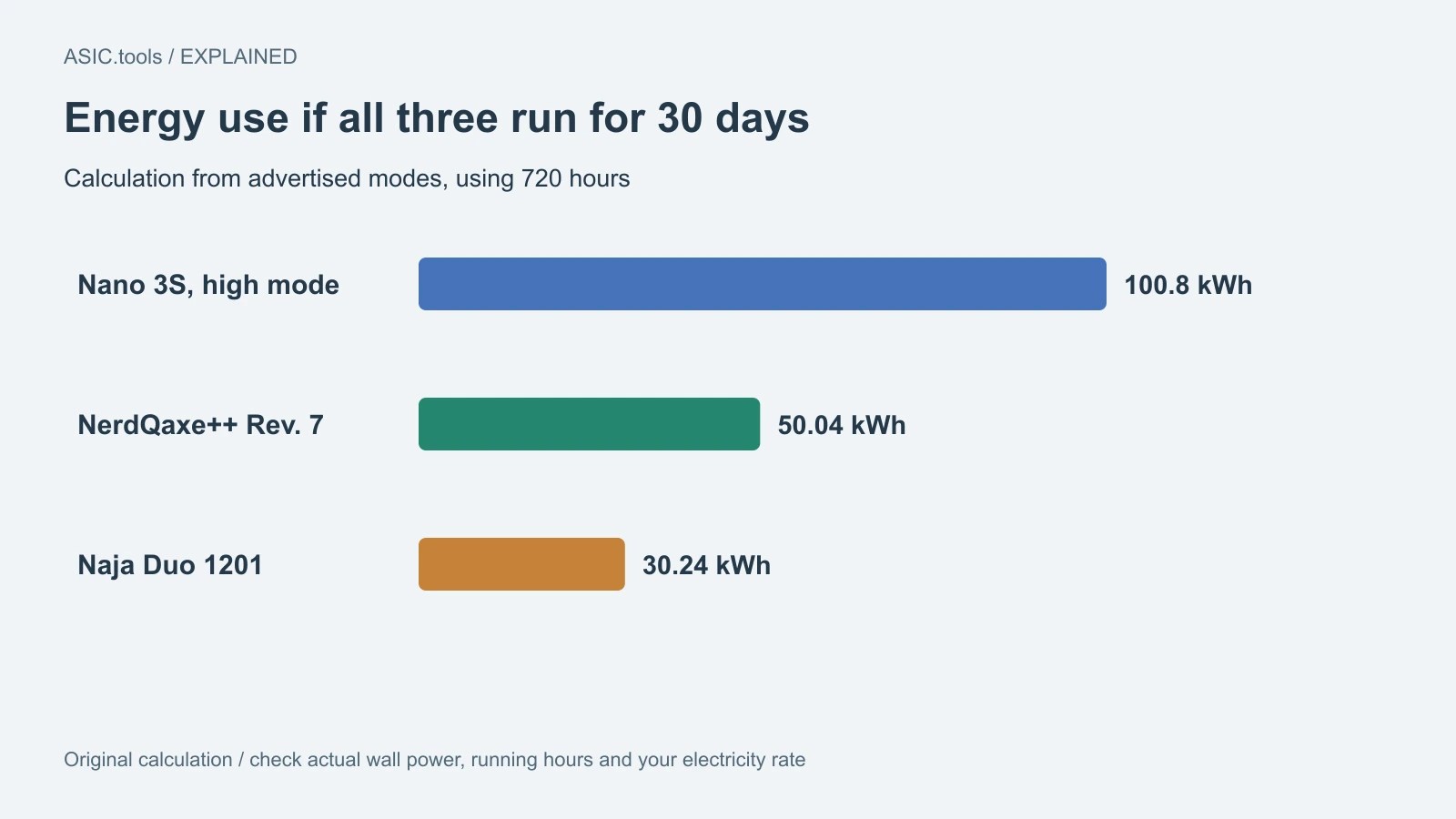
The Naja Duo’s higher acquisition cost buys a more efficient stated operating point, not guaranteed profit. Compared with the NerdQaxe++ at their respective stock settings, it saves 19.8 kWh per 30 days, or approximately $2.38 at the assumed tariff, but also supplies 0.4 TH/s less. Equal-hashrate comparisons require normalizing both power and capital expense.
Operational considerations
Buyers should confirm input voltage, connector compatibility, ventilation, warranty terms and pool configuration before energizing any miner. Our NerdQAxe firmware report explains why independent cooling telemetry matters. Canaan’s industrial heat-recovery projects demonstrate how differently heat can be managed at commercial scale. Home mining produces heat too, but its usefulness depends on season, building needs and the alternative heating system.
Solo mining rewards are probabilistic; no purchase price or rated hashrate guarantees a block discovery. The promotion is scheduled to end November 30 at 11:59 p.m. Central time. Source: retailer sale announcement and specifications. The featured image is credited retailer promotional artwork, not an independent product test.
We volunteer daily to ensure the credibility of the information on our platform is Verifiably True. If you would like to support to help further secure the integrity of our research initiative, please scan the QR code below.



Leave a Reply