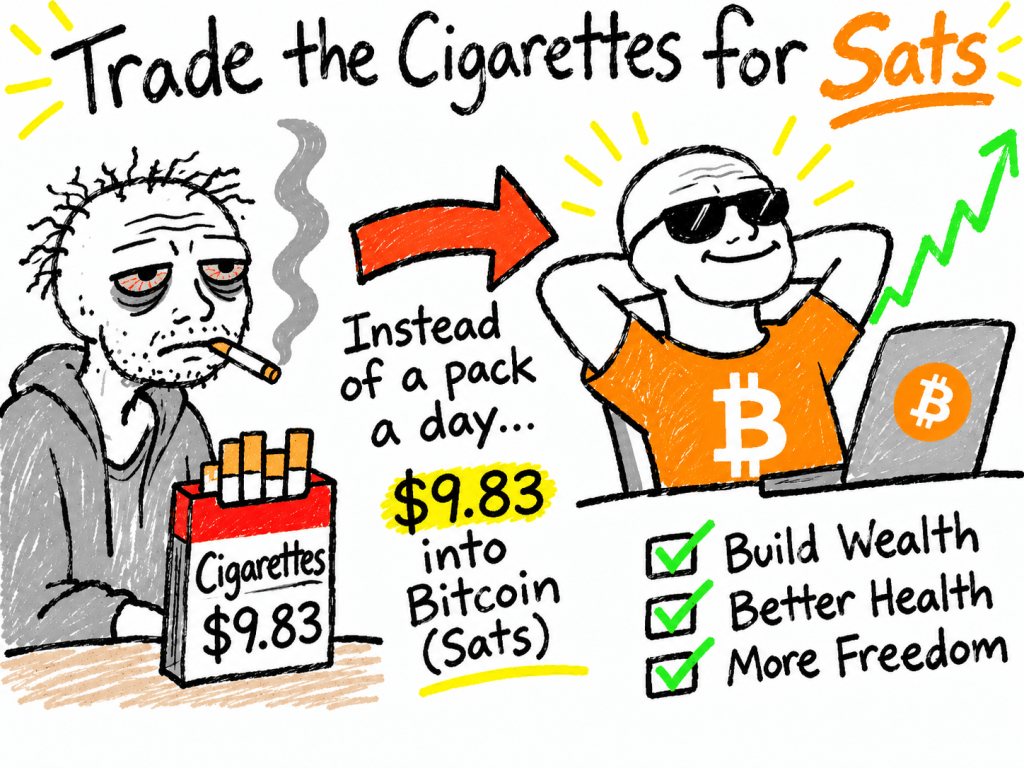
A pack of cigarettes and a small Bitcoin purchase can have the same immediate cost but very different financial consequences. The Campaign for Tobacco-Free Kids reported a weighted average U.S. retail cigarette price of $9.83 per pack, including sales tax, in October 2026. What would happen if a person redirected that daily amount into Bitcoin for four years instead?
The experiment covers November 29, 2022, through November 28, 2026, inclusive, rather than starting at a halving. As with our discussion of the four-year interval standard, the observation window is defined explicitly. However, the investment calculation is separate from Power Efficiency Theory and does not estimate Bitcoin’s physical or theoretical value.
Original Trade the Cigarettes for Sats post on X. The featured illustration communicates the spending alternative; it is not a forecast of investment performance.
Four years of $9.83 daily contributions
The period contains 1,461 days, including February 29, 2024. At $9.83 per day, total contributions equal $14,361.63. Assuming one 20-cigarette pack per day, the alternative would avoid purchasing 1,461 packs, or 29,220 cigarettes. The modeled Bitcoin balance is approximately 0.285723 BTC, equivalent to 28.57 million satoshis. At the November 28, 2026 closing price of $59,321.42 reported by Yahoo Finance, the estimated portfolio is worth $16,949.48, approximately $2,587.85 above contributions, or 18.02%.
SmartChart 1: Portfolio value versus money contributed
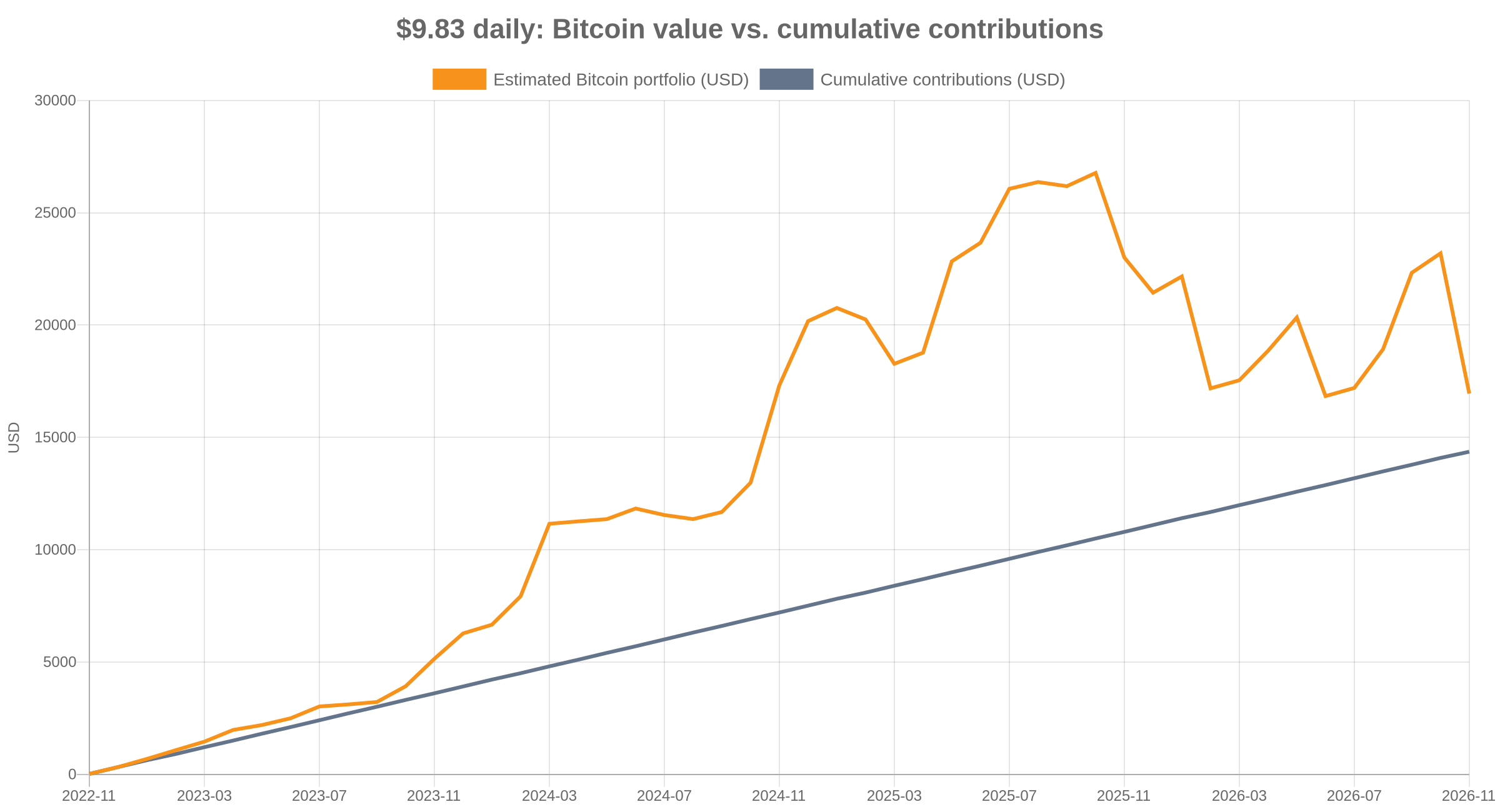
The orange line is the estimated market value of accumulated Bitcoin, while the gray line tracks money contributed. Bitcoin’s price fluctuations change the value of every previously purchased fraction, so the portfolio line can decline despite continued purchases. The October 2025 monthly-average valuation approached $26,800, before subsequent market weakness reduced its value. The final return is a simple gain relative to contributions, not an annualized or time-weighted return. Our weekly crypto financial analysis similarly separates market measurements from investment recommendations.
SmartChart 9: Three spending alternatives
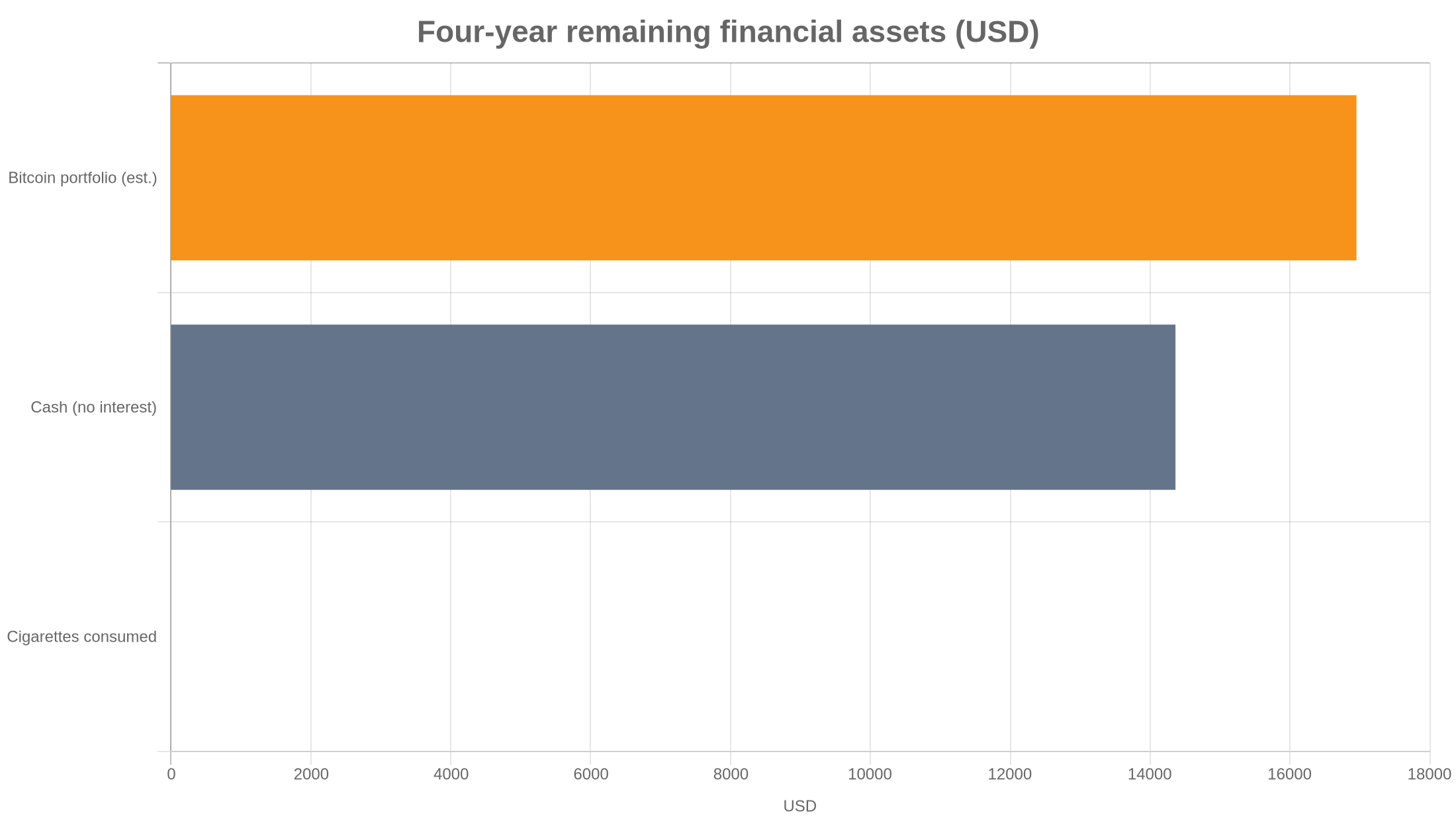
Saving the same amount as cash without interest would leave $14,361.63. Buying Bitcoin would leave an estimated $16,949.48 under the selected historical conditions. Consuming the cigarettes would leave no corresponding financial asset. The comparison concerns retained financial assets only, not the complete utility or costs of each choice. Bitcoin can lose value, while cash has inflation risk. Repeated purchases, also known as dollar-cost averaging, do not eliminate market risk. For another example of repeated purchases, see Strategy’s November Bitcoin acquisition.
Methodology and limitations
For each calendar month, multiply the number of included days by $9.83 and divide the result by the monthly mean daily Bitcoin closing price published by Chihuahua Signals. Sum the resulting Bitcoin quantities, then multiply by the final closing price. November 2022 includes two days and November 2026 includes 28 days; the latter mean is the source’s November 27 month-to-date observation. Because full daily execution prices were not obtained, the model approximates daily purchases using monthly means. Actual daily purchase totals would differ. The current cigarette price is applied retrospectively as a constant hypothetical budget, not as a record of historical tobacco prices. Trading fees, spreads, taxes, and cash interest are excluded.
The two visual forms were selected from the 80-format SmartChart catalog and rendered with QuickChart. The financial exercise demonstrates the opportunity cost of recurring spending, not a promise of returns. For free evidence-based help quitting tobacco, visit Smokefree.gov. Quitting does not require investing the proceeds in any particular asset.


Leave a Reply