
Turkmenistan is examining international data center investments following the introduction of its virtual-asset legal framework. On November 5, 2026, Interfax reported that Deputy Energy Minister Serdar Saparov described preliminary negotiations with foreign companies for high-performance computing facilities. The ministry oversees 11 generating stations with more than 6.5 GW of installed capacity, according to the official. The negotiations do not establish a contracted Bitcoin mine or an allocation of electricity to cryptocurrency operations. Neighboring Uzbekistan’s mining permit and infrastructure expansion illustrates why project authorization and measured computing capacity must be distinguished.
Mining becomes a regulated industrial activity
The Law on Virtual Assets entered into force on January 1, 2026. Associated Press reported that the framework legalized cryptocurrency mining and exchanges under regulatory supervision. The Ministry of Communications’ October 2 announcement describes a 2026–2030 implementation roadmap, with the central bank supervising exchange licensing and the energy ministry responsible for industrial mining energy policy. The communications ministry identifies fiber upgrades, backbone expansion, routing equipment and cybersecurity as infrastructure priorities. A legal framework does not guarantee an operator access to sufficient power or connectivity.
SmartChart: how facility power translates into hashrate
A mining machine’s energy intensity, measured in joules per terahash (J/TH), determines the rate of hashing obtainable from a given electrical input. Power usage effectiveness (PUE) is the ratio of total facility power to IT equipment power. Assuming a PUE of 1.10 and treating all IT power as ASIC power for a simplified model, a facility rated at 100 MW supplies approximately 90.91 MW to its machines. At 15 J/TH, that corresponds to 6.06 EH/s. At 10 J/TH, the same facility could theoretically reach 9.09 EH/s. The ASIC hardware price analysis examines why greater efficiency can also entail higher capital costs.
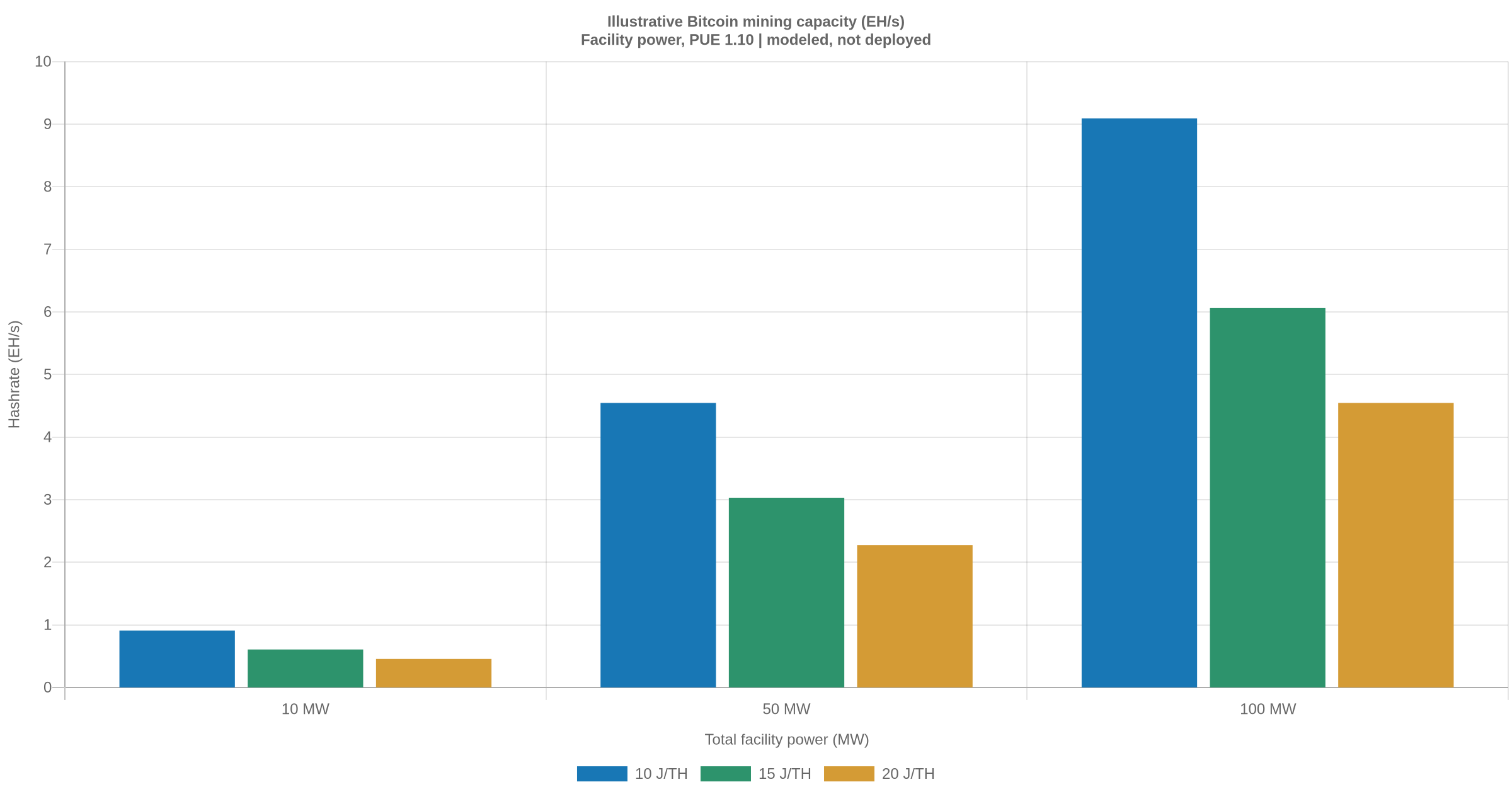
At 50 MW, the model yields 4.55 EH/s at 10 J/TH, 3.03 EH/s at 15 J/TH and 2.27 EH/s at 20 J/TH. A continuous 100 MW load would consume 2,400 MWh per day. Actual utilization, power conversion losses, network equipment, cooling loads and hardware conditions change delivered performance. Nameplate generation capacity cannot be interpreted as spare power. Even 100 MW represents approximately 1.54% of a 6.5 GW reference capacity, but the reported national figure exceeds that reference and does not quantify available electricity.
Infrastructure conditions determine the outcome
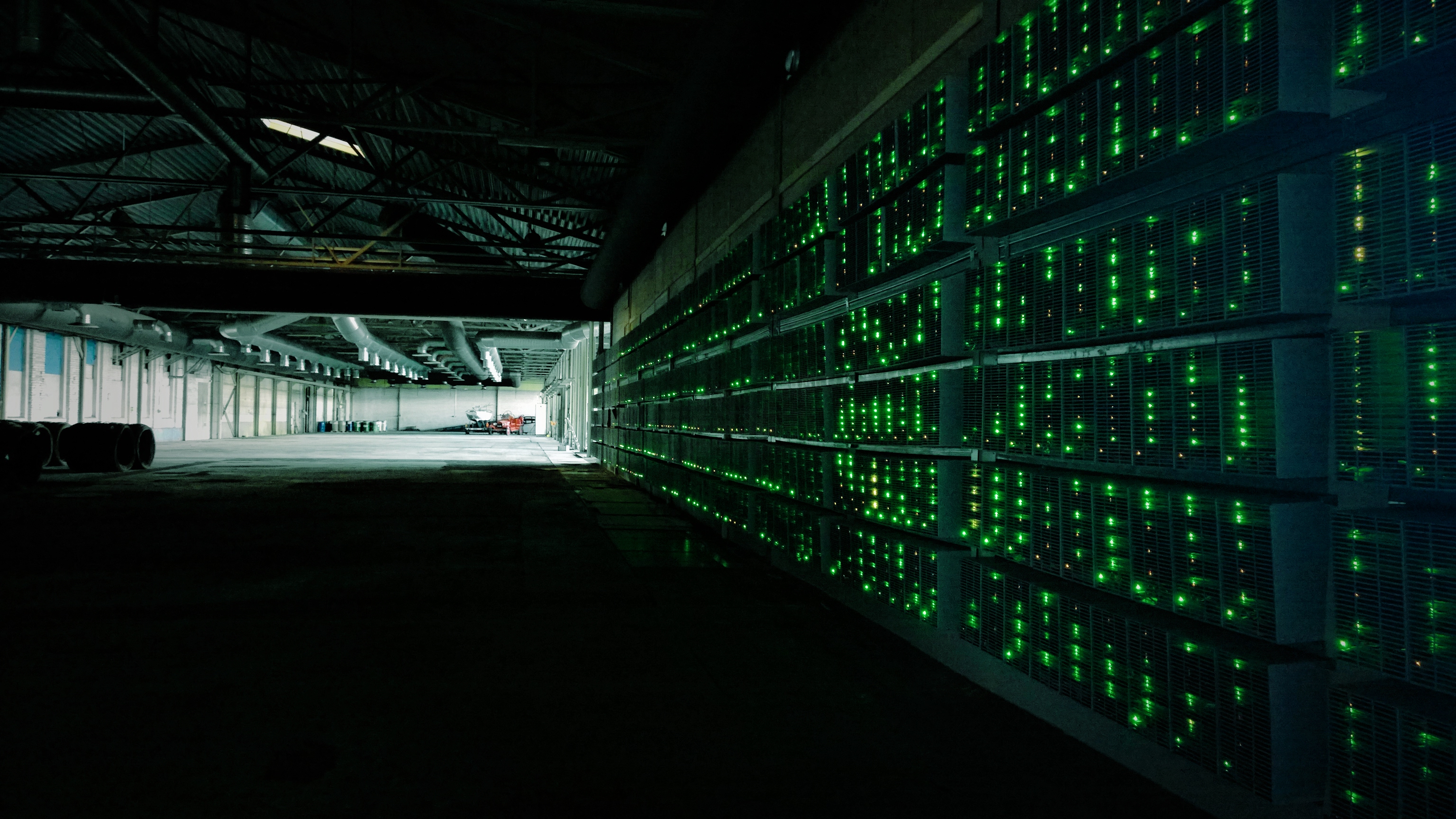
Turkmenistan’s energy ministry is also modernizing its transmission networks and evaluating combined-cycle gas turbine technology. A mining installation would need a suitable connection, dependable cooling, electrical protection, metering and stable access to mining pools or Bitcoin nodes. The potential value of flexible demand depends on local grid constraints, not simply national generating capacity. Our British wind curtailment analysis discusses a separate example of matching computing demand to electricity availability. The Abu Dhabi mining guidance similarly illustrates the importance of technical planning and regulatory oversight. No specific contracted facility capacity, ASIC fleet or operational Bitcoin hashrate in Turkmenistan was established by the November reports.
Featured photograph: Ashgabat at night from the International Space Station, NASA / Expedition 72, public domain, cropped to 1200 by 630 pixels. Credited media and a static analytical chart replace untested interactive embeds.
We volunteer daily to ensure the credibility of the information on our platform is Verifiably True. If you would like to support our independent research, please scan the QR code below.



Leave a Reply