Uzbekistan’s electronic mining permit registry, consulted November 29, 2026, lists two authorized mining entities. The second, LINKWISE, received regulatory approval under Order No. 78 dated September 28; its certificate records September 29 as the issue date and September 28, 2031 as the expiry date. The listed mining location is in Takhiatash district, Karakalpakstan. The permit marks a concrete administrative milestone within a wider regional infrastructure expansion. In August, Daryo reported that regional authorities were developing three cryptocurrency mining facilities and three data centers valued collectively at $5.11 billion. The investment figure encompasses all six projects, not exclusively Bitcoin mining.
A mining permit is not a hashrate measurement
The official M #002 certificate authorizes mining activity but does not specify the cryptocurrency mined, installed ASIC inventory, power demand or operational hashrate. The first permit was recorded in January for a Bukhara-region operation. A November review of the register therefore establishes two listed permits, not a comprehensive count of active mining machines. Our global mining infrastructure report provides context for the separate challenge of estimating geographic hashrate.
Besqala Mining Valley changes the power equation
Presidential Resolution RP-143 of April 17, 2026 established a special mining zone in Karakalpakstan, with exceptions to the general solar-powered mining requirement. Eligible residents receive mining-income tax and fee exemptions until January 1, 2035, subject to a monthly payment of 1% of mining income to the zone directorate. Grid-connected consumption generally faces twice the second tariff group’s rate, with specified exceptions, and requires dedicated metering. The resolution also provides for potential energy projects using certain depleted or underutilized hydrocarbon deposits. It does not establish that every mining operation uses renewable power.
The tariff matters because Bitcoin mining converts electricity into repeated SHA-256 computations. Consider an illustrative 10 MW of power supplied directly to mining equipment operating at 10 J/TH. Dividing 10 million watts by 10 joules per terahash yields 1 million TH/s, or 1 EH/s. At continuous full load, daily equipment consumption would be 240 MWh. Cooling, electrical losses and networking would increase facility-level consumption. Neither figure describes LINKWISE or any of the announced facilities. Our Power Efficiency Theory equations examine the relationship between network hashrate and machine efficiency.
Infrastructure milestones to distinguish
The September 16 Dunyo report describes the broader investment program. Data centers can host workloads unrelated to cryptocurrency, so their capital cost cannot be translated directly into Bitcoin mining capacity. Commissioning a Bitcoin facility additionally requires energized electrical distribution, operating cooling, connected mining hardware and reliable network connectivity. As discussed in our Bitcoin network hashrate analysis, measured network activity is different from theoretical equipment capability. The strongest evidence of a project’s progress would be independently documented energized capacity, equipment specifications and measured output. The official register provides a permit milestone, not those measurements. Other country-specific frameworks, including Zambia’s custody regulations, address different segments of the Bitcoin industry.
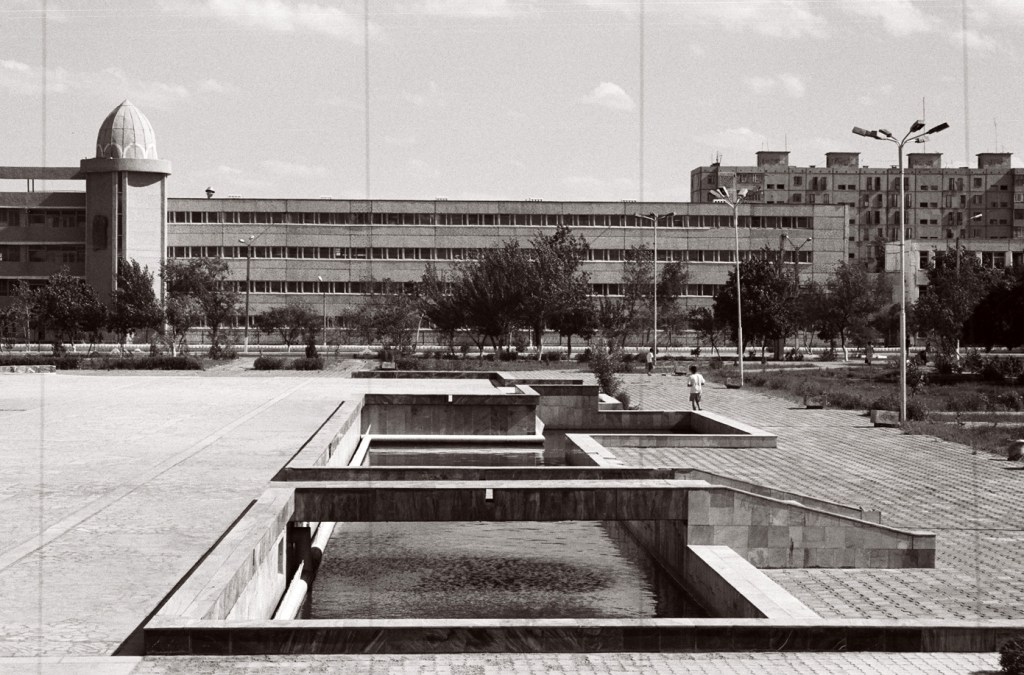
Featured photograph: central Nukus in 2005, Zartosht / Wikimedia Commons, CC BY-SA 3.0. The official permit is supplied as a downloadable document rather than an untested interactive viewer.
We volunteer daily to ensure the credibility of the information on our platform is Verifiably True. If you would like to support our independent research, please scan the QR code below.



Leave a Reply