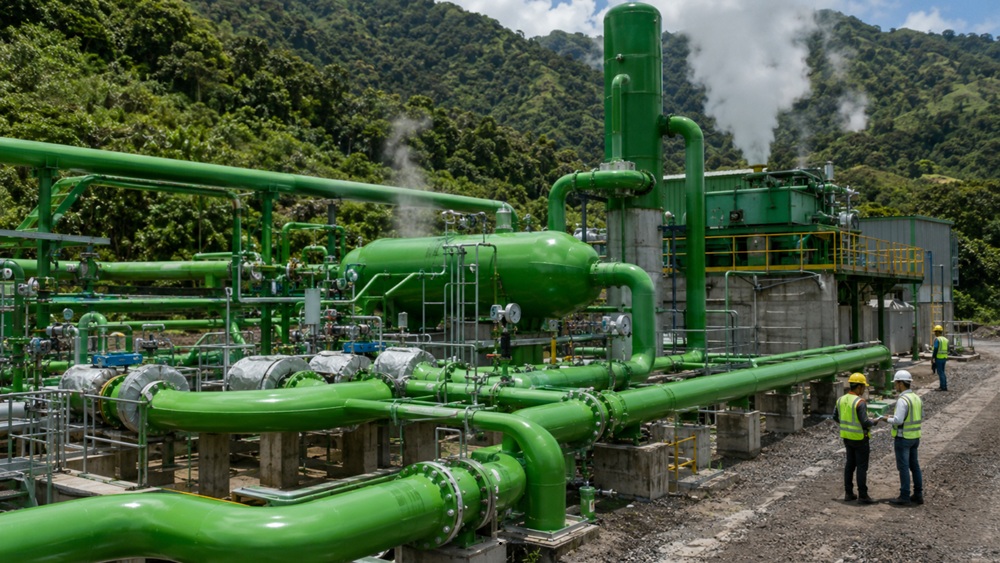
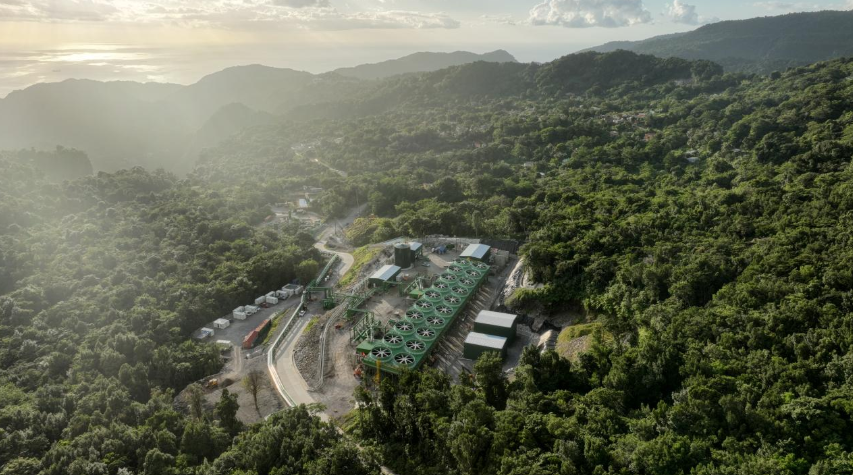
The Caribbean Development Bank (CDB) announced on November 18, 2026, that Dominica’s geothermal development received two Caribbean Renewable Energy Forum awards for project execution and financing. The bank’s announcement identifies a rated generating capacity of 10.3 MW and projects that the plant could supply up to 70% of the country’s annual electricity requirements. The operating facility represents a later development stage than the geothermal drilling prospect in Comoros.
The country’s Independent Regulatory Commission confirms commercial operation began July 31, 2026, after required reliability testing. Ormat Technologies independently reports the same milestone in its quarterly regulatory filing, describing the facility as a 10 MW project. The November recognition is new; the plant did not begin operating in November.
Original drilling research established the resource
A 2014 Stanford Geothermal Workshop paper by Will Osborn, Jonathan Hernández and Alexis George describes three exploration wells drilled in 2012 to depths of 1,200–1,613 meters. The strongest well delivered up to 29 kilograms of fluid per second at 17.5 bar gauge pressure. Measured temperatures reached 246°C. A separate 2024 conceptual reservoir study by R. Libbey and colleagues incorporates seven wells drilled between 2012 and 2023. The authors interpret a roughly 400-meter-thick reservoir with temperatures of 240–255°C in fractured volcanic rock. These are historical research findings, not new November measurements.
Converting underground heat into electricity
Ormat describes the facility in its 2025 annual report as an air-cooled binary geothermal system. In a binary cycle, geothermal fluid transfers heat through an exchanger into a separate working fluid. Vapor drives a turbine and generator; the working fluid is subsequently cooled and condensed. Reinjection returns geothermal fluid underground and can help support reservoir pressure. Production and injection behavior must be monitored over time. Rock permeability and fluid movement are also relevant to the Costa Rican volcanic systems studied in recent laboratory research.
What the new capacity means for an island grid
At a hypothetical 90% capacity factor, a 10.3 MW generator would produce approximately 81.2 GWh in a 365-day year. Actual annual energy depends on outages, auxiliary consumption, reservoir performance and grid dispatch. Unlike the proposed tidal array in Djibouti, geothermal generation does not follow a tidal cycle. Nevertheless, a small electricity system needs reserves for generator outages and changes in demand, a challenge illustrated by Cuba’s grid-forming battery program.
CDB reports $34.8 million in concessional funding and a decline in electricity fuel surcharges. Future monthly bills and independently measured generation will establish the longer-term economic outcome. The 70% annual electricity share remains a projection rather than a completed full-year result. Featured photograph: Dominica Independent Regulatory Commission, August 2026.


Leave a Reply