A November 6, 2026 study by Domenico Coiro of the University of Naples Federico II and Giancarlo Troise of Seapower estimates the electricity production of a hypothetical tidal turbine installation in Djibouti. Their original scientific research, published in Energies, combines local ocean-current measurements with numerical modeling to examine the Grand Passage connecting Ghoubet-el-Kharab with the Gulf of Tadjoura. Unlike a commercial deployment such as the proposed Scottish EURO-TIDES array, the Djibouti configuration is a preliminary feasibility scenario.
Measuring tidal currents beneath the surface
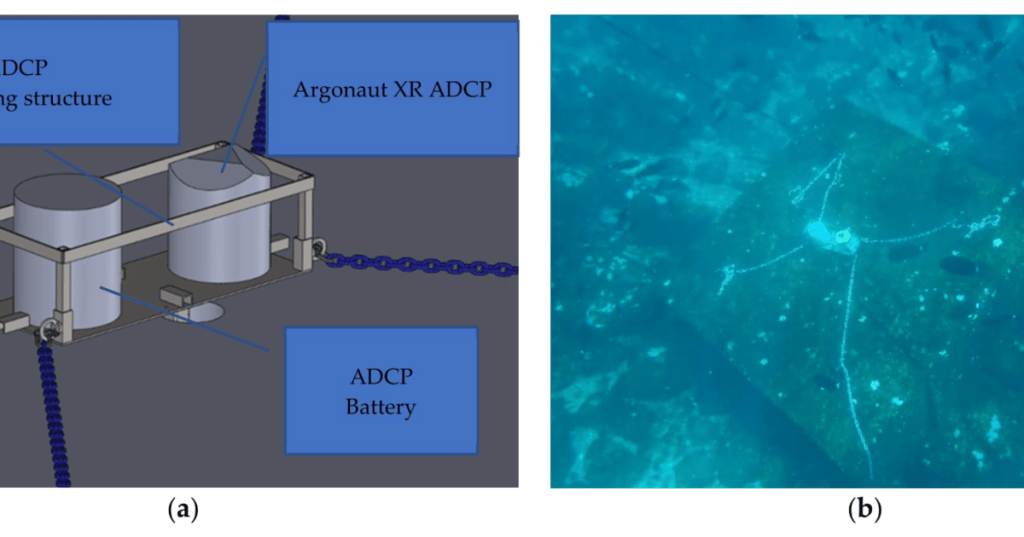
During a three-day campaign in June 2026, the team used a SonTek Argonaut XR acoustic Doppler current profiler to measure water movement at different heights. Acoustic pulses scatter from particles suspended in the water; changes in the returned signal frequency reveal flow velocity. The instrument also uses pressure and orientation measurements to characterize its surroundings. A sonar survey provided information about the seabed.
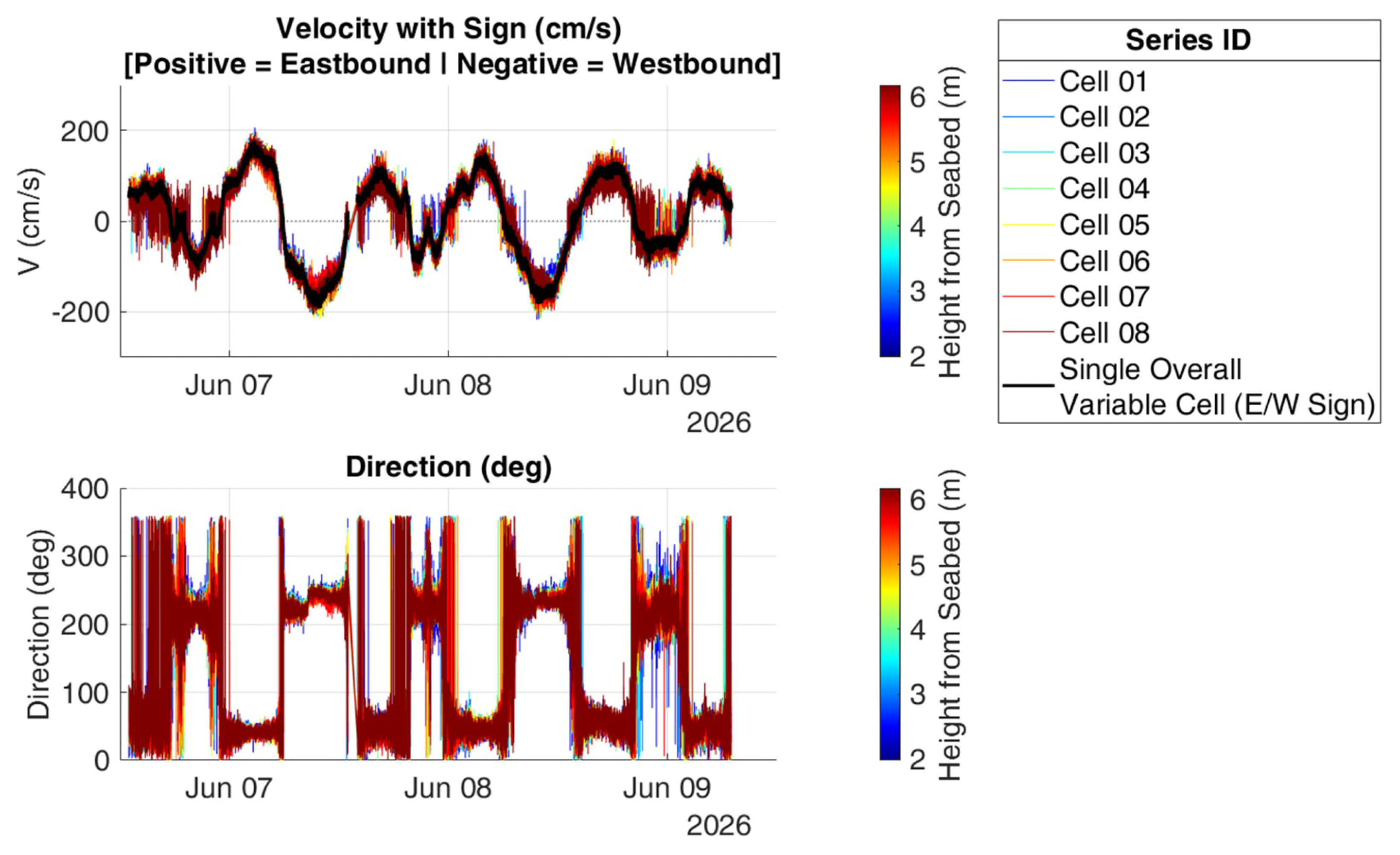
The researchers correlated the measured current with the rate of change of sea level predicted by the FES2022 tidal model. The fitted relationship achieved an R² of 0.89, but the short observation period covered neap tides. Extrapolation to stronger spring tides could overestimate current speed. Local measurement and model validation are also important in solar resource assessment in the Republic of the Congo.
From moving water to electrical output
Available kinetic power increases approximately with the cube of flow speed for a fixed cross-sectional area and water density. Doubling current speed therefore increases the ideal kinetic power eightfold, although a real generator cannot necessarily capture that increase. Turbine ratings, cut-in thresholds, protective shutdowns and efficiency constrain electrical output. Our marine energy guide explains the distinction between tidal currents and wave energy.
| Modeled quantity | Estimate |
|---|---|
| Peak annual current velocity | 3.87 m/s |
| Hypothetical turbine count | 18 |
| Rated power per turbine | 85 kW |
| Combined nameplate power | 1.53 MW |
| Annual electrical production | 2.99 GWh |
| Capacity factor | 22.2% |
Why the result remains an upper-limit scenario
The paper estimates the idealized channel resource at 36.88 GWh annually, using a simplified 300-meter-wide and seven-meter-deep section. The modeled farm captures around 8.1% of that figure. Alternative turbine designs yield modeled estimates between 1.86 and 3.05 GWh annually. These scenarios are not statistical confidence intervals.
The proposed rotors occupy approximately 20.4% of the assumed channel cross section. The authors warn that resistance from the installed equipment could modify the flow itself; their simplified production estimate does not account for that interaction. Longer measurement campaigns, hydrodynamic array simulations, environmental studies and lifecycle cost analysis are necessary before commercial investment. A similar distinction between resource estimates and construction decisions appears in our Comoros geothermal exploration report.
Featured image: actual current-profiler mounting design and underwater installation, Figure 3 of Coiro and Troise, Energies 19(21), 5320, cropped, CC BY. Both embedded interviews feature the paper’s lead author and his research organization; neither records the Djibouti campaign.


Leave a Reply