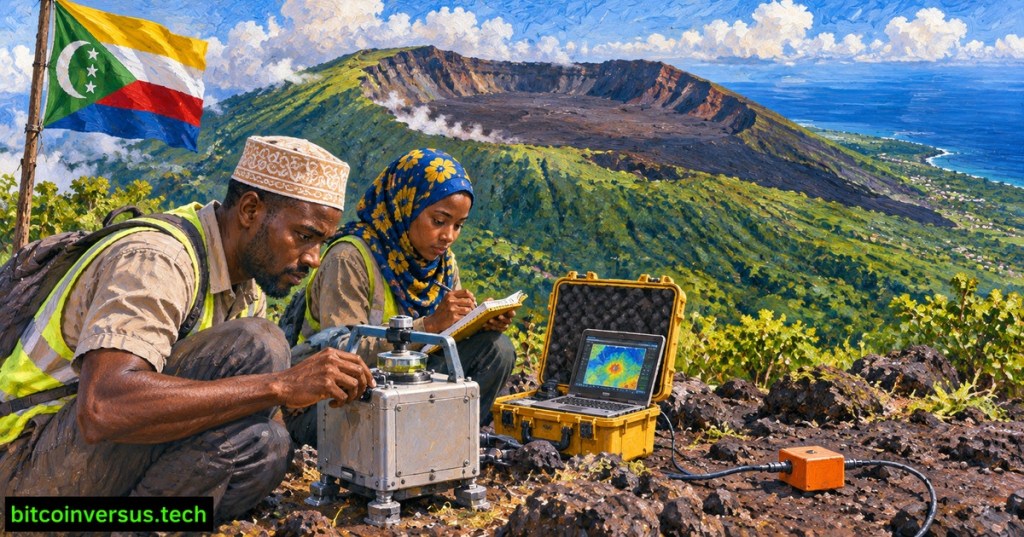
Comoros has advanced its investigation of geothermal electricity on Grande Comore following a field campaign examining the northern slopes of Karthala volcano. An October 21, 2026 report describes the completion of surface surveys by Steam S.r.l. for the United Nations Development Programme (UNDP) and the Geological Bureau of Comoros. The work identifies a preferred exploration area rather than an operating power station. Unlike Kenya’s commissioned geothermal infrastructure, Karthala still requires confirmation of its underground resource through drilling.
Original research reveals two different volcanic systems
A separate peer-reviewed study by F. J. P. Lötter and colleagues, published March 18, 2026 in Geochemistry, Geophysics, Geosystems, provides scientific context for the island’s subsurface architecture. The original scientific research examines the distribution, orientation, shape and chemical composition of volcanic cones associated with Karthala and La Grille. The researchers infer that Karthala has a developed shallow magma transport system, while their observations do not reveal an equivalent system under La Grille.
The team interprets regional tectonic stresses as influencing both volcanoes, with the mass of Karthala’s volcanic edifice adding a local influence on magma pathways. A magma plumbing system transports molten rock; a geothermal reservoir contains heated fluids and permeable rock. The systems can be related, but evidence of magma transport alone does not determine whether commercial quantities of hot water or steam can be extracted.
Combining gravity, electricity and fluid chemistry
The geothermal assessment combines magnetotelluric measurements from 2024, a new gravity survey, volcanic gas sampling and seismic records spanning 2016–2025. Magnetotellurics uses naturally varying electromagnetic fields to estimate subsurface electrical resistivity. Gravity measurements help infer density contrasts. Fluid chemistry provides independent information about water-rock interactions and possible underground temperatures.
A low-density anomaly around La Soufrière coincides with hydrothermally altered surface rock. The integrated model interprets a conductive layer as a possible clay-rich seal above a deeper reservoir. The survey recommends La Soufrière as the first exploration area. Alternative explanations for geophysical signatures remain possible, so direct well observations are necessary to validate the model.
From a 45 MW resource estimate to a proposed 15 MW plant
The Geological Bureau of Comoros identifies earlier investigations estimating a 45 MW geothermal resource. The African Geothermal Association describes a proposed initial 15 MW generating facility contingent on successful exploration. UNDP’s July project announcement cites potential temperatures approaching 300°C at approximately 2,900 meters depth, not a verified production-well measurement.
A hypothetical 15 MW plant operating at a 90% capacity factor would generate approximately 118.3 GWh over a 365-day year. Actual production depends on reservoir productivity, maintenance, auxiliary loads and grid availability. Unlike the solar system examined in Colombia’s distributed-generation research, geothermal plants can potentially sustain output through nighttime hours.
The decisive tests are sustained fluid flow, temperature, pressure and chemistry in completed wells, along with reinjection performance and environmental monitoring. Drilling risk remains significant, as illustrated by the need for specialist well services at Nevada’s Blue Mountain project. Comoros has gained a more detailed exploration model, but commercial capacity and generation costs remain undetermined.


Leave a Reply