
A study published November 1, 2026, in the International Journal of Renewable Energy Development estimates that a hybrid photovoltaic system in La Tebaida, Colombia, could deliver electricity at 487 Colombian pesos per kilowatt-hour (COP/kWh). Its reference commercial tariff is 900 COP/kWh. The research examines distributed generation rather than utility-scale construction, a different operating model from the 250 MW Cypress Knee solar project in Arkansas.
John Grimaldo-Guerrero and colleagues from Universidad de la Costa, Universidad Simón Bolívar and Universidad del Magdalena published the original scientific research following an October 10 acceptance. Their findings concern modeled technical and financial feasibility rather than independently measured savings from deployed residential systems.
Measuring the available solar resource
The researchers analyzed weather records at five-minute resolution and examined three irradiance thresholds: 600, 650 and 700 watts per square meter. Between 9 a.m. and 2 p.m., four-fifths of the observations exceeded 600 W/m². Estimated annual production surpassed 700 kWh per panel across the modeled scenarios.
Irradiance describes incoming solar power per unit of surface area, not the electrical power delivered by a photovoltaic module. Conversion efficiency, panel area, cell temperature, shading and electrical losses determine useful output. A panel rated at 450 W under standard test conditions will generally deliver less under weaker illumination. Five-minute sampling can capture short-lived variations that daily averages obscure. Distributed installations such as the Singapore rooftop portfolio also depend on local site conditions.
Comparing modeled generation cost with purchased electricity
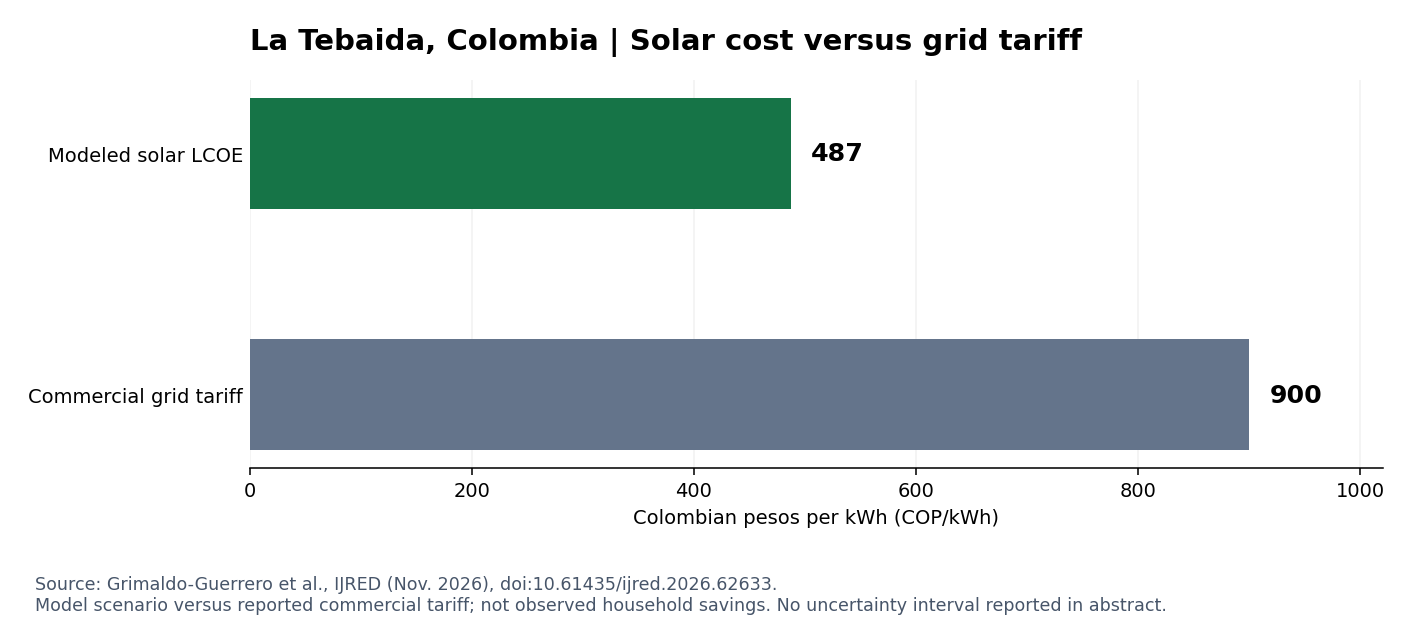
The difference between the two reported figures is 413 COP/kWh, or approximately 45.9% of the reference tariff. The authors model ten-year cash flows and report a 62-month break-even point and 16.94% internal rate of return under a representative financing scenario.
Levelized cost of energy divides discounted lifetime costs by discounted electricity production. An electricity tariff, by contrast, is the price charged for purchasing electricity. A lower modeled levelized cost does not guarantee equivalent reductions in household bills. Grid fees, financing eligibility, maintenance, battery replacement and the timing of energy consumption may affect the financial outcome. The same distinction between modeled energy economics and contracted costs matters in commercial solar procurement.
Why battery storage changes the economics
The study favors consuming locally generated power with storage over exporting surplus electricity at lower compensation rates. A battery shifts part of the midday output to evening hours, when photovoltaic generation falls. It also introduces equipment costs, conversion losses and degradation. A hypothetical battery delivering 90% round-trip efficiency returns nine kilowatt-hours for every ten kilowatt-hours supplied during charging. The economic benefit depends on the purchase price avoided and any export revenue forgone.
A successful household system must match both the power and energy requirements of its loads. Similar sizing considerations apply at larger scales, including the proposed Malaysian solar-and-storage campus. For Colombian households, the central question is whether realistic local financing and actual consumption patterns can support the modeled returns. Field measurements and operating-cost records would provide the next level of evidence.
Original research: Energy equity in the integration of photovoltaic systems: A case study of Armenia, Colombia, International Journal of Renewable Energy Development, 15(6), 1399–1409, November 2026. Analysis is based on the accessible journal abstract, not a full-paper methodological review.


Leave a Reply