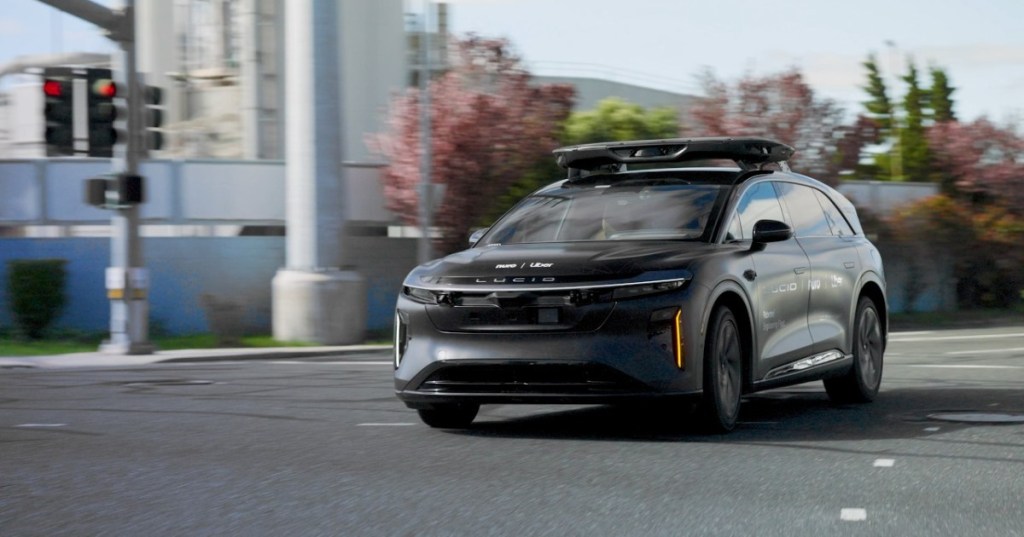
Nuro, Lucid and Uber announced on November 24, 2026 that their jointly developed robotaxi had begun public-road testing in the San Francisco Bay Area without a human safety operator behind the wheel. Nuro’s announcement marks a transition from supervised operation toward a planned commercial passenger launch in early 2027. The milestone differs from the operating fleet discussed in our Toyota and Pony.ai robotaxi report. Unsupervised testing is not equivalent to a broadly available paid passenger service.
Dividing the engineering responsibilities
Lucid supplies the Gravity electric vehicle architecture and integrates the required hardware into the vehicle. Nuro provides its Level 4 driving system, including perception, prediction and motion planning. Uber supplies the ride-hailing platform and coordinates fleet operations. A production robotaxi must integrate those components into an operational system that handles pickup points, route constraints, passenger support and maintenance. Failure management requires more than a successful drive under favorable conditions.
Operating without a safety driver
A Level 4 automated driving system must perform the entire driving task and manage fallback within its defined operational design domain. The domain can limit geography, road classes, weather or other conditions. A vehicle may need to slow, stop or reach a minimum-risk condition when it cannot continue safely. Level 4 does not mean every road and weather condition is supported. Earlier freeway restrictions involving Waymo illustrate why the permitted domain matters. Nuro’s new milestone follows California’s driverless testing authorization and a separate drivered passenger pilot permit; testing authority does not itself grant unrestricted commercial service.
Safety needs comparable evidence
Removing a driver eliminates direct exposure to human fatigue and road rage, but introduces risks involving perception errors, unexpected road behavior, software faults and remote-support operations. A meaningful safety comparison requires exposure-adjusted collision and injury rates for matched road types, operating conditions and vehicle populations. Near misses, interventions and failure-recovery performance also matter. The companies have not supplied a matched human-versus-machine safety dataset in the November release. The same evidence standard applies to driverless freight transportation.
What happens before public rides
Independent reporting by Axios and The Verge identifies the intended early-2027 public launch and plans for employee rides. Fleet availability, charging, cleaning and maintenance will affect operational readiness, alongside safety validation and regulatory approvals. The commercial model builds on the opportunities examined in our robotaxi fleet business analysis. November’s removal of safety operators is a meaningful technical milestone. It is not proof that autonomous systems have surpassed human driving in every environment.
We volunteer daily to ensure the credibility of the information on this platform is Verifiably True. If you would like to support to help further secure the integrity of our research initiative, please scan the QR code below.



Leave a Reply