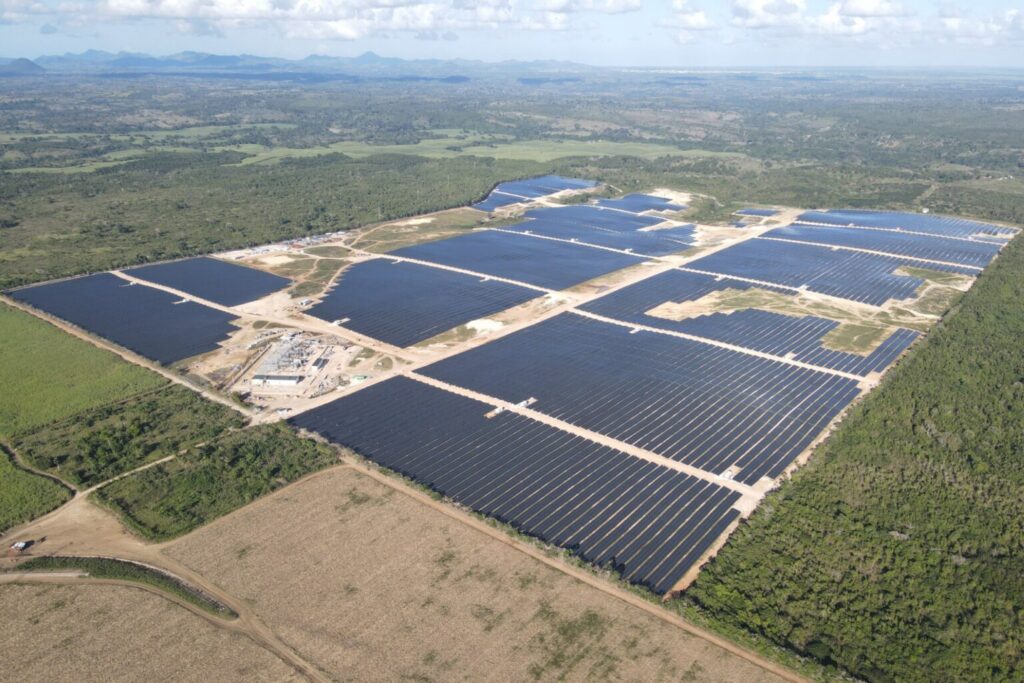
ACCIONA Energía announced on November 3, 2026, plans to add battery energy storage systems to three operating photovoltaic facilities in the Dominican Republic. The developer’s announcement specifies a combined 21.2 MW power rating and 41.7 MWh energy capacity, targeting commissioning in the fourth quarter of 2027. The batteries remain planned rather than operational, unlike the recently inaugurated Habana 220 storage installation in Cuba.
Adding batteries to operating solar infrastructure
The projects will sit alongside Cotoperí Solar, Calabaza I and Pedro Corto, allowing shared use of existing infrastructure. Their photovoltaic nameplate capacities are 162.6 MWp, 58 MWp and 82.7 MWp respectively, totaling 303.3 MWp. The peak direct-current panel rating does not represent continuous output or necessarily the alternating-current interconnection limit. Storage capacity is reported only for the combined portfolio, so individual battery ratings cannot be inferred.
Dividing 41.7 MWh by 21.2 MW gives an aggregate nominal duration of approximately 1.97 hours. At half the combined rated discharge power, the theoretical duration approaches 3.93 hours. Available energy will depend on operating reserves, conversion losses and battery condition. As explained in our Colombian solar and battery economics analysis, storage shifts electricity across time rather than creating additional net energy.
Frequency response and energy scheduling
Battery inverters can adjust active power rapidly to counter short-term differences between electricity supply and consumption. The developer identifies frequency regulation and renewable integration as intended services. It has not published the inverter control mode, site-level dispatch strategy or measured response characteristics for the planned installations. Grid-forming capability should therefore not be assumed. A separate approach to balancing electricity networks is illustrated by the proposed Cyprus interconnector.
Original scientific research on renewable capacity value
A June 2026 Energy Reports study led by René Báez-Santana of Instituto Tecnológico de Santo Domingo used 2023 Dominican electricity-market records to model the economic capacity value of variable renewable generation. The model estimates solar capacity-value fractions of 17.2% in the north and 33.6% in the southwest; corresponding wind estimates are 43.9% and 34.4%. These figures characterize modeled market contributions rather than guaranteed output or measured battery performance. The researchers also released their supporting technical and economic dataset.
Capacity value reflects the contribution of a resource when the system needs dependable power. It differs from capacity factor, which compares actual energy production against continuous operation at rated capacity. A storage installation may improve dispatch flexibility, but its capacity contribution depends on duration, charging availability and the timing of system stress.
The new investment could help address the mismatch between daytime photovoltaic generation and evening demand. Establishing the actual benefit will require measured dispatch and frequency-response records after commissioning, along with operating-cost data. As with the Dominica geothermal development, dependable electricity delivery must be assessed separately from installed nameplate capacity. Featured photograph: existing Cotoperí Solar facility, ACCIONA Energía via pv magazine, December 2025.


Leave a Reply