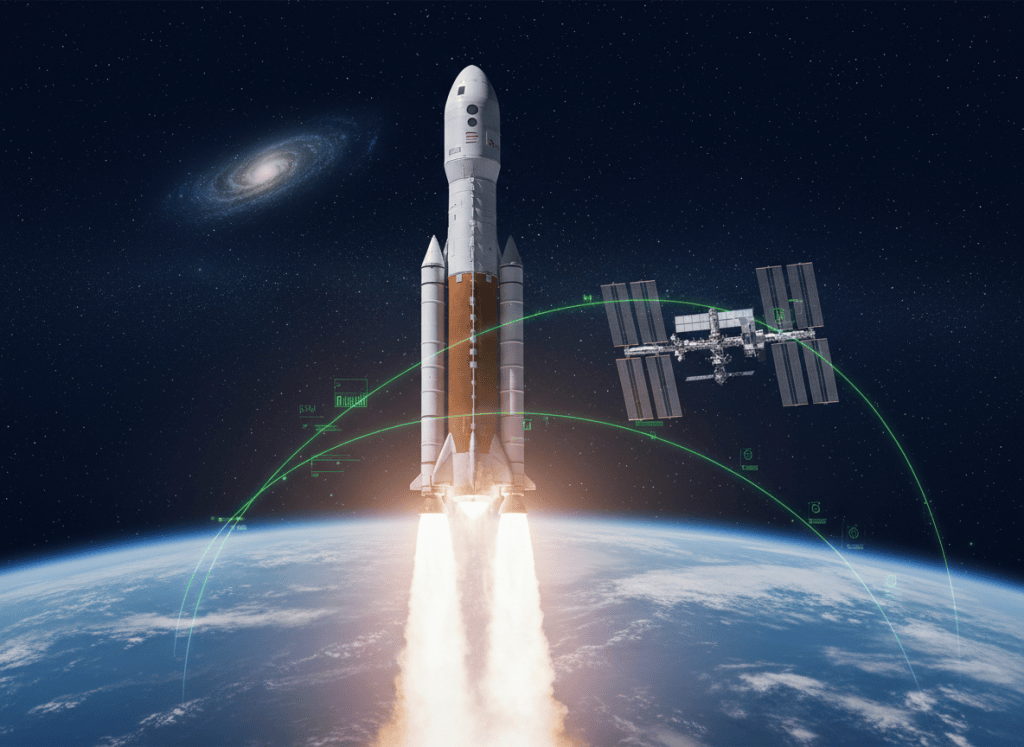
NASA has awarded SpaceX three additional astronaut missions to the International Space Station, extending the company’s Commercial Crew Transportation Capability contract with a $946 million modification covering Crew-15, Crew-16 and Crew-17.
The September 18 NASA award brings SpaceX’s total contracted Commercial Crew missions to 17 and raises the total value of its CCtCap contract to $5.92 billion. NASA describes the modification as firm-fixed-price and indefinite-delivery/indefinite-quantity, with the period of performance running through 2030 and mission readiness dates in 2027 and 2028.
The Contract Covers More Than Launch
The $946 million is not simply a payment for three Falcon 9 launches. NASA says the modification includes ground operations, launch services, in-orbit operations, return and recovery, cargo transportation for each mission and Dragon’s ability to serve as a lifeboat while docked to the station.
That last capability is an important part of crew transportation architecture. A docked crew spacecraft is not only transportation to and from orbit; it also remains available as an emergency return vehicle for astronauts living aboard the station.
SpaceX received NASA certification for crew transportation in November 2020. NASA says Crew-12, the company’s twelfth crew-rotation mission for the agency, is currently docked to the ISS. Meanwhile, Crew-13 preparations are underway for an early October launch.
Falcon 9 and Dragon Remain Central to ISS Access
NASA’s Commercial Crew Program was designed around having more than one U.S. commercial transportation provider. NASA awarded CCtCap contracts to Boeing and SpaceX in 2014 and says the latest SpaceX modification helps maintain access to the station through two commercial crew industry partners.
The additional missions also reinforce how deeply reusable launch infrastructure has become integrated into U.S. space operations. BitcoinVersus.tech recently reported on a separate $1.6 billion Space Force award covering 18 Falcon 9 launches. The NASA agreement is different in mission, customer and contract structure, but both rely on the same broader Falcon 9 launch ecosystem.
Commercial crew missions add another layer of complexity because the system must transport people, support life, autonomously rendezvous and dock with the station, remain attached for an extended expedition and then safely return the crew to Earth. NASA’s Crew-10 mission record shows the basic architecture in operation: Falcon 9 delivers Dragon to orbit, Dragon travels to the ISS, and the spacecraft later returns its crew to Earth.
ISS Transportation Through 2030
The contract period is significant because it extends through 2030, the period in which NASA is preparing for the eventual transition away from the International Space Station toward commercial destinations in low Earth orbit. The new award therefore provides additional transportation capacity during the remaining years of current ISS operations while NASA continues planning for what comes next.
NASA also noted that this sole-source modification does not prevent the agency from seeking additional transportation services later. Crew-15, Crew-16 and Crew-17 should therefore be viewed as confirmed additions to the current mission manifest rather than a final statement on every crew flight NASA may purchase before the station program concludes.
For space infrastructure, the award shows how commercial crew has evolved from a spacecraft-development program into recurring transportation operations. The engineering challenge is no longer only proving that Dragon and Falcon 9 can carry astronauts. It is maintaining a repeatable system of launch preparation, orbital operations, station docking, emergency return capability and recovery across a multi-year mission schedule.
BitcoinVersus.Tech Editor’s Note:
We volunteer daily to ensure the credibility of the information on this platform is Verifiably True. If you would like to support to help further secure the integrity of our research initiatives, please donate here: 3C9o19EH5HSiwEPyCTmEKzxhNCbo2X6TTb
https://x.com/1BitcoinVersus/status/1937006164555993338
BitcoinVersus.tech is not a financial advisor. This media platform reports on financial subjects purely for informational purposes.


Leave a Reply