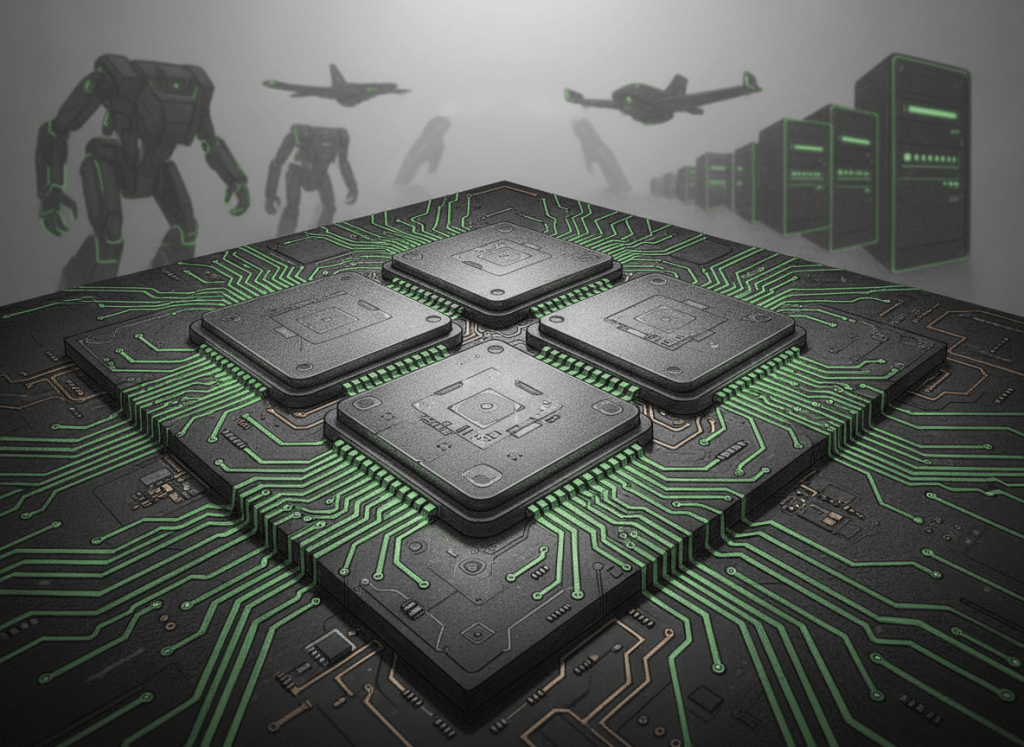
Japanese fabless semiconductor company EdgeCortix has unveiled RAIDEN, a scalable AI chiplet platform aimed at physical AI systems such as robots, autonomous machines, aerospace equipment and high-performance edge servers.
The flagship RAIDEN X4 is architected for up to 3.36 PFLOPS of FP4 AI compute, up to 256 GB of memory, 548 GB/s of memory bandwidth, up to 1.54 TB/s of aggregate die-to-die bandwidth and as much as 6.4 Tb/s of chip-to-chip scale-out connectivity. Those figures are announced specifications rather than independent benchmark results, according to EdgeCortix’s official RAIDEN launch. Independent Japanese semiconductor publication MONOist also reported the 3.36-PFLOPS figure and EdgeCortix’s planned 2027 sampling and production timeline.
Four dies operate as one AI system
RAIDEN scales from a single compute die to the four-die X4 while preserving a common hardware and software environment. Instead of treating four accelerators as isolated devices, EdgeCortix says X4 is designed to operate the dies as a tightly integrated system. The architecture combines the company’s DNA-X accelerator design with its MERA software stack.
The approach fits a broader semiconductor shift toward chiplet and heterogeneous integration. Rather than relying only on a larger monolithic die, designers can scale compute and connectivity across multiple dies inside one package. That can create new engineering tradeoffs involving yield, packaging, thermal density, memory bandwidth and interconnect latency.
RAIDEN targets physical AI outside the data center
EdgeCortix calls its target market the “thick edge,” where high-performance AI runs closer to sensors, machines and operational environments instead of sending every workload to a centralized cloud. The company lists robotics, autonomous systems, smart manufacturing, telecommunications, aerospace and edge AI infrastructure among its intended applications.
That makes power efficiency and memory movement especially important. A robot or industrial machine cannot simply add unlimited accelerator racks. Compute, memory, interconnects and cooling have to fit within a practical electrical and thermal envelope. BitcoinVersus.tech recently examined the same system-level constraints in AI data-center infrastructure, where processors are only one part of a much larger power, memory, networking and cooling system.
Kawasaki Heavy Industries is an early customer
EdgeCortix says RAIDEN already has customer design wins. Kawasaki Heavy Industries has selected RAIDEN-based solutions for multiple next-generation aerospace and defense products, while Unigen is developing RAIDEN-based server platforms. Customer sampling is expected in early 2027, with volume production planned for the second half of 2027.
The announced performance is substantial, but the next meaningful test will come when production silicon reaches customers and independent workloads can measure sustained performance, power consumption, latency and software compatibility. Until then, RAIDEN’s headline numbers should be understood as architectural targets supplied by EdgeCortix.
AI hardware is becoming a system problem
RAIDEN reinforces a trend already visible across the AI semiconductor market. Raw arithmetic throughput matters, but memory capacity, bandwidth, packaging, interconnects, software and power efficiency increasingly determine whether that compute can be used effectively. The same principle appears in rack-scale systems such as the NVIDIA GB200 NVL72, where compute, networking, memory, power and cooling operate as one platform.
For EdgeCortix, the next milestones are customer sampling, detailed X1 and X2 specifications, and production deployments. If RAIDEN reaches its announced targets under real workloads, it would give physical-AI developers another high-performance accelerator architecture built specifically for systems operating beyond the traditional data center.
BitcoinVersus.Tech
Advertisement
Editor’s Note:
We volunteer daily to ensure the credibility of the information on this platform is Verifiably True. If you would like to support our research initiatives, please donate here: 3C9o19EH5HSiwEPyCTmEKzxhNCbo2X6TTb
BitcoinVersus.tech is not a financial advisor. This media platform reports on financial subjects purely for informational purposes.


Leave a Reply