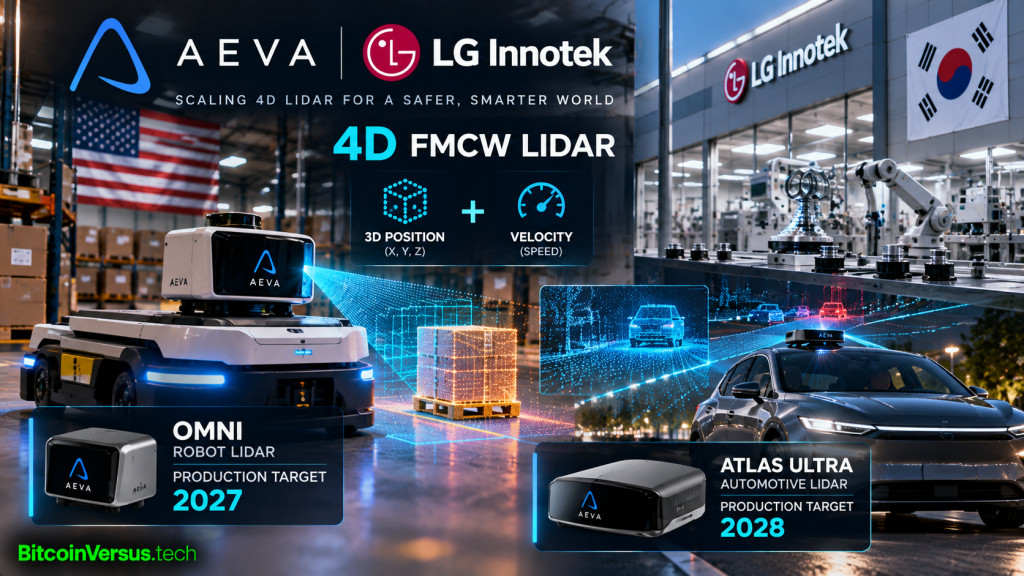
Aeva and LG Innotek are moving their 4D FMCW lidar partnership toward production, with short-range Omni sensors targeted for robot applications in 2027 and Atlas Ultra long-range sensors aimed at automotive production in 2028.
Fresh reporting from South Korea says LG Innotek’s strategic relationship with the U.S. lidar company is proceeding as planned after its investment last year, expanding from equity backing into manufacturing and product collaboration.
Aeva and LG Innotek are pairing chip-scale FMCW lidar with high-volume optical manufacturing for robots and automated vehicles.
Omni targets robot production in 2027
Aeva’s compact Omni sensor is designed for short-range physical-AI applications. The company describes it as a wide-view FMCW 4D lidar capable of measuring an object’s position and velocity rather than only generating a conventional depth map.
According to the latest report, Aeva plans full Omni production next year after customer validation and trial shipments. The sensor measures about 85 millimeters in diameter, with a 360-degree horizontal and 90-degree vertical field of view and detection out to roughly 80 meters.
That geometry is designed for machines working close to people and obstacles, including autonomous mobile robots and automated guided vehicles. It complements the physical-AI hardware BitcoinVersus.tech has recently covered in Trossen and Stereolabs’ robot-learning stack, Ambarella’s 2-to-5-watt X7 physical-AI chip and QBit’s robot-control silicon.
FMCW adds velocity to the point cloud
Traditional time-of-flight lidar measures distance by timing reflected laser pulses. Aeva’s Frequency Modulated Continuous Wave architecture instead uses frequency shifts to measure range and instantaneous velocity simultaneously.
The company says its silicon-photonics CoreVision architecture integrates key lidar elements onto a chip and its custom processing hardware turns the optical measurements into perception data. That combination is intended to shrink sensors while improving manufacturability. citeturn0search3
FMCW lidar gives autonomous systems another dimension of information: how fast detected objects are moving, not only where they are.
Atlas Ultra moves toward automotive production
The partners are also preparing Atlas Ultra, Aeva’s long-range high-resolution automotive lidar, for volume production. The current target is 2028, with LG Innotek handling production and Aeva supplying units into an automotive program.
Aeva says its Atlas platform uses its X1 automotive-grade lidar system-on-chip and CoreVision silicon photonics. Current Atlas specifications include long-range sensing, per-point Doppler velocity and automotive functional-safety design. citeturn0search6
The expansion fits a larger convergence of semiconductors, sensing and robotics. BitcoinVersus.tech has tracked that transition through Cognex’s RealSense acquisition, Qualcomm’s robotics expansion and NEURA and SECO’s physical-AI hardware.
LG Innotek brings manufacturing scale
For Aeva, the value of LG Innotek goes beyond capital. High-volume automotive and robotics sensors require optical assembly, calibration and manufacturing repeatability at a scale very different from laboratory lidar systems.
LG Innotek invested up to $50 million in Aeva last year. The Korean supplier’s manufacturing capabilities are intended to complement Aeva’s lidar-on-chip and signal-processing technology as the partners move from engineering programs toward production.
The U.S.–South Korea partnership joins Aeva’s sensing silicon with LG Innotek’s optical manufacturing base.
Why this matters for physical AI
Robots need reliable perception before they can safely share warehouses, factories and roads with people. Cameras provide rich visual information, but lidar can independently measure geometry, while FMCW lidar adds direct velocity information.
The latest Aeva and LG Innotek production plans therefore matter beyond autonomous cars. Omni pushes the same sensing architecture into warehouse robots and AGVs, while Atlas Ultra targets higher-speed automotive environments.
As physical AI expands, the competitive question will not be only which model makes the best decisions. It will also be which sensor stack can perceive movement accurately, survive real industrial environments and be manufactured economically by the hundreds of thousands.
Advertisement:
Support BitcoinVersus.tech’s independent technology reporting and research.
BitcoinVersus.Tech Editor’s Note & Disclaimer:
We volunteer daily to ensure the credibility of the information on this platform is Verifiably True. BitcoinVersus.tech provides news, technical analysis and educational information and does not provide financial or investment advice. Verify technical specifications and operational requirements with the manufacturer before making purchasing, deployment or investment decisions. If you would like to support to help further secure the integrity of our research initiatives, please donate here: 3C9o19EH5HSiwEPyCTmEKzxhNCbo2X6TTb


Leave a comment