Bitcoin mining firmware is moving beyond static tuning. BitFuFu says its BitFuFuOS system is now being used to intelligently overclock and underclock mining fleets in real time as electricity prices and market conditions change, turning ASIC firmware into part of the power-management layer of a large mining operation.
The disclosure came during BitFuFu’s second-quarter 2026 earnings discussion. Management said the company used the firmware to dynamically manage large-scale energy consumption while maintaining average fleet efficiency around 17.8–18.1 J/TH during the quarter. At its Oklahoma site, optimized curtailment programs helped reduce electricity cost to approximately $0.03 per kWh in June.
Firmware Is Becoming Part of the Power Plant
Traditional ASIC tuning is often described at the machine level: raise frequency for more terahash, reduce voltage or frequency for better efficiency, and keep temperatures inside the operating envelope. BitFuFu’s description pushes that concept to fleet scale. Instead of treating every miner as a fixed electrical load, the operating point can change with the economics of the power feeding the site.
BitFuFuOS advertises configurable overclocking and underclocking modes for Antminer S21, T21, S19 XP, S19k Pro, S19j Pro+, S19j Pro, S19 Pro and S19 machines, along with hydro-cooled S19 XP and S19 Pro+ models. BitFuFu says one operating mode can raise hashrate by roughly 15% while maintaining factory-level J/TH, while another can produce roughly 6% more hashrate at the same power while reducing J/TH by about 6%.
Those are vendor-stated figures rather than guarantees for every machine. More importantly, the company’s own preparation guidance emphasizes the physical limits behind firmware: the PSU must have enough capacity, electrical wiring must support the increased load, and cooling must dissipate the extra heat.
The Electrical Infrastructure Sets the Ceiling
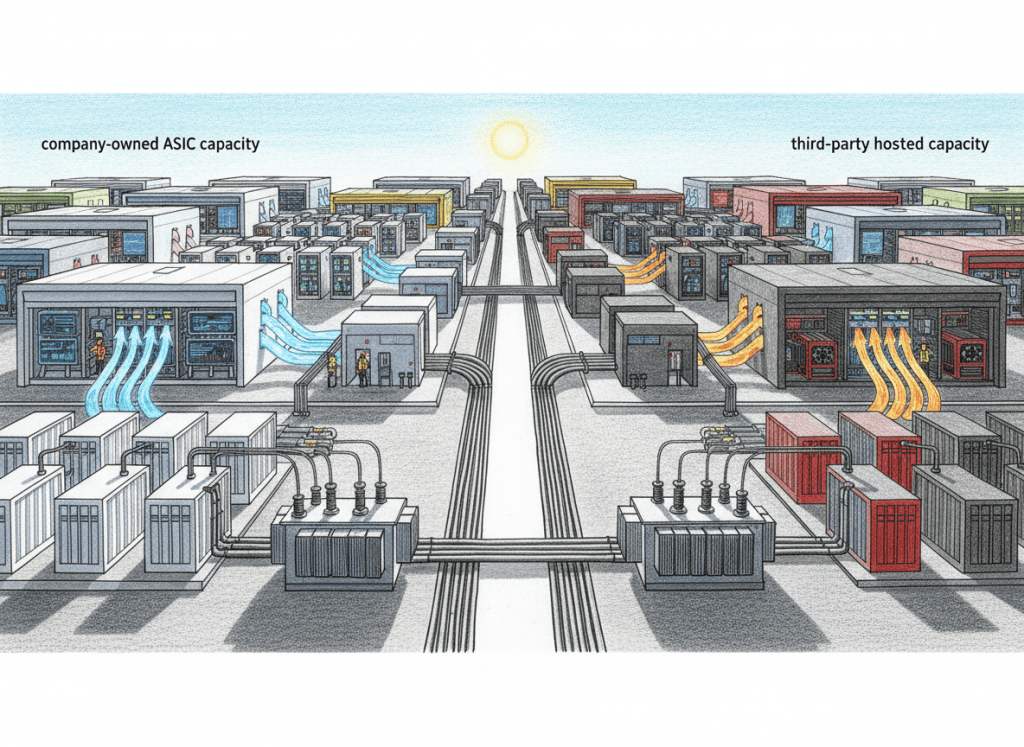
A frequency slider cannot create spare transformer, switchgear, busway, breaker, conductor or cooling capacity. At scale, an overclocking decision therefore becomes an infrastructure decision. If thousands of ASICs simultaneously move to a higher-power profile, the site’s aggregate load can change by megawatts.
This is why the BitFuFuOS disclosure fits a broader shift BitcoinVersus.tech has been tracking. Braiins OS 26.09 added deeper ASIC power and startup diagnostics, while S21-generation hardware is increasingly displacing older S19 fleets. Firmware, power electronics and facility controls are becoming increasingly interconnected parts of mining performance.
Oklahoma Shows the Grid Side of the Strategy
BitFuFu CFO Kala Zhao said the company worked with its Oklahoma power provider on optimized curtailment programs that reduced June electricity cost to approximately $0.03 per kWh. That makes the firmware strategy more interesting than ordinary overclocking: the ASIC operating point can become one variable inside a larger demand-response and energy-cost strategy.
When power is inexpensive and infrastructure has thermal and electrical headroom, a miner can potentially run a more aggressive profile. When power prices rise, curtailment is requested, or cooling margins tighten, the same fleet can move toward a lower-power state. The economic objective is not maximum hashrate every minute; it is productive hashrate at an acceptable marginal cost.
That distinction also helps explain why headline EH/s alone can be misleading. BitcoinVersus.tech previously reported BitFuFu’s expansion beyond 20 EH/s. The company’s August SEC-filed operating update put total managed capacity at 20.6 EH/s and 344 MW, with average fleet efficiency improving to 16.7 J/TH. The new firmware disclosure adds another layer: how that installed compute can be operated as conditions change.
ASIC Tuning Has Facility-Level Consequences
For mining technicians, the practical lesson is that firmware tuning should never be isolated from the hardware around the miner. PSU temperature, input voltage, connector condition, conductor sizing, airflow or coolant flow, ambient conditions and breaker loading all matter when power targets change.
The same system-level thinking applies when hardware is repaired or consolidated. BitcoinVersus.tech recently examined why hashboards cannot always be swapped between apparently similar ASICs. Fleet optimization is increasingly about knowing the exact hardware revision, firmware behavior and electrical envelope of each machine rather than treating a rack as a collection of identical black boxes.
It also changes how operators can think about fleet replacement. Newer ASIC swaps can increase hashrate per physical machine, while dynamic firmware can alter the operating point of equipment already installed. Those are different tools, but both aim to extract more useful computation from constrained electrical infrastructure.
Mining Fleets Are Becoming Controllable Electrical Loads
BitFuFu’s approach points toward a more software-defined mining facility. The ASIC remains specialized SHA-256 hardware, but its electrical behavior is increasingly programmable. A fleet can respond to power price, curtailment signals, cooling capacity and mining economics without physically replacing machines every time conditions change.
That does not eliminate the constraints of transformers, PSUs, hashboards or cooling systems. It makes those constraints more important because software can move the fleet toward them much faster. The next generation of mining operations will be judged not only by how many terahashes they install, but by how precisely they can control the megawatts behind those terahashes.
BitcoinVersus.Tech Editor’s Note
Primary references include BitFuFuOS technical information, BitFuFu’s second-quarter 2026 earnings discussion and the company’s August operating update filed with the U.S. Securities and Exchange Commission.
Support independent technology reporting: BTC donations may be sent to 3C9o19EH5HSiwEPyCTmEKzxhNCbo2X6TTb.
Follow BitcoinVersus.tech on X/Twitter for Bitcoin mining, ASIC hardware, AI infrastructure, semiconductor and data-center reporting.
Disclaimer: BitcoinVersus.tech is not a financial advisor. This media platform reports on financial subjects purely for informational purposes.


Leave a comment