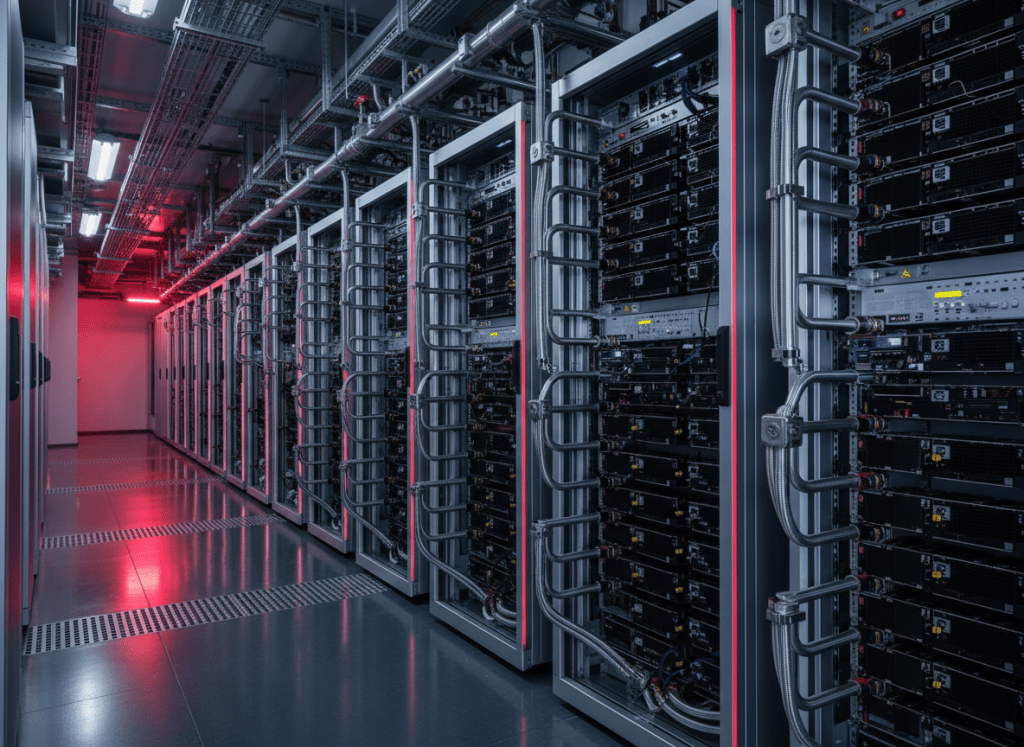
LITEON Technology is moving deeper into the physical infrastructure behind AI computing. The Taiwan-based power-electronics company plans to acquire roughly 25% of Warsaw-based DCX Liquid Cooling Systems in a transaction valued at about $176 million, combining rack-level power delivery with direct liquid cooling for high-density AI and HPC systems.
The company says the transaction is designed to pair its AI server power management, rack-level power delivery and 800 VDC architecture with DCX technologies spanning coolant distribution units, facility distribution units, cold plates and immersion cooling. Independent data-center reporting places the deal at approximately 25% ownership and roughly $176 million, while regional coverage describes the investment as part of LITEON’s attempt to combine power and in-row thermal systems for AI facilities.
Power and Cooling Are Converging at the Rack
AI infrastructure is increasingly forcing electrical and thermal design to be treated as one system. Higher rack densities raise current, busway and conversion challenges at the same time they make air cooling less practical.
BitcoinVersus.tech has been tracking that convergence across the stack. Delta is pairing 800 VDC power with 3 MW cooling systems, while Enphase is building 800 VDC AI power modules in Texas. LITEON’s DCX investment pushes in the same direction, but through an equity relationship with a specialist cooling company.
DCX Brings Megawatt-Scale Liquid Cooling
DCX’s portfolio gives the transaction practical infrastructure depth. Its current product range includes enterprise coolant distribution units rated from hundreds of kilowatts into the multi-megawatt range, facility distribution systems, cold plates, dry coolers and immersion platforms.
The company recently summarized that portfolio in this infrastructure update, showing ECDU systems from 0.6 to 2.6 MW and FDU systems from 5 to 8 MW alongside immersion cooling and dry-cooler options.
Those capacities matter because the AI market is already moving beyond conventional enterprise cooling envelopes. BitcoinVersus.tech recently covered Vertiv’s expansion of AI liquid-cooling services in Europe and Applied Digital’s 210 MW Alabama AI campus, both examples of infrastructure scaling around much denser compute.
A 2.6 MW ECDU Shows the Scale DCX Is Targeting
One current DCX design illustrates the scale more concretely. Its ECDU 1380/2600 H2 is specified for 1.38 to 2.6 MW of cooling capacity with flow rates up to 3,870 liters per minute and N+1 redundancy.
DCX describes that platform in this technical post, giving a more useful picture of what LITEON is buying into than the transaction percentage alone.
Why LITEON Wants Cooling Beside 800 VDC Power
LITEON already sells power shelves, rack-level delivery hardware and high-voltage architectures for AI systems. Taking a strategic position in DCX gives it access to the adjacent thermal layer without having to build every cooling technology internally from scratch.
The strategic logic becomes clearer in LITEON’s own technical presentation. In this English Open Compute Project session, LITEON presents 800 VDC rack infrastructure together with precision cooling for next-generation AI systems, including designs pushing toward hundreds of kilowatts per rack.
The broader industry is heading the same way. onsemi is changing power packaging for denser AI racks, while Wise and Navitas are targeting GaN and SiC power conversion. The common constraint is no longer simply delivering more compute; it is delivering power and removing heat at the same density.
The Deal Is Strategic, Not Full Ownership
The structure matters. LITEON is not acquiring DCX outright. The announced transaction would leave it with approximately 25% equity ownership after closing, giving the companies an incentive to collaborate while DCX remains a distinct specialist business.
LITEON says the partnership will focus on product development, engineering, manufacturing scale-up and global go-to-market work, including integrated power-and-cooling platforms for hyperscale customers. Those plans are forward-looking; the deal announcement does not mean a combined product portfolio has already reached volume deployment.
The signal is still meaningful: as AI racks move toward megawatt-scale infrastructure, the boundary between the power vendor and the cooling vendor is getting thinner. LITEON’s investment in DCX is a direct bet that customers will increasingly want those systems engineered together.
BitcoinVersus.Tech Editor’s Note
Support independent technology reporting: BTC donations may be sent to 3C9o19EH5HSiwEPyCTmEKzxhNCbo2X6TTb.
Follow BitcoinVersus.tech on X/Twitter for AI infrastructure, Bitcoin mining, semiconductor and data-center reporting.
Disclaimer: BitcoinVersus.tech is not a financial advisor. This media platform reports on financial subjects purely for informational purposes.


Leave a Reply