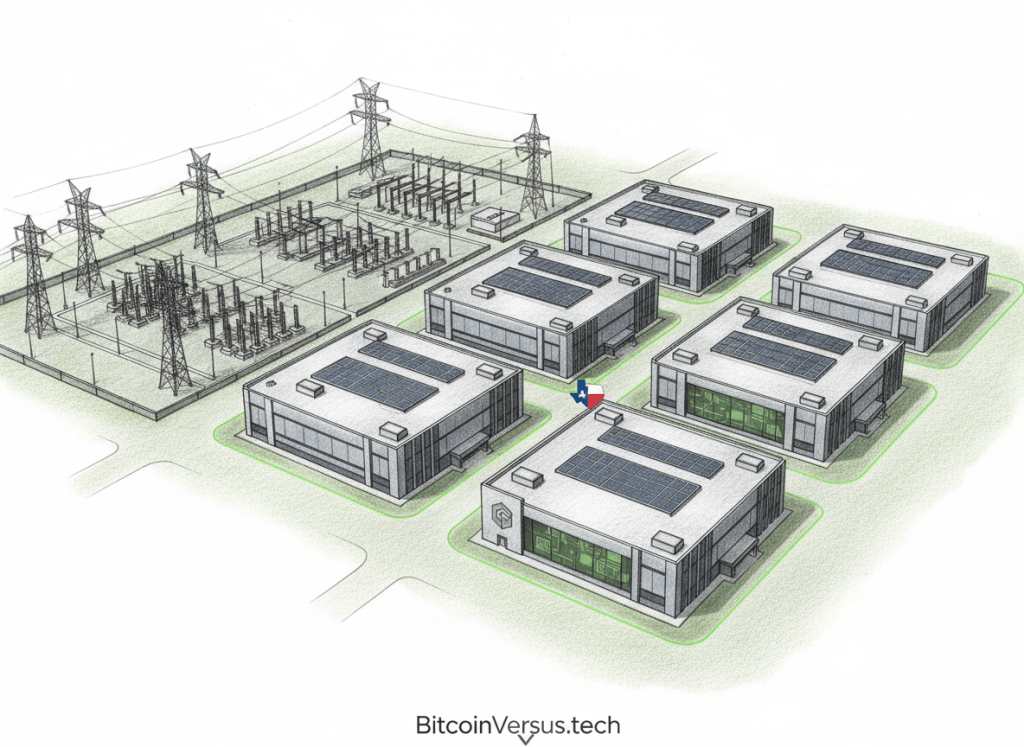
Cipher Digital’s latest grid milestone shows why Bitcoin miners are becoming power-market operators. On September 16, the company disclosed a 3.2-gigawatt conditional position in the Electric Reliability Council of Texas queue, giving its planned data-center expansion a much larger power story than a conventional mining buildout.
3.2 GW is a queue position, not a finished campus
The headline number needs careful reading. Reporting from market coverage separated the conditional capacity into 1.1 GW of base load and 2.1 GW of studied load. The first portion is modeled into ERCOT’s demand outlook. The second still faces technical review, audits and capacity-allocation work before it can be treated as delivered power.
That distinction is important for Bitcoin-mining investors. A queue position can support planning, financing and customer conversations, but it is not the same as energized transformers, commissioned switchgear or a completed interconnection. The company’s reported position creates room for growth while leaving execution risk between the spreadsheet and the rack.
ERCOT’s own control-room explainer helps clarify the operating backdrop: large loads are not abstract megawatts. They are scheduled, balanced and constrained against a live Texas system. For readers who want the grid context before looking at the corporate strategy, the playable video above shows the system-operator side of the equation.
Why Bitcoin infrastructure is valuable to AI
Bitcoin mining sites were built around power access, cooling, fiber, substations and rapid deployment. AI workloads need many of the same physical ingredients, but often demand longer contracts and denser thermal systems. That makes a mining campus valuable even when its original ASIC plan becomes less attractive.
Reuters described the broader shift as a scarcity trade in which electricity and interconnection rights can be more durable assets than computing hardware. The reported analysis placed Cipher Digital alongside Hut 8 and TeraWulf as operators leaning toward powered-shell arrangements, where infrastructure is leased to compute customers rather than filled entirely with company-owned accelerators.
Conditional load can still be strategically useful
Investors also focused on the studied portion’s flexibility. Reporting said 1.4 GW of studied load qualified for ERCOT’s Provisional Controllable Load Resource framework. That status can allow a site to consume requested power ahead of some transmission construction, subject to curtailment and system conditions. In practice, controllability can turn a large data-center customer into a resource that responds when the grid is tight.
The operating model therefore looks different from a fixed industrial plant. A Bitcoin fleet can shut down quickly when hashprice falls or grid conditions change. AI customers may pay more for capacity, but the site still needs a credible plan for backup generation, cooling, transmission timing and customer service. ERCOT’s official system overview describes the market’s scale and role across more than 27 million Texas customers.
Power optionality is becoming the mining moat
BitcoinVersus.tech coverage has followed related parts of the transition, including miners shifting megawatts from ASICs to AI, Luxor’s AI infrastructure expansion, managed hashrate growth and ASIC efficiency in joules per terahash. Cipher’s grid position adds a different measurement: not only how efficiently a machine hashes, but how much flexible power a campus can secure and monetize.
The market commentary around the announcement treated the development as a signal that power optionality is becoming a core mining moat. The qualifier matters. A conditional queue award can strengthen a company’s strategic position, but construction, permitting, financing and customer contracts still decide whether the megawatts become revenue.
Editor’s note and sources
Bitcoin mining and AI infrastructure remain capital-intensive businesses. The figures above are reported facts or reported estimates, not a forecast of investment returns. BitcoinVersus.tech’s donation address for independent reporting is 3C9o19EH5HSiWEPyCTmEKzxhNCbo2X6TTb.
Illustration: BitcoinVersus.Tech. A Texas mining campus, grid-control screens and conditional power paths represent the transition from ASIC capacity to AI infrastructure.
BitcoinVersus.tech on X
Follow BitcoinVersus.tech for original reporting on Bitcoin mining, ASIC efficiency, power markets and industrial compute.
Disclaimer: Educational and editorial content only. Nothing here is investment advice. Math is verifiable; interpretation is experimental. Support independent BitcoinVersus.tech reporting through the site’s published channels.


Leave a Reply