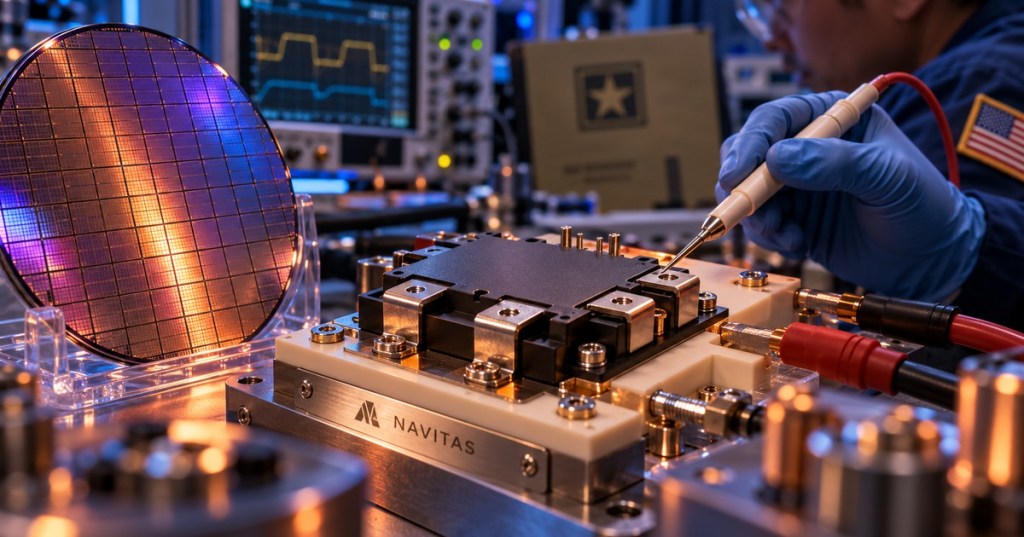
AI-generated conceptual artwork of ultra-high-voltage power-device research, not a photograph of an ALATTIS prototype or an actual Navitas laboratory.
Navitas Semiconductor announced September 28 that it has won the U.S. Army’s ALATTIS program to develop next-generation 10 kV silicon-carbide power devices. According to the company’s release, the award targets a domestic manufacturing process for ultra-high-voltage devices through design, fabrication and testing.
An award for development
ALATTIS stands for Accelerated, Large-Area, 10 kV SiC IGBT. The Army Research Laboratory sponsors the prototype project under the Army’s DEVCOM organization, with support from the Joint Experimentation and Technology Accelerator. The planned work includes silicon-carbide insulated-gate bipolar transistors and associated PiN diodes for military systems.
The announcement describes research and process validation, rather than a completed commercial product launch. Independent coverage from Barron’s also identifies the news as an Army project to develop power-chip technology.
A different branch of the power-chip story
Navitas says its existing GeneSiC power-device portfolio spans 650 V to 6.5 kV. The 10 kV program therefore addresses a different voltage range and device-development objective from the company’s commercial portfolio. Readers can compare the award with our earlier reporting on Navitas’s AI data-center power collaboration.
The distinction is useful when following semiconductor news: a research award, a supply agreement and a product release represent different milestones. Our coverage of power-device packaging for AI racks follows another part of the development chain.
For a related system-level example, see our report on 800 VDC circuit protection. Those rack-level applications should not be treated as interchangeable with an ultra-high-voltage military prototype program.
What to watch next
Editorial assessment: the next meaningful evidence will be manufacturing-process validation, device test results and reliability data. A program award establishes an opportunity to perform the work; it does not by itself establish production yield, commercial availability or a measured efficiency improvement.
For mining operators and data-center technicians, the broader relevance is the continued development of power-conversion hardware. The announcement does not identify a Bitcoin miner deployment or report a reduction in mining J/TH.
BitcoinVersus community promotion
Readers interested in home-mining hardware can inspect our published offer in the original X post below. The promotion is separate from the Navitas news report.
Disclaimer: News and educational content only, not investment advice. Prototype development may change and does not guarantee a commercial product. The footer contains promotional content. The cover is AI-generated conceptual artwork.


Leave a Reply