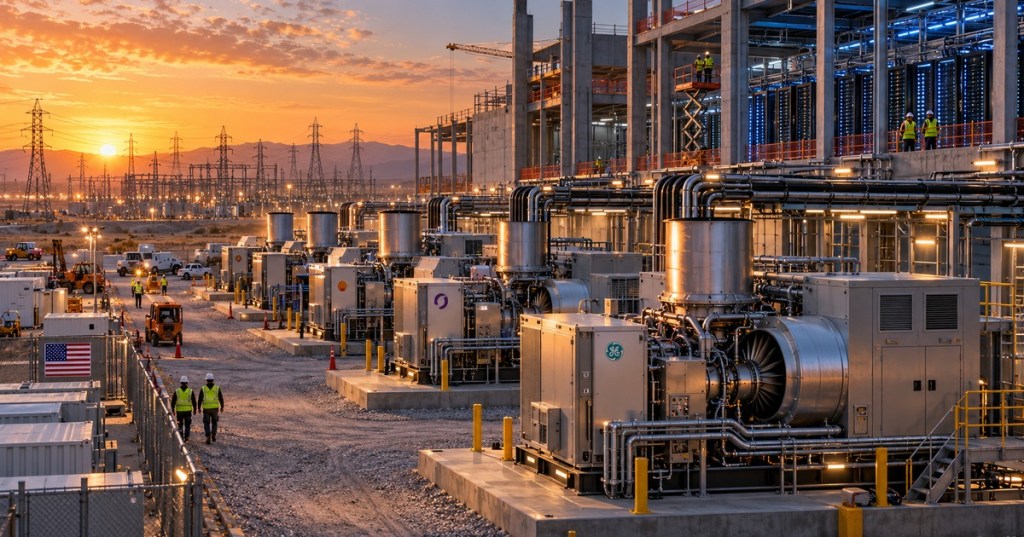
AI-generated conceptual artwork of modular behind-the-meter gas generation beside an unfinished data center; not a photograph of a specific site.
Data-center developers are turning to smaller behind-the-meter gas turbines to get electricity sooner, even though the choice can raise lifetime power costs and emissions. A Reuters report published September 29 cites Enverus Intelligence Research, which expects 29.6 GW of behind-the-meter gas generation to be added in the United States through 2030, with data centers representing roughly 88% of demand.
Speed has become a power-system premium
Large combined-cycle gas plants can take as long as six years to deliver, while smaller frame turbines may arrive within two years and aeroderivative units in about 40 months, according to the report. Smaller systems also let developers add generation in stages as a campus expands.
Crusoe has ordered 29 GE Vernova 35 MW aeroderivative turbines for U.S. data-center projects, including ten for its Abilene, Texas campus. The manufacturer describes its data-center gas-power portfolio as a way to provide fast on-site generation while supporting grid stability.
The cost follows the schedule
The tradeoff is that smaller open-cycle units can carry higher lifetime costs than larger combined-cycle plants. Reuters cited estimates that capital costs per unit of electricity can be up to 50% higher for smaller turbines. Developers are paying for earlier availability, modularity and redundancy while grid connections and large turbine manufacturing remain constrained.
That schedule pressure connects with our coverage of Crusoe’s turbine procurement changes and the broader shift from Bitcoin mining campuses toward AI workloads. Our earlier analysis of Bitcoin mining as flexible power backup explains why dispatchable power has become valuable across both sectors.
Mining operators can also compare the deployment decision with our report on power as a Bitcoin miner’s AI asset. A turbine added for an AI campus may change the economics of nearby mining loads, but the Reuters report does not identify a Bitcoin-mining application for the projects described.
What operators should measure
The meaningful comparison is not turbine size alone. Operators need delivery date, fuel cost, heat rate, emissions controls, maintenance intervals, grid-interconnection timing and the cost of replacing temporary generation with permanent capacity. A fast installation can protect a project schedule while still producing a more expensive megawatt-hour.
Editorial assessment: behind-the-meter turbines are becoming a bridge between urgent AI demand and slow grid construction. Their long-term value depends on whether developers can later use the assets as merchant generation, grid support or a transition system after permanent power arrives.
BitcoinVersus community promotion
Readers exploring home-mining hardware can inspect our published offer in the embedded X post below.
BitcoinVersus.Tech Editor’s Note:
We volunteer daily to ensure the credibility of the information on this platform is Verifiably True. If you would like to support our research initiatives, you can donate here: 3C9o19EH5HSiwEPyCTmEKzxhNCbo2X6TTb
BitcoinVersus.tech is not a financial advisor. This media platform reports on financial subjects purely for informational purposes.


Leave a comment