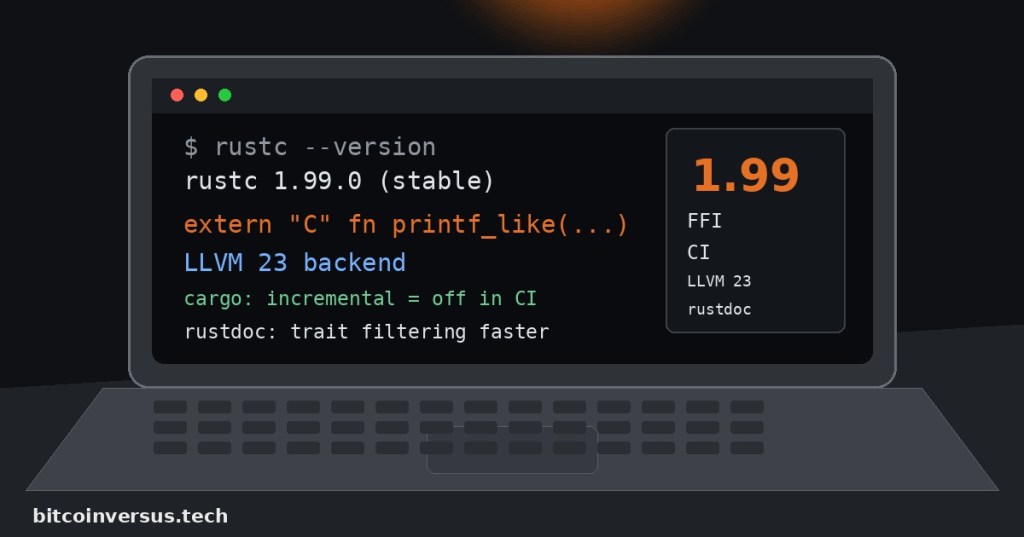
Rust 1.99 has landed with a deceptively important systems-programming upgrade: stable Rust can now define C-compatible variadic functions, while Cargo also changes how it behaves inside continuous-integration environments.
The release pushes Rust further into the territory where C has historically dominated—FFI boundaries, low-level libraries, operating-system interfaces and performance-sensitive tooling—without changing the language’s broader safety model.
Stable Rust can now define C-style variadic functions
According to the official Rust 1.99 release announcement, stable Rust now supports defining variadic functions using the extern "C" and extern "C-unwind" ABIs. That means Rust can directly implement functions that accept a variable number of arguments—the same broad calling pattern behind classic C interfaces such as printf.
This is especially relevant when Rust has to sit on the other side of an existing C ABI instead of merely calling into one. The change makes certain interoperability layers easier to implement without dropping back to C or relying on unstable compiler features.
That interoperability story connects directly with BitcoinVersus.Tech’s recent report on GitHub rewriting Copilot’s shared runtime in Rust. The larger Rust becomes in production infrastructure, the more often it has to coexist with legacy C, C++, operating-system and runtime boundaries rather than live in a clean-room Rust-only environment.
Cargo now recognizes clean CI builds differently
Rust 1.99 also changes Cargo’s default behavior when it detects a continuous-integration environment. Incremental compilation is now disabled by default in CI, where build directories are often short-lived and the incremental cache may never be reused.
RustRover, JetBrains’ Rust IDE, highlighted that behavior change in a specific X post about Rust 1.99, noting that disabling incremental compilation can save both time and storage in clean CI jobs.
LLVM 23 moves underneath the compiler
An independent technical breakdown of the release also notes that Rust 1.99 moves its main code-generation backend to LLVM 23. That matters because LLVM is the layer that turns much of Rust’s optimized intermediate representation into machine code across supported architectures.
Compiler-backend upgrades are rarely flashy, but they affect instruction selection, optimization quality, target support and the toolchain behavior developers eventually see in production binaries.
Rustdoc gets materially faster in a common path
Rust 1.99 also improves rustdoc performance when filtering trait implementations. The reported average improvement is around 20%, with some crates seeing substantially larger gains. That is a quality-of-life change rather than a language redesign, but documentation generation is part of the daily workflow for large Rust projects and CI pipelines.
The release arrives while Rust is also spreading into Linux user space. BitcoinVersus.Tech recently covered Ubuntu 26.10 completing its move to Rust Coreutils, putting Rust implementations behind foundational command-line tools in a mainstream Linux distribution.
Why 1.99 matters more than its version number suggests
Rust 1.99 is not a dramatic syntax release. Its importance is that several rough edges around real-world systems deployment are getting smaller at once: stronger C interoperability, more sensible CI defaults, a newer LLVM backend and faster documentation tooling.
That is the same long-term pattern behind programming-language evolution more broadly. BitcoinVersus.Tech’s overview of how programming languages moved from assembly toward higher-level abstractions shows that languages rarely win by replacing every lower-level layer. They win by making more of the difficult work safer and easier while still interfacing with what came before.
Rust 1.99 pushes in exactly that direction. It gives developers a little more reach into C-style systems interfaces while making the modern build and documentation pipeline less wasteful around the edges.
BitcoinVersus.Tech
Advertisement
Editor’s Note
We volunteer daily to ensure the credibility of the information on this platform is Verifiably True. If you would like to support to help further secure the integrity of our research initiatives, please donate here: 3C9o19EH5HSiwEPyCTmEKzxhNCbo2X6TTb
BitcoinVersus.tech is not a financial advisor. This media platform reports on financial subjects purely for informational purposes.


Leave a comment