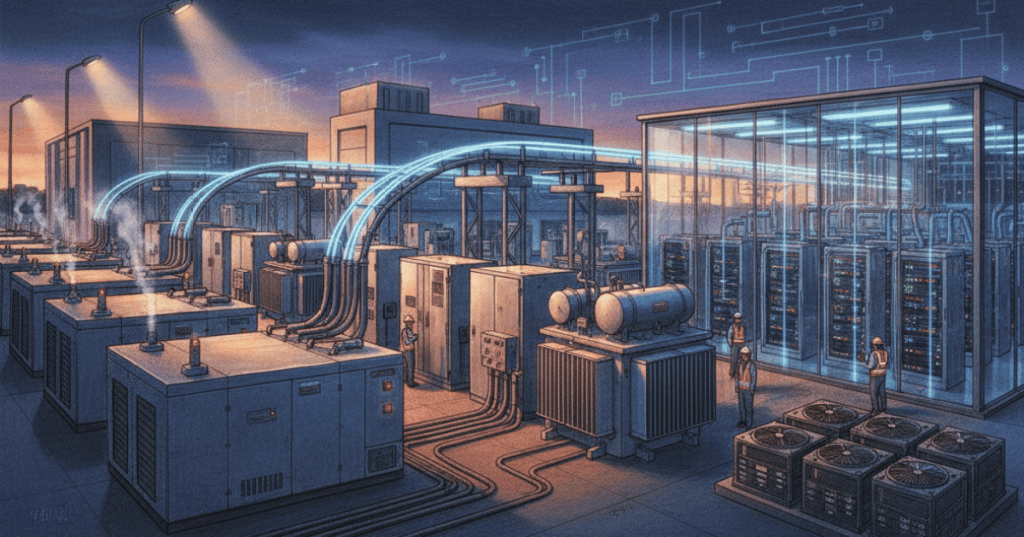
Three infrastructure companies are trying to collapse one of the biggest bottlenecks in the AI buildout: the distance between finding power and actually energizing a data center. Schneider Electric, Wärtsilä and Stanley Consultants have launched a coordinated “Generator-to-Chip” approach that links onsite generation, electrical distribution, automation, engineering and project execution as one system rather than a sequence of separate contracts.
Schneider Electric’s September 30 announcement says the architecture is aimed at U.S. data-center developers that need scalable capacity faster than traditional grid and construction timelines can often deliver. The system is designed around the AI load first, then coordinates generation, switchgear, distribution, digital monitoring and the IT load from the beginning.
Power has become the schedule
The most important part of the announcement is not a single generator, breaker or software platform. It is the decision to treat the entire electrical path as one delivery problem. AI data centers are increasingly constrained by interconnection queues, transformer lead times, permitting, construction sequencing and the difficulty of coordinating equipment that traditionally comes from different vendors at different stages.
BitcoinVersus.Tech recently covered Enerflex’s 450 MW contract for behind-the-meter gas generation, another sign that operators are no longer assuming the utility grid will always arrive first. The new Schneider-Wärtsilä-Stanley model pushes that trend further by integrating the generation source directly with the electrical and engineering stack that sits downstream.
What each company brings to the system
Wärtsilä is supplying the modular engine power-plant side of the architecture. Those plants can be deployed as onsite generation, started rapidly and expanded as load grows. Schneider Electric is responsible for the integrated electrical architecture, automation and digital power-management layer that connects generation to the AI load. Stanley Consultants adds engineering, permitting, construction management, commissioning oversight and climate-resilience work across the project lifecycle.
That division of labor matters because the critical interfaces are where large projects frequently lose time. A generator plant can be ready before downstream switchgear. A substation can be designed around assumptions that change when rack density changes. Commissioning can stall when protection, controls and monitoring systems are not aligned early enough. The Generator-to-Chip concept attempts to remove those handoffs before they become schedule problems.
The companies say the same architecture can support grid-connected, islanded and hybrid configurations. That gives developers room to start with onsite generation, operate independently where needed, or integrate with the grid as transmission and utility capacity become available.
The transformer bottleneck does not disappear
Integrated delivery can reduce coordination delays, but it cannot manufacture missing equipment. The U.S. electrical supply chain is still under pressure from long lead times for transformers, switchgear and other high-voltage components. BitcoinVersus.Tech recently examined Hitachi Energy’s $528 million Mississippi transformer-factory expansion, which is aimed directly at a shortage that has become a data-center construction issue as much as a utility issue.
Generator-to-Chip therefore works best as a scheduling and integration strategy, not a claim that physical supply constraints have vanished. The advantage is that generation, electrical gear, controls and engineering can be planned around the same load model instead of being stitched together late in the project.
AI racks are forcing power architecture to move closer to compute
The shift is also being driven by rack density. Modern AI clusters are pushing power requirements far beyond the patterns that shaped older enterprise data centers. Schneider has been publicly discussing grid-to-chip and chip-to-chiller architectures as operators prepare for hundreds of kilowatts per rack and, eventually, megawatt-class rack designs.
Data Center Dynamics has highlighted the same macro-grid pressure: large AI campuses increasingly need dedicated generation, storage, UPS systems, switchgear and controls that can operate independently or alongside the grid because traditional interconnection timelines are often slower than compute deployment schedules.
The grid still matters — but operators want options before it arrives
The broader policy fight is not going away. Utilities and regulators still have to decide who pays for transmission upgrades and how large loads should be connected without shifting disproportionate costs onto other customers. BitcoinVersus.Tech’s coverage of FERC’s delay of PJM’s 6.8 GW backstop over data-center cost rules shows how quickly the AI power race has become a regulatory issue as well as an engineering issue.
That is why onsite power is becoming strategically important. A developer that can energize part of a campus before a full grid interconnection is complete gains flexibility over construction sequencing, commissioning and revenue timing. A system that is engineered from the generator through the rack can also reduce the risk that one vendor’s assumptions collide with another vendor’s equipment late in the build.
Generator-to-Chip is really a delivery-model bet
The new partnership is not introducing one revolutionary component. It is betting that the next competitive advantage in AI infrastructure will come from coordinating ordinary but mission-critical systems earlier and more tightly.
If that model works, the payoff is measured in fewer design handoffs, faster commissioning and less time between securing a site and putting GPUs to work. In a market where billion-dollar compute clusters can sit idle while they wait for power infrastructure, shaving months from electrical delivery can be as valuable as another generation of faster chips.
BitcoinVersus.Tech
Advertisement
Editor’s Note
If you value independent technology reporting, consider supporting BitcoinVersus.Tech with a Bitcoin donation: 3C9o19EH5HSiwEPyCTmEKzxhNCbo2X6TTb
BitcoinVersus.tech is not a financial advisor. This media platform reports on financial subjects purely for informational purposes.


Leave a comment