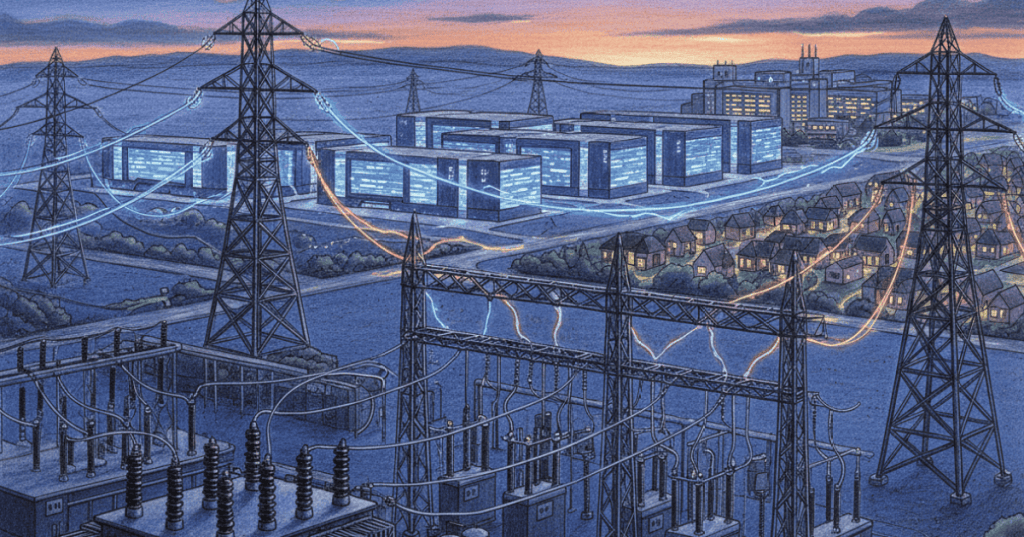
Federal regulators have delayed PJM Interconnection’s emergency plan to secure new electricity supply, telling the nation’s largest grid operator to do more to ensure that the customers driving new demand—including data centers—bear the costs created by that growth.
The decision lands directly in the middle of the AI infrastructure buildout. PJM serves about 67 million people across 13 states and Washington, D.C., including Northern Virginia’s enormous concentration of data centers. Electricity demand is now rising faster than new generation can connect, leaving the region with a capacity shortfall of more than 6.8 GW.
FERC accepted the backstop idea—but not the cost structure
Reuters reported September 30 that the Federal Energy Regulatory Commission partially approved PJM’s one-time Reliability Backstop Procurement, but suspended the program for five months while opening further proceedings on cost allocation and other provisions.
The backstop is designed to bring new power supply onto the grid after PJM’s latest capacity process exposed a 6,831 MW resource-adequacy shortfall. Instead of letting the procurement begin as planned, FERC pushed its effective date to February 28, 2027, subject to the outcome of the additional proceedings.
The key question is who caused the new cost
In her official concurrence, FERC Commissioner Lindsay See said PJM needs more generation but did not adequately ensure that the procurement costs would be assigned to the customers driving the need for it.
That distinction matters. A grid can need new power because total demand is rising, but the financing question is separate: should the cost be spread across existing households, hospitals, manufacturers and businesses, or concentrated more heavily on the large new loads that triggered the expansion?
Load forecasting is becoming an infrastructure problem of its own
FERC also told PJM to improve the way it forecasts data-center electricity demand. The challenge is that grid operators can receive enormous connection requests for projects that are still speculative, duplicated across possible sites or years away from construction.
That can distort planning in both directions. Underestimate real demand and generation arrives too late. Overestimate speculative demand and utilities can build expensive infrastructure that existing customers may ultimately be asked to support.
BitcoinVersus.Tech recently examined the same cost-allocation issue from another angle when Google’s Michigan data-center power agreement added explicit ratepayer guardrails. The common theme is becoming clearer: speed-to-power is no longer only an engineering problem. It is a question of who financially guarantees the infrastructure required to deliver that power.
AI demand keeps pushing the physical grid harder
The pressure is not likely to disappear if compute becomes cheaper. Our analysis of why lower AI costs could drive data-center electricity demand even higher shows how efficiency gains can expand total usage instead of automatically reducing energy consumption.
At the supply end, large technology companies are increasingly trying to secure generation directly. Amazon’s 20-year nuclear agreement supporting a 190 MW uprate at Calvert Cliffs is one example of hyperscale demand becoming tied directly to new or expanded firm generation.
What happens next
PJM must revise the backstop framework and address FERC’s remaining concerns before the procurement can move ahead. The regulator has signaled that it views additional generation as urgent, not optional; the dispute is over how the program is structured and how its costs are allocated.
For data-center developers, the direction is significant. The grid is moving toward a model in which large new loads may need to carry more of the financial responsibility for the capacity and infrastructure required to serve them. For existing ratepayers, that could determine whether the AI power buildout appears mainly as new infrastructure—or as a larger line item on the monthly electric bill.
BitcoinVersus.Tech
Advertisement
Editor’s Note
We volunteer daily to ensure the credibility of the information on this platform is Verifiably True. If you would like to support to help further secure the integrity of our research initiatives, please donate here: 3C9o19EH5HSiwEPyCTmEKzxhNCbo2X6TTb
BitcoinVersus.tech is not a financial advisor. This media platform reports on financial subjects purely for informational purposes.


Leave a Reply