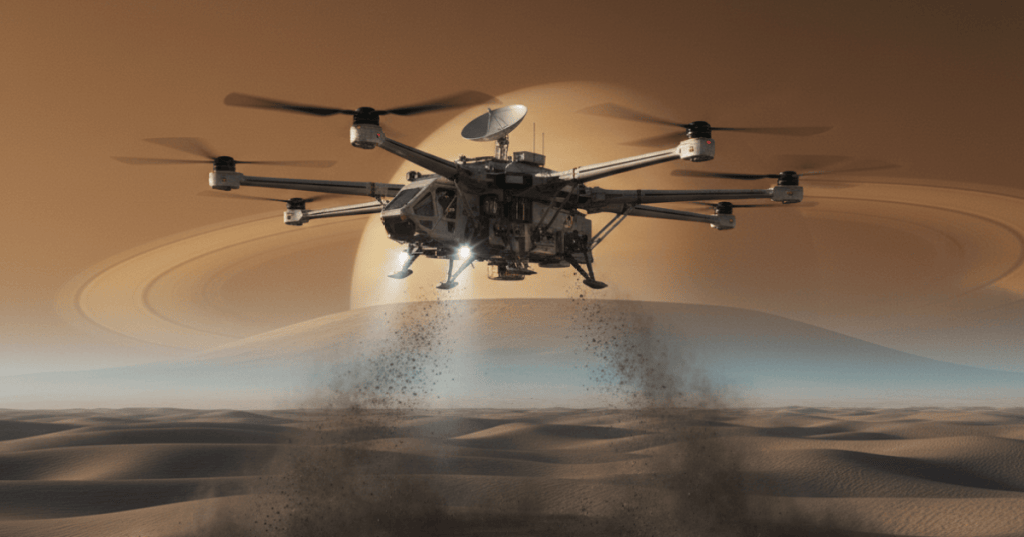
NASA’s Dragonfly mission now has a named destination on Saturn’s moon Titan. The International Astronomical Union has approved Ahmakiq Undae for the large dune field where Dragonfly will land, giving the Titan rotorcraft’s target region an official place name as spacecraft integration continues. NASA’s September 2 Dragonfly update also shows engineers installing the mission’s electrical harness inside the rotorcraft lander.
That makes this a two-part milestone. Dragonfly’s science map is becoming more specific, and its flight hardware is becoming more complete. The named region lies in Titan’s equatorial dune fields south of Selk Crater, where Dragonfly is expected to investigate organic-rich dunes and impact-related deposits that may preserve clues about prebiotic chemistry.
The Register framed the update around the spacecraft’s wiring and destination: the rotorcraft’s harness includes thousands of feet of conductor wire and hundreds of connectors, while the newly named landing area points to the mission’s first major field site on Titan.
Why Ahmakiq Undae Matters
Ahmakiq Undae is not just a label on a map. NASA says the region spans roughly 500 miles across Titan’s equatorial dunes and borders Selk Crater, an impact site about 50 miles wide. Selk is important because impact heating may once have melted Titan’s icy crust, producing temporary liquid-water environments where complex organics and water could have existed together.
The name also fits Titan’s environment. “Undae” is the planetary-science term for dune fields, and Ahmakiq comes from a Mayan wind spirit. That is appropriate for a moon where dunes, haze, hydrocarbons and thick atmosphere shape the landscape that Dragonfly will have to fly through and land on repeatedly.
The Dragonfly story also connects to broader spaceflight infrastructure coverage on BitcoinVersus.Tech. NASA is expanding the launch side of its exploration menu, including Blue Origin’s New Glenn 9×4 entry into NASA’s launch-services catalog. At the science end, NASA is sharpening where future robotic missions will go and what they will measure.
Dragonfly Is Becoming Real Hardware
The harness installation matters because the electrical harness is the spacecraft’s internal nervous system. It routes power and data between computers, sensors, actuators, science instruments and the battery. On Titan, that system has to work inside a lander built to retain heat from a nuclear power source while operating in extremely cold conditions.
That engineering challenge is very different from Mars rover operations. BitcoinVersus.Tech just covered Perseverance finding three ancient water episodes in Jezero Crater, but Dragonfly will explore a colder world where methane and ethane replace liquid water at the surface and a dense nitrogen atmosphere makes rotorcraft flight practical.
The wider Mars-and-outer-planets question is not only where missions go, but how they communicate and operate once they get there. That is why NASA’s Mars telecommunications network work matters alongside Dragonfly: future planetary exploration depends on vehicles, landing sites, energy systems and communications architecture all maturing together.
Dragonfly is scheduled to launch in summer 2028 and reach Titan in late 2034. If it stays on track, Ahmakiq Undae will become the first stop for a flying laboratory built to hop across one of the most chemically complex worlds in the solar system.
BitcoinVersus.Tech
Advertisement
Editor’s Note
We volunteer daily to ensure the credibility of the information on this platform is Verifiably True. If you would like to support to help further secure the integrity of our research initiatives, please donate here: 3C9o19EH5HSiwEPyCTmEKzxhNCbo2X6TTb
BitcoinVersus.tech is not a financial advisor. This media platform reports on financial subjects purely for informational purposes.


Leave a Reply