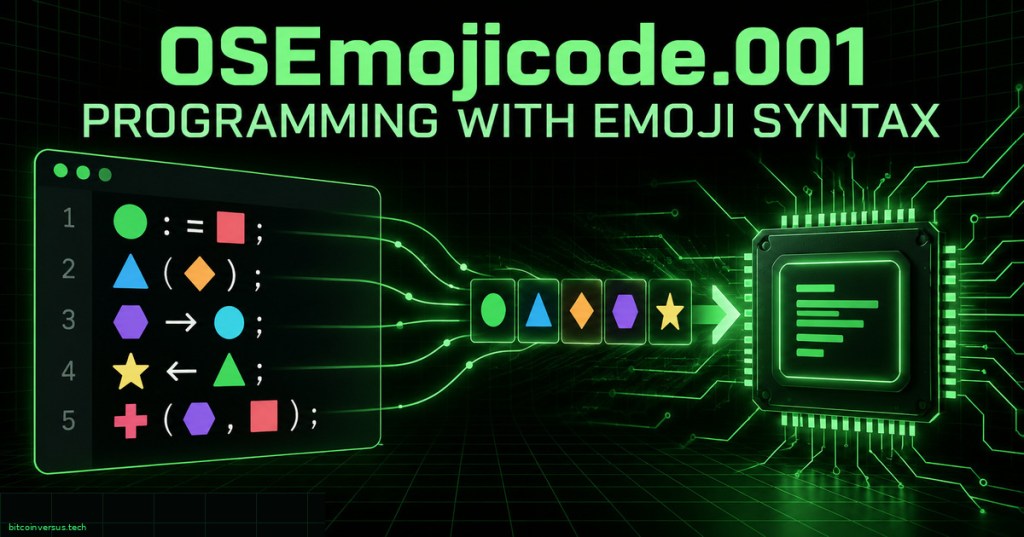
Elementary overview: Emojicode is a real open-source programming language whose syntax uses emoji tokens for many of the jobs that words and punctuation perform in more conventional languages. Underneath the unusual appearance, the ideas are familiar: a program has an entry point, blocks have beginnings and endings, values have types, functions perform work, and instructions execute in a defined order. The official Emojicode project describes it as a full programming language rather than a joke notation, and its reference documentation treats the language as strongly typed. For broader context, compare this with our history of programming languages, where radically different syntax still maps to the same basic need to represent data and computation.
Read the Hello World as Ordinary Program Structure
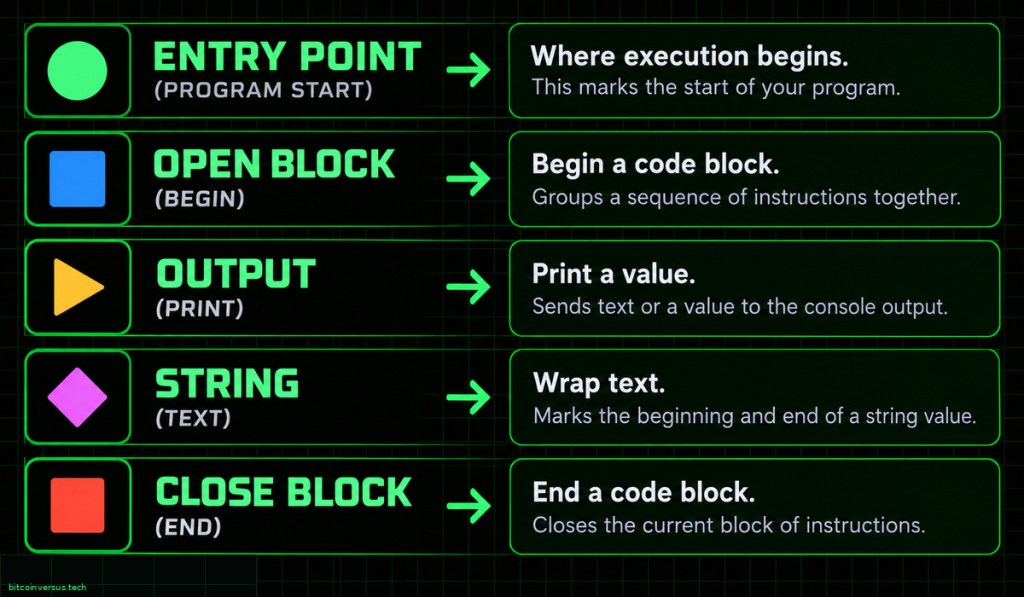
The official basics documentation makes the first program easier to read once the symbols are translated. 🏁 marks the program entry point, 🍇 opens the block, 😀 performs output, 🔤...🔤 encloses a string, and 🍉 closes the block. In other words, the visual vocabulary is unusual but the structure is not. That is similar to the lesson behind Chef and the Shakespeare Programming Language: syntax can look radically different while still representing state, operations, control flow, and input/output.
🏁 🍇
  😀 🔤Hello World!🔤❗️
🍉Five Symbols to Recognize First
- 🏁 — entry point: where execution of the program begins.
- 🍇 — open block: begins a block of executable statements.
- 🍉 — close block: ends that block.
- 😀 — output: used in the introductory example to print a value.
- 🔤…🔤 — string: surrounds text data such as
Hello World!.
What Makes Emojicode a Real Programming Language
- Strong typing: values and operations are governed by a type system rather than being arbitrary emoji sequences.
- Functions and methods: programs can organize reusable behavior instead of only executing one flat list of commands.
- Classes, value types, optionals, generics, and closures: the language supports concepts found in modern general-purpose languages.
- Packages: code can be organized and reused through the language’s package system.
- Native compilation: the project is designed to compile programs rather than merely display emoji as decorative source text.
- UTF-8 source: the official documentation uses UTF-8 source files and recognizes
.🍇and.emojicfilename extensions.
First Reading Exercise
🏁 🍇
  😀 🔤BitcoinVersus.Tech🔤❗️
🍉- Identify the entry-point token.
- Identify where the executable block begins and ends.
- Identify the output instruction.
- Identify the string value.
- Change only the string contents and predict what the program should print.
- Explain why changing the displayed text does not change the overall program structure.
Knowledge Check + Answers
- Is Emojicode only a joke or visual encoding? No. It is an open-source programming language with a defined syntax, type system, compiler, and standard programming constructs.
- What does 🏁 represent in the introductory program? The entry point.
- What do 🍇 and 🍉 do? They open and close a block.
- What surrounds a string in the introductory syntax? The 🔤 delimiter.
- What is the central lesson of the first program? Unusual syntax can still express ordinary programming structure.
Primary Technical References
- Emojicode — Official Project
- Emojicode Reference — Welcome
- Emojicode Reference — Basics
- Emojicode Reference — Syntax
- Emojicode — Official GitHub Repository
Next Lesson
Next in the Emojicode track: OSEmojicode.002 — Variables and Basic Values. That lesson will keep the scope narrow: declaring values, recognizing basic data types, and reading simple variable usage before moving into functions or object-oriented features.
BitcoinVersus.Tech
Editor’s Note: This lesson is educational and follows the official Emojicode language documentation for its introductory syntax.
We volunteer daily to improve the credibility of the information on this platform. If you would like to support the research, please donate here: 3C9o19EH5HSiwEPyCTmEKzxhNCbo2X6TTb
BitcoinVersus.tech is not a financial advisor. This media platform reports on technical and financial subjects purely for informational purposes.


Leave a comment