
Bitcoin’s mining network is pressing back toward the 1 zettahash-per-second line even as miner revenue remains tight. At the time of publication on October 9, Hashrate Index’s live network dashboard showed a 7-day estimated hashrate of 997.03 EH/s, current difficulty of 132.72T, spot hashprice of $39.14 per PH/s/day, and an estimated +4.83% difficulty adjustment around October 16.
That combination matters because rising network hashrate and a higher difficulty target increase competition for the same block subsidy, while a sub-$40 hashprice leaves inefficient machines with little room for expensive electricity or site overhead.
Bitcoin Is Back at the Edge of 1 ZH/s
One zettahash per second equals 1,000 exahashes per second. A 997.03 EH/s 7-day estimate therefore puts Bitcoin only about 3 EH/s below that round-number threshold on the rolling network estimate.
This should not be read as a literal machine counter. Network hashrate is inferred from how quickly miners find blocks relative to difficulty, so short-term estimates move with statistical luck as well as real machines turning on and off. That is also why today’s rolling estimate can sit well above the roughly 941 EH/s end-of-quarter figure in Hashrate Index’s October 5 global heatmap update.
The distinction matters because BitcoinVersus recently covered the geographic picture behind that quarterly estimate: global hashrate held near 941 EH/s while U.S. share fell and Russia gained. The live network number answers a different question: how much SHA-256 work the network appears to be producing now.
Difficulty Is Pointing Higher Again
Bitcoin’s current difficulty is about 132.72 trillion. Hashrate Index’s live estimate currently points to a roughly 4.83% increase at the next adjustment, although that forecast will keep changing until the 2,016-block epoch ends.
Difficulty is Bitcoin’s automatic balancing mechanism. Faster-than-target block production pushes the next adjustment upward; slower block production pushes it downward. BitcoinVersus covered the current difficulty regime when difficulty reached roughly 132.76T in September. A renewed increase would reinforce the pressure on marginal machines even if Bitcoin’s dollar price stays unchanged.
Hashprice Near $39 Keeps Efficiency in Control
Hashprice converts the network’s economics into a simple revenue rate per unit of compute. At $39.14 per PH/s/day, one terahash per second is grossing about $0.03914 per day before pool fees and operating costs.
That makes joules per terahash decisive. Using the current hashprice, the gross electricity-only break-even rate is approximately 18.3¢/kWh at 8.9 J/TH, 12.1¢ at 13.5 J/TH, 9.3¢ at 17.5 J/TH, 7.6¢ at 21.5 J/TH, 6.5¢ at 25 J/TH, and only 4.8¢ at 34 J/TH.
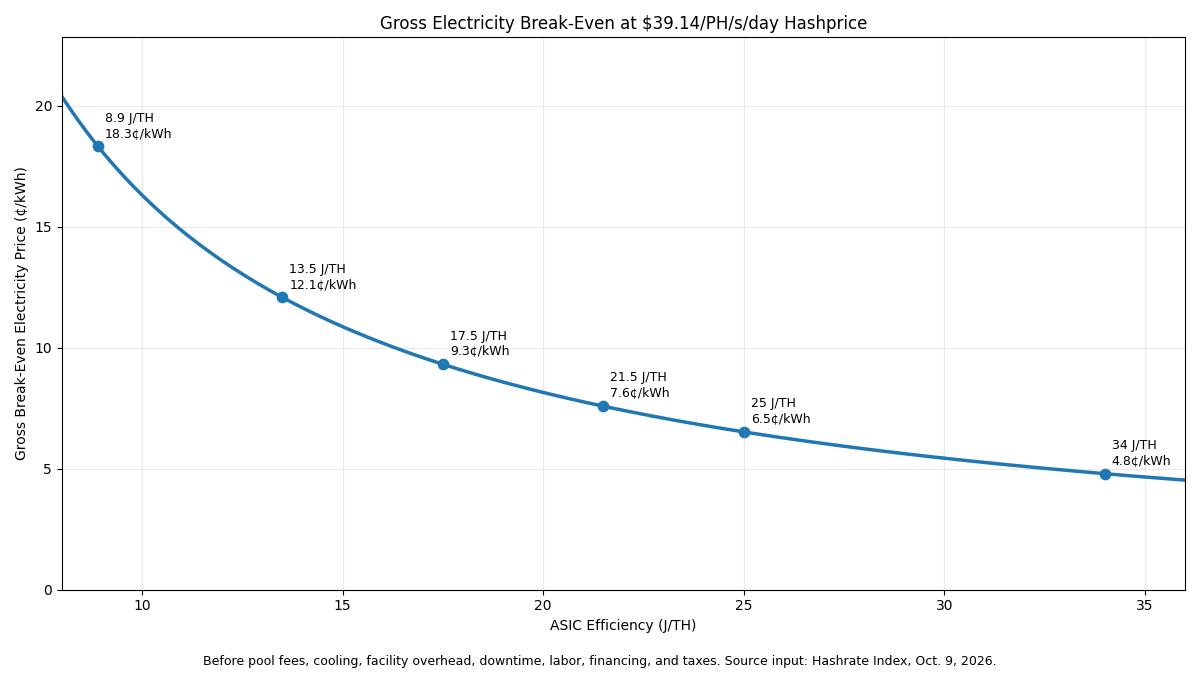
Those are not profit margins. They are only the theoretical electricity ceiling before every other expense at the mine. Real facilities need additional margin for cooling, transformers, networking, labor, repairs, pool fees, downtime and capital costs. BitcoinVersus has also shown why an ASIC’s nameplate J/TH is not the same as a site’s total J/TH.
Idle ASIC Capacity Is the Wild Card
The network can regain hashrate faster than a greenfield mine can be built because some machines and powered racks already exist. BitcoinVersus recently covered an estimate that roughly 235 EH/s of ASIC capacity was sitting idle. If economics improve enough, part of that fleet can return without waiting for a new substation, data hall or ASIC generation.
The reverse is also true. If difficulty rises faster than Bitcoin price and fees, older machines can disappear quickly. That self-balancing loop is why a near-1 ZH/s hashrate reading is impressive for network security without automatically meaning the mining business has become easy again.
Watch Hashrate, Difficulty, and Hashprice Together
Looking at any one mining metric in isolation can be misleading. Hashrate measures the network’s estimated compute, difficulty determines how hard miners must work for blocks, and hashprice measures the revenue attached to that compute. The useful signal is how all three move together.
What Comes Next
The next checkpoint is the estimated October 16 difficulty adjustment. If the current pace holds, miners could enter the next epoch with higher difficulty while hashprice remains around the high-$30s. If hashrate stays near or above 1 ZH/s after the adjustment rather than merely touching the level during a lucky stretch of blocks, that would be a stronger sign that meaningful SHA-256 capacity has returned to production.
For operators, the immediate question remains brutally practical: not whether the network can produce a zettahash, but whether each machine can produce that hashrate cheaply enough to stay plugged in.


Leave a Reply