
By Jules Porter | October 10, 2026
One year after crypto’s $19 billion liquidation shock, Bitcoin’s market plumbing looks stronger than it did before the crash. New market-depth data show more capital sitting in Bitcoin’s order book near the current price, even though overall spot trading activity remains far below the frenzy of October 2025.
The split matters. A market can trade less frequently while still becoming harder for a single large order to move. That appears to be what has happened to Bitcoin: liquidity close to the market has improved, while total spot turnover has cooled sharply.
Bitcoin’s 1% Order-Book Depth Reached About $11.7 Million
CoinDesk Research compared centralized-exchange market depth on January 1, 2025; October 10, 2025; January 1, 2026; and this week. On October 7, 2026, roughly $11.7 million of Bitcoin buy and sell orders sat within 1% of the market price.
That is about 75% deeper than the order book on the day of the October 2025 crash. It also compares with roughly $9 million at the start of 2026 and about $6.9 million at the beginning of 2025.
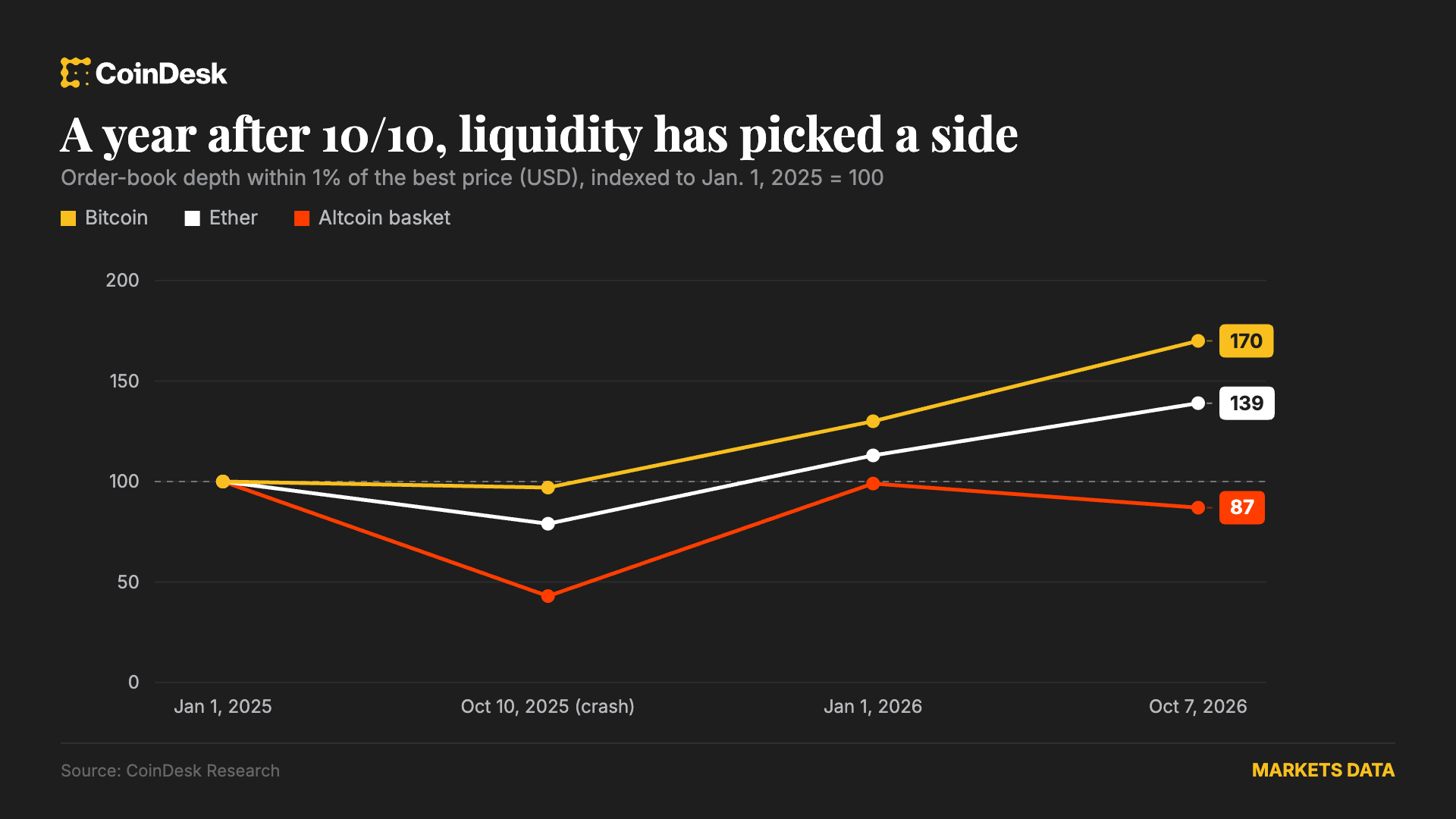
That increase cannot be explained by Bitcoin simply becoming more expensive. Bitcoin is trading roughly one-third below its October 2025 record, so deeper dollar-denominated books mean market makers have actually committed more capital near the price.
What Happened on October 10, 2025
Bitcoin had traded above $126,000 only days before the crash. On October 10, 2025, it fell from roughly $122,000 to below $105,000, with a large portion of the decline happening within minutes during thin Friday-evening U.S. trading. More than $19 billion in leveraged crypto positions were liquidated across the market.
A companion CoinDesk review of the crash argues that leverage and crowded derivatives positioning remain central short-term risks. Open interest and perpetual-futures funding still matter because Bitcoin’s near-term price can be pushed by leveraged paper exposure even when long-term spot holders are not selling.
That distinction fits a theme BitcoinVersus.Tech has explored for years: price is not produced by a single variable. Our older technical review of Bitcoin’s price looked at how multiple market forces interact rather than treating one indicator as a complete explanation.
The Market Is Deeper, but Trading Is Much Quieter
Stronger order-book depth does not mean trading activity has returned to 2025 levels. Weekly centralized-exchange spot volume averaged about $279 billion over the four weeks ending September 27, according to CoinDesk Research. The week of the October 2025 crash saw roughly $801 billion in spot volume.
That means current weekly spot volume is still nearly two-thirds below the crash-week level. Activity has recovered from an August 2026 low near $135 billion per week, but the market is nowhere close to last year’s turnover.
Bitcoin and Ether Recovered More Liquidity Than Altcoins
The recovery is not evenly distributed across crypto. CoinDesk Research found that Bitcoin and Ether order books now hold more resting liquidity than on crash day, while a basket of smaller tokens has continued to lose dollar-denominated depth.
That is important because institutional market makers tend to concentrate capital where trading is deepest and execution risk is lowest. Bitcoin’s advantage can therefore become self-reinforcing: deeper markets attract more capital, and more capital can make the market still easier to trade.
Leverage Is Still the Weak Point
Deeper books reduce the price impact of large spot orders, but they do not remove liquidation cascades. If too many traders build leveraged positions on the same side of the market, falling prices can still trigger forced selling, which pushes prices lower and activates another layer of liquidations.
That is why improved liquidity should not be interpreted as crash protection. The market has more capacity to absorb ordinary flow, but derivatives can still create unusually large bursts of forced activity. The same caution applies to long-term price models. BitcoinVersus.Tech’s Power Efficiency Theory versus Michael Saylor growth-model comparison treated price models as frameworks rather than guarantees.
Why This Matters to Bitcoin Miners
Mining companies feel these market-structure changes quickly because Bitcoin price remains a major input into hashprice and fleet profitability. A more liquid Bitcoin market can improve execution for treasury sales and hedging, but a sudden derivatives-driven drawdown can still hit miner revenue immediately.
We saw that relationship recently when Bitcoin miner revenue rebounded 78% largely because of Bitcoin’s price recovery rather than a comparable jump in transaction fees.
Bottom Line
The October 10, 2025 crash did not permanently break Bitcoin’s market structure. One year later, the Bitcoin order book is deeper close to the market, and more market-making capital appears to be committed near the price. But the recovery is incomplete: spot volume remains dramatically lower, altcoin liquidity has weakened, and leverage is still capable of turning a fast selloff into a liquidation cascade.
The strongest signal may be that Bitcoin survived the largest liquidation event in crypto history and came back with deeper near-market liquidity. The warning is that the mechanism capable of producing another violent move—crowded leverage—never disappeared.
Editor’s Note: Market depth can change rapidly and differs by exchange and measurement window. The figures above describe aggregated market structure at specific dates, not guaranteed liquidity available for every trade.
BitcoinVersus.Tech independently researches Bitcoin, mining hardware, semiconductors, data centers and computing infrastructure. Donations help fund additional open technical publishing: 3C9o19EH5HSiwEPyCTmEKzxhNCbo2X6TTb
BitcoinVersus.tech is not a financial advisor. Content is provided for informational purposes.


Leave a Reply