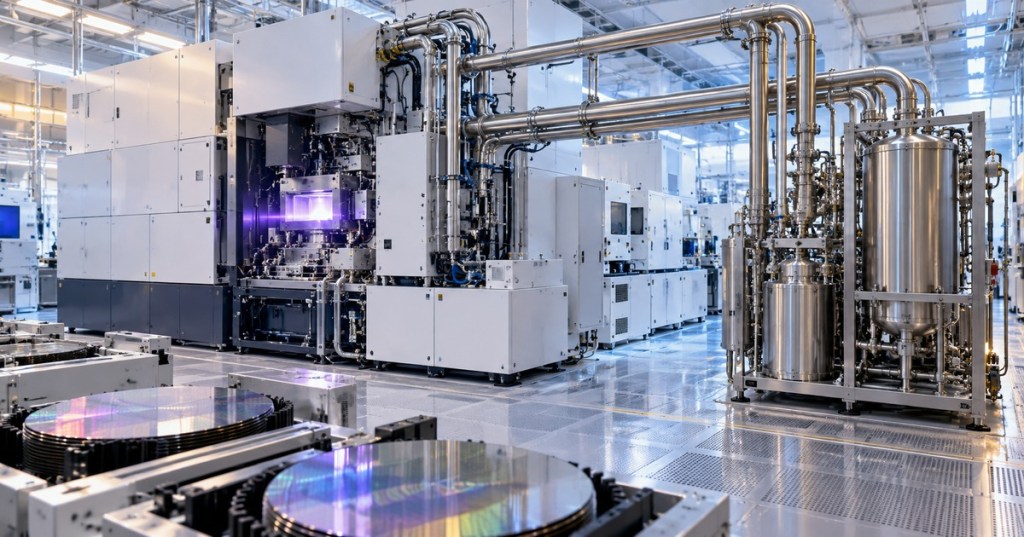
One of the semiconductor industry’s less-visible supply-chain risks is a noble gas most people associate with glowing signs: neon. Gigaphoton says it has now developed an on-site recycling system for the 193 nm argon-fluoride lasers used throughout deep-ultraviolet chip lithography.
The Japanese lithography-light-source maker says its new hTGM for ArF can recycle 50% of the neon used by ArF excimer-laser systems. One unit can connect to as many as five ArF lasers, with Gigaphoton claiming annual gas-processing capacity of up to 470 kiloliters.
That sounds like a materials story, but it is really a manufacturing-uptime story. ArF lasers remain critical to high-volume semiconductor production even in an era dominated by headlines about EUV. If a fab cannot secure the process gases needed to keep its DUV light sources running, expensive lithography capacity can become constrained by something far less glamorous than mirrors or numerical aperture.

Why Neon Matters to DUV Lithography
ArF lithography produces deep-ultraviolet light at 193 nanometers. That light is generated by an excimer-laser gas mixture that includes neon, and the laser then becomes the illumination source for the scanner that transfers circuit patterns onto photoresist-coated wafers.
BitcoinVersus.Tech’s earlier photoresist explainer covered what happens when light reaches the wafer. Gigaphoton’s announcement focuses one layer upstream: keeping the laser source supplied with the gas it needs to create that light in the first place.
The New System Recycles Gas Inside the Fab
Instead of treating the spent laser gas as a one-way consumable stream, hTGM for ArF collects used gas inside the semiconductor fab, processes it, and sends recycled gas back into the lithography-light-source workflow. Gigaphoton says the platform shares substantial hardware with its existing recycling system for KrF excimer lasers, which should simplify manufacturing and support.
The company’s stated 50% recycling rate should still be read as a vendor claim rather than independent fab-performance data. Gigaphoton has not publicly supplied a customer list, pricing, maintenance interval, operating-cost model, or independently audited recovery test in the announcement.
The Bigger Reason: Neon Supply Has Been Volatile
Neon is not rare because Earth lacks it; it is difficult because semiconductor-grade neon depends on a concentrated industrial purification chain. Russia’s invasion of Ukraine exposed how vulnerable that supply could become, because Ukraine had historically been a major supplier of purified neon used by chipmakers.
Tom’s Hardware notes that semiconductor lithography consumes a large share of global neon supply and that recycling is increasingly attractive as fabs look for ways to reduce exposure to external gas markets.
This is another example of semiconductor resilience moving deeper into the factory. Chipmakers already obsess over wafer yield, ultrapure water, chemicals, power quality and tool uptime. Process-gas circularity is becoming part of the same operational discipline.
A Rival Is Claiming More Than 90%
Gigaphoton is not alone. Japanese environmental-equipment company Kanken Techno has been promoting an on-site neon recycling platform that it says can exceed 90% recovery in a semiconductor-fab installation connected to three ArF lasers.
That does not automatically make Kanken’s system superior. The two companies have not published a controlled, apples-to-apples comparison, and neither recycling percentage should be treated as independently validated fleet data. But the competing claims show that neon recovery is becoming a real equipment category rather than a one-off experiment.
DUV Is Not Going Away Just Because EUV Exists
The timing is important. EUV gets most of the attention because it enables the smallest leading-edge features, but advanced fabs still contain large fleets of DUV tools. Many chip layers do not need EUV, and using a less-expensive DUV exposure step where possible remains economically attractive.
That is also why the semiconductor industry’s future is not simply “replace DUV with EUV.” The two technologies coexist inside modern process flows. Our recent coverage of ASML and ZEISS’s Hyper-NA roadmap shows how far EUV is pushing at the leading edge, while the new Gigaphoton system shows continued investment in the 193 nm DUV infrastructure that still carries enormous production volume.
What This Could Mean for Chip Fabs
If the recycling system performs reliably in production, its value is straightforward: lower fresh-neon consumption, less exposure to supply shocks, and potentially lower operating cost for a toolset that runs continuously in high-volume fabs.
The more subtle benefit is resilience. Modern fabs are built around preventing small upstream failures from shutting down vastly more expensive downstream equipment. A gas recycler is not as visually dramatic as a lithography scanner, but it can protect the availability of the light source feeding that scanner.
That same systems-engineering mentality appears throughout chip manufacturing—from 300 mm wafer handling to photoresist chemistry, vacuum systems, metrology and ultrapure process utilities. The final transistor depends on an enormous chain of supporting equipment staying inside specification.
Bottom Line
Gigaphoton says hTGM for ArF can recycle half of the neon used by ArF lithography lasers, process up to 470 kL of gas annually, and support as many as five laser systems from one recycler. The numbers still need real-world customer validation, but the product points toward a broader change in semiconductor manufacturing: fabs are beginning to treat process gases as resources worth recovering rather than simply consuming.
For an industry that measures downtime in extraordinarily expensive minutes, recycling neon is not primarily about being green. It is about making the lithography supply chain harder to interrupt.
Editor’s Note
The 50% recycling rate, 470 kL annual capacity and five-laser configuration are Gigaphoton specifications. The competing above-90% Kanken figure is also a supplier/industry claim. Neither should be read as an independently audited universal fab result.
BitcoinVersus.Tech independently researches semiconductor manufacturing, data centers, mining hardware and computing infrastructure. Donations help fund additional open technical publishing: 3C9o19EH5HSiwEPyCTmEKzxhNCbo2X6TTb
BitcoinVersus.tech is not a financial advisor. Content is provided for informational purposes.


Leave a Reply