IREN is highlighting NVIDIA validation of its Mirantis software stack as the former Bitcoin-mining specialist moves closer to becoming an AI-first infrastructure company. The company said Mirantis completed NVIDIA-Certified Hypervisor validation for the k0rdent AI virtualization stack on Arm-based NVIDIA GB200 systems.
The technical point matters because large GPU clouds increasingly need two operating modes at once: dedicated bare-metal clusters for maximum performance and virtualized infrastructure for multiple isolated customers. IREN says the validation shows k0rdent AI can provide predictable, near-bare-metal GPU performance while using virtual machines as hardened tenancy boundaries.
IREN’s October post highlights Mirantis k0rdent AI running through NVIDIA’s certified hypervisor validation path on Arm-based GB200 systems.
This Is Validation of the Software Layer
A hypervisor lets one physical server host multiple isolated virtual machines. On expensive GPU systems, the engineering challenge is preserving enough of the underlying accelerator performance while still giving cloud customers isolation, provisioning and lifecycle controls.
Mirantis’ k0rdent AI sits above the hardware and helps manage AI infrastructure across bare metal, virtual machines and Kubernetes environments. Its role is different from the GPU itself: NVIDIA supplies the accelerated-computing hardware, while k0rdent AI helps operators provision and manage that hardware as consumable cloud infrastructure.
Mirantis and NVIDIA demonstrate how k0rdent AI can provision an 18-node GB200 cluster and deploy validated software stacks for GPU-cloud customers.
The software layer becomes more important as AI clusters grow. BitcoinVersus’ CUDA overview explains how NVIDIA’s programming ecosystem turns GPU hardware into a general accelerated-computing platform; cloud orchestration sits another layer above that, deciding how those expensive systems are allocated and operated for customers.
IREN Is Replacing ASIC Capacity With GPUs
The validation also lands during a much larger business transition. In its fiscal 2026 annual report, IREN said it still had about 23.2 EH/s of installed Bitcoin-mining capacity representing roughly 380 MW as of June 30, but expects to substantially complete the transition of that capacity toward AI Cloud Services by December 31, 2026.
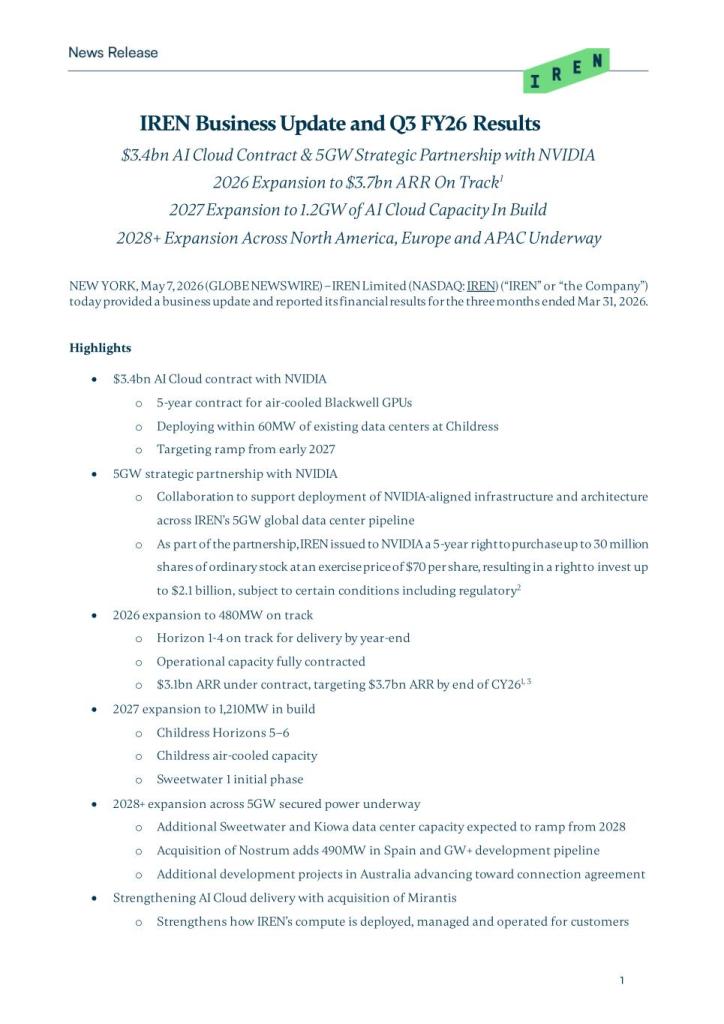
IREN says it typically liquidates the Bitcoin it mines rather than maintaining a treasury, and held no Bitcoin at June 30. For the June quarter, AI Cloud revenue reached $70.5 million while mining revenue fell to $66.7 million, meaning AI Cloud surpassed Bitcoin mining revenue for the first time.
That shift is part of the wider trend BitcoinVersus covered in Bitcoin miners shifting megawatts from ASICs to AI. Mining sites already control something AI developers urgently need: energized land, substations, transmission access, cooling expertise and data-center operating teams.
The Validation Does Not Erase Infrastructure Criticism
The positive software milestone comes with an important counterpoint. Research firm SemiAnalysis recently criticized reliability at IREN’s older Prince George and Mackenzie sites in British Columbia, citing reports of outages, networking problems, storage failures and other operating issues.
SemiAnalysis criticized IREN’s older Canadian sites while separately saying the newer Childress and Sweetwater builds look materially better.
The SemiAnalysis ClusterMAX report distinguishes the older Canadian infrastructure from IREN’s newer Texas campuses. That distinction matters: a validated hypervisor stack says something about software and GPU virtualization, while data-center reliability depends on a much larger physical system that includes utility power, backup architecture, networking, storage, cooling and operational processes.
BitcoinVersus previously explored the same infrastructure reality in why power may be a Bitcoin miner’s most valuable AI asset. Moving from ASIC mining to enterprise AI is not simply a matter of swapping machines in a rack. AI customers generally demand different redundancy, networking, latency, service-level and support expectations.
Why GB200 Validation Matters
NVIDIA’s GB200 Grace Blackwell systems combine Arm-based Grace CPUs with Blackwell GPUs for large-scale AI training and inference. A cloud provider trying to sell those systems to multiple enterprise customers needs more than working hardware: it needs repeatable provisioning, isolation, monitoring and lifecycle management.
IREN’s strategy is therefore moving up the stack. The company began primarily as a Bitcoin miner, then accumulated power and data-center infrastructure, added large GPU deployments, and acquired Mirantis to build a software and managed-services layer above the physical compute.
What Is Confirmed
- IREN says Mirantis completed NVIDIA-Certified Hypervisor validation for k0rdent AI on Arm-based NVIDIA GB200 systems.
- Mirantis had already been identified as an inaugural NVIDIA AI Cloud Ready partner and announced its certified-hypervisor status earlier in 2026, so the October post should be read as a validation milestone and demonstration—not the first disclosure of the partnership.
- IREN’s annual report says it intends to substantially complete its transition away from Bitcoin mining capacity by December 31, 2026.
- AI Cloud revenue surpassed Bitcoin-mining revenue in the June quarter.
- SemiAnalysis has raised reliability concerns about older Canadian sites while saying newer Texas infrastructure looks stronger.
The result is a useful snapshot of what the mining-to-AI transition actually looks like. The ASICs are only one layer being replaced. Power, buildings, GPUs, networking, virtualization and cloud software all have to mature together before a former mining operator becomes a full AI infrastructure provider.
BitcoinVersus.Tech
Editor’s Note: IREN’s performance and validation statements are company claims supported by NVIDIA’s certification program; they do not independently resolve separate operational criticism involving legacy facilities. SemiAnalysis’ reliability claims are attributed to the research firm and its reported users rather than presented as established facts about every IREN site.
We volunteer daily to improve the credibility of the information on this platform. If you would like to support the research, please donate here: 3C9o19EH5HSiwEPyCTmEKzxhNCbo2X6TTb
BitcoinVersus.tech is not a financial advisor. This media platform reports on technical and financial subjects purely for informational purposes.


Leave a Reply