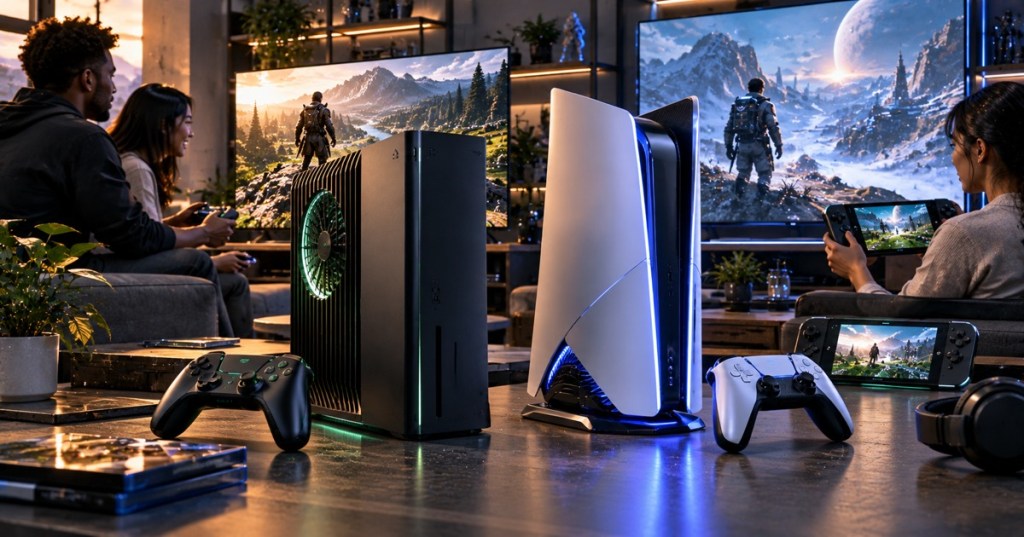
The next Xbox and PlayStation 6 are still partly hidden behind official silence and hardware rumors, but enough credible information now exists to build a reasonable early forecast. BitcoinVersus.Tech expects Microsoft’s Project Helix to be the more powerful and more PC-like machine, while Sony’s PS6 is likely to be the more tightly optimized traditional console. The biggest uncertainty is memory: our current best estimate is roughly 32–48GB of unified GDDR7-class memory for Xbox Helix and about 20–30GB for PS6, with 30GB currently the most specific PS6 rumor.
What Is Actually Confirmed
- Xbox Project Helix is real. Microsoft says it is powered by a custom AMD SoC and is designed to play Xbox console and PC games.
- Microsoft says Helix targets a major ray-tracing leap and will use next-generation DirectX and AMD FSR technology, including machine-learning graphics features.
- Microsoft plans to send alpha Helix hardware to developers beginning in 2027.
- Xbox is building a broader hardware family, not just one box. Microsoft has publicly discussed console, handheld, PC, cloud and partner hardware as parts of its next-generation strategy.
- Sony and AMD are deepening their graphics partnership through Project Amethyst. That work is already feeding newer PSSR and QSSR machine-learning upscaling on PS5 hardware.
- Sony has not officially announced PS6 specifications, launch timing or pricing. Sony has explicitly said next-generation timing and pricing remain undecided while memory costs stay volatile.
Microsoft has been unusually open. In its official Project Helix announcement, Xbox said the machine will use a custom AMD SoC, play both console and PC games, preserve four generations of Xbox software and deliver what Microsoft called an order-of-magnitude leap in ray-tracing capability.
Our Best-Guess Spec Sheet
Xbox Project Helix — BitcoinVersus.Tech estimate:
- CPU: AMD Zen 6-family hybrid design, likely mixing performance and compact cores.
- GPU: RDNA 5-class architecture, probably larger than PS6.
- Graphics target: roughly 50–60 TFLOPS-class theoretical FP32 based on current leaks, but TFLOPS should not be treated as a direct measure of real game performance.
- Memory: most likely 32–36GB GDDR7-class unified memory; leaked designs reportedly support as much as 48GB.
- Dedicated AI hardware: highly likely, with current leaks pointing to a substantial NPU alongside neural graphics hardware.
- Storage: likely 1–2TB base NVMe-class storage, expandable.
- Software: Xbox console library plus PC games through a Windows-derived Xbox environment.
- Backward compatibility: four Xbox generations is officially part of the plan.
PlayStation 6 — BitcoinVersus.Tech estimate:
- CPU: AMD Zen 6-family architecture.
- GPU: RDNA 5-class custom graphics, probably smaller than Helix but more aggressively optimized around one fixed console target.
- Graphics target: roughly 35–40 TFLOPS-class theoretical FP32 based on current rumors.
- Memory: 20–30GB GDDR7-class unified memory, with 30GB currently the most detailed leaked configuration.
- Memory bandwidth: one widely circulated rumor points to about 640GB/s from 30GB of GDDR7.
- AI graphics: next-generation PSSR/Project Amethyst technology is extremely likely.
- Storage: likely 1–2TB SSD, with cost pressure making a huge base drive less likely.
- Backward compatibility: PS5 support looks highly probable; PS4 compatibility is also technically plausible but not officially announced.
Recent reporting based on hardware leaker KeplerL2 puts PS6 near 40 TFLOPS and Helix near 56 TFLOPS, while also claiming both chips have reached tape-out. That information remains unconfirmed. Even if the figures are accurate, modern ray tracing, cache, neural rendering, memory compression and frame-generation hardware make simple TFLOPS comparisons much less useful than they were a decade ago.
Why Xbox Probably Needs More Memory
The memory question is where the two machines could diverge most. A conventional console operating system can reserve relatively little memory compared with a full PC environment. Helix is different because Microsoft says it will play both Xbox console and PC games and is explicitly blending Xbox with Windows.
That makes 32GB feel like the practical floor for a premium Helix-class console if Microsoft wants enough headroom for modern PC titles, background services, AI features and future games without starving the GPU. A leaked Magnus design has been described as supporting up to 48GB of GDDR7 on a 192-bit interface. We would not treat 48GB as the most likely shipping configuration because memory costs have become one of Microsoft’s biggest hardware problems, but it is a credible upper-bound design target.
Microsoft itself says component costs are reshaping the hardware business. Xbox leadership has warned that memory and storage costs are materially higher than they were only two years ago and will affect Helix pricing and availability. That makes a 32GB or 36GB retail configuration more plausible to us than a fully populated 48GB launch model.
PS6 Memory Could Be the Biggest Last-Minute Decision
The most specific PS6 memory leak so far points to 30GB of GDDR7 on a 160-bit interface with roughly 640GB/s of bandwidth. That would be a major capacity increase from PS5’s 16GB while still keeping Sony below the memory footprint we expect from a Windows-heavy Helix.
Sony’s own investor comments are the reason we would not lock 30GB in yet. Sony says rising memory prices are increasing console manufacturing costs and that no final decision has been announced on next-generation pricing or timing. Separate rumors have suggested Sony could reduce memory capacity if component pricing remains extreme.
Our base case is therefore 30GB if Sony can make the economics work, with something in the low-to-mid 20GB range as the cost-cut version. The important point is that PS6 should still offer materially more game-accessible memory than PS5 even if Sony trims the original target.
Will There Be Multiple Versions?
Xbox: almost certainly yes—but probably not another Series S/Series X split.
Microsoft has already said its next-generation strategy spans console, handheld, PC, cloud and accessories. More recent internal messaging describes Gen-10 as covering multiple device types, including handheld hardware. Microsoft has also confirmed that Helix itself will exist as a first-party Xbox console.
Our expectation is one premium first-party Helix living-room console, plus one or more handheld or OEM-built Xbox/Windows devices. That lets Microsoft create lower-priced entry points without forcing every game developer to target a dramatically weaker living-room box for the entire generation.
PlayStation: probably a main PS6 plus a separate handheld.
Rumors around Sony’s next generation increasingly describe two hardware classes: a home PS6 and a standalone PlayStation handheld. The handheld has been rumored with roughly 24GB of LPDDR5X memory and a smaller RDNA 5-class GPU. None of that is official, but it fits Sony’s existing strategy better than launching a deliberately weak home console beside PS6.
A digital-only PS6 and a disc-capable model—or a detachable disc drive—also looks plausible because Sony has already experimented extensively with modular optical-drive configurations this generation.
Xbox Could Feel More Like a Gaming PC
The most important difference may not be GPU power at all. Microsoft says Helix is designed to play PC games as well as Xbox console games, and Xbox Mode is already being brought into Windows. That suggests the next Xbox may behave more like a console-optimized gaming PC than any Xbox before it.
If Microsoft fully follows through, likely features include third-party PC storefront access, mouse-and-keyboard support, broader mod compatibility, faster storage expansion, PC-like multitasking and a console-first user interface layered over Windows technology. Microsoft has not confirmed every one of those features, so they remain predictions rather than promises.
BitcoinVersus.Tech recently covered Xbox expanding its franchises beyond games through the new XP division. Helix fits that broader strategy: Microsoft increasingly wants Xbox to be an ecosystem and identity that follows the player across hardware rather than a single closed box.
Sony Will Probably Optimize Harder Around One Target
Sony’s likely advantage is the opposite. A narrower hardware target lets developers and Sony’s internal studios optimize around one fixed console configuration. Project Amethyst’s machine-learning graphics work also shows Sony focusing heavily on getting more visible image quality from each unit of GPU performance and memory bandwidth.
PS5 Pro already demonstrated that strategy with PSSR, and Sony has continued pushing the technology forward. In 2026, PlayStation even introduced QSSR to bring a lighter version of AI upscaling to the base PS5. That strongly suggests PS6 will be designed around neural rendering from day one rather than treating AI upscaling as an optional enhancement.
BitcoinVersus.Tech recently covered next-generation semiconductor manufacturing moving toward increasingly specialized compute. Consoles are following the same general direction: fewer gains now come from brute-force raster performance alone, while specialized AI, compression and ray-tracing blocks do more of the work.
Features We Think Both Will Have
- Hardware-accelerated AI upscaling and frame reconstruction.
- Much stronger ray tracing and practical path-traced effects in selected games.
- Neural texture or geometry compression.
- Faster SSD-to-GPU streaming.
- More dedicated hardware for AI workloads.
- Expanded backward compatibility.
- 120Hz support becoming more common.
- Variable-rate rendering and increasingly aggressive dynamic-resolution systems.
- Better capture, streaming and AI-assisted highlight features.
- Longer cross-generation software support because next-gen hardware may be expensive at launch.
Our Current Prediction
If the current evidence holds, Xbox Helix wins the raw-spec battle while PS6 wins the efficiency-and-price battle. Helix looks like Microsoft’s attempt to merge a premium Xbox with a compact gaming PC. PS6 looks more like a conventional console pushed much further through AMD graphics technology, neural rendering and aggressive optimization.
Our current working estimate is:
- Xbox Helix: Zen 6-family CPU, RDNA 5-class GPU, roughly 50–60 TFLOPS-class theoretical graphics, 32–48GB GDDR7, dedicated AI hardware, console + PC game support, premium first-party console plus broader device family.
- PS6: Zen 6-family CPU, RDNA 5-class GPU, roughly 35–40 TFLOPS-class theoretical graphics, 20–30GB GDDR7, next-generation PSSR/Amethyst graphics, traditional home console plus likely companion handheld.
The memory ranges are the numbers most likely to move before launch because both Microsoft and Sony are openly dealing with an unusually expensive memory market. The architecture itself appears further along than the retail configuration.
Editor’s Note: This article intentionally combines confirmed information with clearly labeled speculation. Project Helix’s AMD partnership, PC-and-console compatibility, next-generation DirectX/FSR direction, ray-tracing goals and 2027 developer-alpha plan are official Microsoft disclosures. Sony’s Project Amethyst and current PSSR/QSSR work are official. PS6 memory, TFLOPS, handheld specifications, Helix memory capacity and leaked GPU configurations are unconfirmed and may change before launch.
Support independent reporting: BitcoinVersus.Tech volunteers daily to help keep its research verifiably true. Bitcoin donation address: 3C9o19EH5HSiWEPyCTmEKzxhNCbo2X6TTb.
BitcoinVersus.Tech is not a financial advisor. This media platform reports on technology and financial subjects for informational purposes.


Leave a Reply