
Hashrate is the speed of hashing. In Bitcoin mining, it measures how many cryptographic hash attempts a miner, mining farm, pool, or the entire Bitcoin network can perform every second.
If a miner is rated at 200 TH/s, that means it can attempt roughly 200 trillion hashes every second. If a mining company operates at 20 EH/s, its fleet is attempting about 20 quintillion hashes per second. Network hashrate combines the estimated work of all miners competing on Bitcoin at the same time.
Hashrate starts with a hash
Before hashrate makes sense, the word hash has to make sense. A hash is the output of a cryptographic hash function. Bitcoin miners repeatedly hash candidate block headers while trying to produce an output that is numerically below the network target.
Our companion article What Is a Hash? explains that process in detail. The important distinction here is simple: a hash is one result; hashrate is how quickly those results can be produced.
Hashrate is measured in hashes per second
Hashrate uses the same metric-prefix ladder found throughout computing:
- 1 H/s = 1 hash per second
- 1 kH/s = 1,000 hashes per second
- 1 MH/s = 1 million hashes per second
- 1 GH/s = 1 billion hashes per second
- 1 TH/s = 1 trillion hashes per second
- 1 PH/s = 1 quadrillion hashes per second
- 1 EH/s = 1 quintillion hashes per second
- 1 ZH/s = 1 sextillion hashes per second
Bitcoin ASIC miners are commonly rated in TH/s or PH/s. Large companies describe fleet capacity in EH/s. The Bitcoin network as a whole has grown large enough that ZH/s is now a useful unit for discussing network-scale computation.
One miner’s hashrate is different from network hashrate
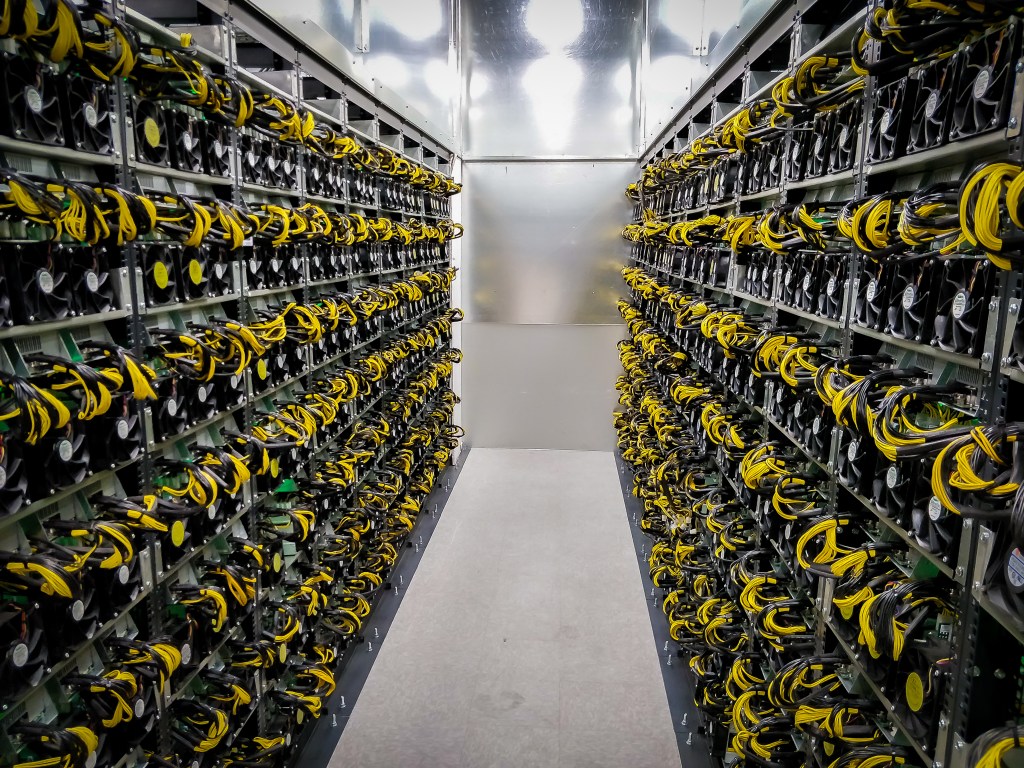
A single ASIC has a local hashrate. A mining farm combines thousands of ASICs into a much larger fleet hashrate. A mining pool combines work contributed by many miners. Network hashrate is an estimate of all Bitcoin mining work occurring globally.
This scaling is visible in BitcoinVersus’ older reporting. In our 2024 coverage of petahash-scale ASIC hardware, individual machines were approaching the point where one unit could be discussed in PH/s instead of only TH/s.
At the company level, our 2025 report on Bitfarms reaching 19.5 EH/s showed how tens of thousands of machines combine into fleet-scale exahash capacity.
More hashrate means more chances to find a block
Bitcoin mining is probabilistic. A miner cannot calculate the winning nonce directly. It repeatedly changes candidate data and hashes the block header again.
A miner with twice the hashrate gets approximately twice as many attempts per second. Assuming all other conditions are equal, that gives it roughly twice the statistical share of the network’s block-finding probability.
This does not guarantee that the faster miner will find the next block. A smaller miner can get lucky, while a much larger miner can go through a period without finding a block. Hashrate changes probability, not certainty.
Higher hashrate does not create more Bitcoin per day
This is one of the most important misconceptions to remove. If the Bitcoin network suddenly doubled its hashrate, it would temporarily find blocks faster—but the protocol would respond at the next difficulty adjustment.
Bitcoin adjusts mining difficulty every 2,016 blocks so the long-run average remains close to one block every 10 minutes. That means more global hashrate does not permanently increase Bitcoin issuance.
As explained in our current Bitcoin issuance explainer, the present subsidy is 3.125 BTC per block and expected issuance is about 450 new BTC per day at the target block cadence. Hashrate decides who has the probability of winning those blocks; the consensus rules decide how many new bitcoin each block can create.
Hashrate and difficulty move together over time
If large amounts of new mining hardware come online, blocks tend to arrive faster until difficulty increases. If many miners shut down, blocks tend to arrive more slowly until difficulty falls.
That feedback loop is what allows Bitcoin to absorb enormous changes in computing power while still targeting roughly the same block interval.
BitcoinVersus was already tracking the scale of this growth in our February 2024 network-hashrate analysis, when the conversation was shifting from hundreds of EH/s toward the possibility of a one-zettahash network.
Hashrate is not the same as efficiency
A miner can have very high hashrate and still be economically poor hardware if it consumes too much electricity. Hashrate measures speed. Efficiency measures how much energy is required to produce that speed.
Bitcoin ASIC efficiency is commonly expressed in joules per terahash, or J/TH. Lower is better.
For example, a 500 TH/s machine at 10 J/TH uses roughly 5,000 watts for its hashing load. A 700 TH/s machine at 20 J/TH would deliver more hashrate but require roughly 14,000 watts. The faster machine is not automatically the better machine.
Overclocking can raise hashrate—but there is a cost
ASIC frequency and voltage can sometimes be increased to make chips hash faster. That is overclocking. It can raise TH/s, but it can also increase heat, power draw, instability, and component stress.
Our 2025 Bitaxe overclocking test showed how changing operating frequency altered measured hashrate and efficiency. That relationship is why mining engineers watch both TH/s and J/TH rather than celebrating raw hashrate alone.
Why network hashrate matters
Network hashrate is useful because it gives a rough picture of how much computational work is competing to extend Bitcoin’s chain.
A larger honest mining base generally raises the amount of external computing power an attacker would need to compete with the existing network. But raw hashrate alone does not describe everything about decentralization. Ownership concentration, pool concentration, geographic concentration, firmware, block-template control, and access to energy also matter.
That is why hashrate should be read as one important network metric—not a complete measurement of Bitcoin security by itself.
The easiest way to remember it
Hash = one cryptographic attempt. Hashrate = how many attempts happen every second. Difficulty = how hard it is for one of those attempts to qualify as a valid block.
A small Bitaxe, an industrial Antminer, a 100-megawatt mining site, and the entire Bitcoin network can all have a hashrate. The only difference is scale.
BitcoinVersus.Tech Editor’s Note: Bitcoin network hashrate is estimated rather than directly counted because the network does not receive a telemetry reading from every miner. Estimates are inferred from observed block production and mining difficulty, so short-term hashrate charts can vary between data providers and averaging windows.
Follow BitcoinVersus.Tech for Bitcoin mining, ASIC hardware, firmware, networking, semiconductors, energy, and open-source infrastructure coverage.
Support independent technology reporting: Bitcoin donations help fund BitcoinVersus.Tech research and publishing.
Disclaimer: BitcoinVersus.Tech provides technology news and education for informational purposes only.


Leave a Reply