
Short-channel MOSFETs stop behaving like the ideal long-channel transistor because the drain and source begin to influence electrostatics that the gate once controlled almost by itself. As channel length shrinks, electric fields rise, carrier velocity saturates, threshold voltage becomes more sensitive to geometry and drain bias, leakage increases, and the textbook square-law current model loses accuracy.
This lesson continues directly from OSSEC.006: Long-Channel MOSFET Operation, builds on OSSEC.005: MOS Capacitor Physics, and connects back to OSSEC.003: PN Junction Electrostatics. The goal is to understand why modern transistor scaling demands new device structures and more advanced compact models.
Learning Objectives
- Explain why the long-channel square-law model breaks down as channel length shrinks.
- Relate lateral electric field to channel length and drain voltage.
- Explain carrier velocity saturation and its effect on drain current.
- Define threshold-voltage roll-off and drain-induced barrier lowering.
- Describe why short-channel effects increase off-state leakage.
- Distinguish channel-length modulation from DIBL.
- Explain why FinFET and gate-all-around structures improve electrostatic control.
- Interpret short-channel trends in measured or simulated transistor data.
Why Channel Length Changes the Physics
In a long-channel MOSFET, the gate has strong electrostatic control over the channel while the source and drain depletion regions occupy a relatively small fraction of the channel length. As the gate length becomes comparable to junction depletion widths and other electrostatic length scales, the source and drain fields penetrate farther into the channel.
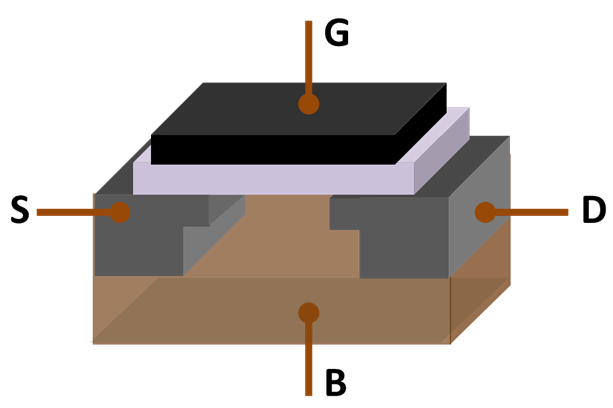
The simplest way to see the scaling pressure is the average lateral electric field. If the drain-to-source voltage stays comparable while channel length decreases, the field scales roughly as E ≈ VDS/L. Cutting the effective channel length in half while keeping the same drain voltage approximately doubles that average field.
Velocity Saturation Changes the Current Law
At low electric field, carrier drift velocity is approximately proportional to field: v ≈ μE, where μ is mobility. At high lateral field, that linear relationship weakens and carrier velocity approaches a saturation velocity. Once velocity saturation dominates, increasing field no longer produces a proportional increase in carrier speed.
This matters because MOSFET drain current can be viewed as mobile charge multiplied by carrier velocity and device width. In the long-channel square-law model, saturation current depends approximately on the square of gate overdrive. Under strong velocity saturation, the dependence becomes closer to linear in VGS − VT. The exact behavior depends on the process and device model, but the key point is that modern short-channel current is not described well by the simple square-law equation alone.
Threshold-Voltage Roll-Off
Threshold voltage is not perfectly independent of channel length. In a short device, source and drain depletion regions help support part of the depletion charge that the gate would have controlled in a long-channel transistor. Less gate voltage may therefore be needed to create inversion, causing threshold voltage to decrease as effective channel length shrinks.
This trend is called threshold-voltage roll-off. It is one reason that merely shrinking the gate length without redesigning junction depth, body geometry, oxide thickness, doping, and gate structure does not preserve ideal transistor behavior.
Drain-Induced Barrier Lowering
DIBL occurs when a higher drain voltage lowers the source-to-channel energy barrier. In a well-controlled long-channel transistor, the source-side barrier is governed mainly by the gate. In a short-channel transistor, the drain electric field reaches farther toward the source and changes that barrier.
The practical result is that the apparent threshold voltage decreases as drain voltage increases. A common DIBL metric is the threshold-voltage shift divided by the change in drain voltage, often reported in millivolts per volt. Larger DIBL means poorer electrostatic isolation between drain and source.
DIBL is especially important in the off state. If the drain lowers the source barrier while the gate is supposed to keep the device off, more carriers can enter the channel and leakage current rises.
Subthreshold Leakage Becomes Harder to Control
A MOSFET does not switch from exactly zero current to full conduction at one perfectly sharp threshold voltage. Below threshold, current falls exponentially with gate voltage. The steepness of that transition is described by the subthreshold swing.
Short-channel electrostatics can worsen off-state leakage by lowering threshold voltage and increasing DIBL. Supply-voltage scaling also becomes difficult because lowering threshold voltage improves drive current but can increase standby leakage exponentially. Device engineering therefore becomes a balance among speed, leakage, electrostatic control, reliability, and manufacturability.
Channel-Length Modulation Is Different From DIBL
Channel-length modulation and DIBL can both make drain current continue increasing with drain voltage, but they are not the same effect. Channel-length modulation refers to the effective conductive channel shortening after pinch-off as drain voltage increases. DIBL is a barrier-control effect in which drain voltage changes the source-side electrostatics and effectively lowers threshold voltage.
In measured output curves, both mechanisms can contribute to non-ideal saturation. Device models separate these effects because they respond differently to geometry, bias, temperature, and process parameters.
Mobility Degradation and High Vertical Field
Short-channel scaling is not only a lateral-field problem. Strong gate fields push inversion-layer carriers closer to the semiconductor-oxide interface, where surface scattering can reduce effective mobility. That mobility degradation further separates real transistor current from the constant-mobility square-law model.
Modern compact models therefore include bias-dependent mobility, velocity saturation, series resistance, channel-length modulation, DIBL, subthreshold conduction, and many other physical effects instead of relying on one ideal equation across all operating regions.
Punch-Through and Junction Control
If source and drain depletion regions extend too far toward one another, the electrostatic barrier between them can become weak even without strong gate inversion. In severe cases this can produce punch-through current. Shallower junctions, optimized channel doping, halo or pocket implants in older planar technologies, and improved gate geometries have all been used to control this behavior.
Why FinFET and Gate-All-Around Devices Help
The fundamental short-channel problem is loss of gate control. Device structures therefore evolved to put the gate around more of the channel. A planar MOSFET controls the channel mainly from one surface. A FinFET wraps the gate around multiple sides of a thin fin. A gate-all-around nanosheet or nanowire surrounds the channel even more completely.
Stronger geometric gate control suppresses drain influence, reduces DIBL, improves subthreshold behavior, and allows scaling to shorter effective channel lengths. This is why modern advanced-node logic moved from planar MOSFETs to FinFETs and is now transitioning toward gate-all-around structures.
Semiconductor-device discussion highlighting gate-all-around transistors as part of the industry’s continued scaling path.
How to Recognize Short-Channel Effects in Data
- Threshold versus channel length: a downward threshold trend at shorter length indicates roll-off.
- Threshold versus drain voltage: a lower extracted threshold at higher drain bias indicates DIBL.
- Transfer curves: increased off-state current at short channel length suggests degraded electrostatic control.
- Output curves: current that rises strongly after nominal saturation can include channel-length modulation and other non-ideal effects.
- Current versus gate overdrive: behavior becoming less quadratic and more linear can reflect velocity saturation.
- Subthreshold slope: degradation indicates weaker gate control over the channel barrier.
Engineering Exercise
- Take two otherwise similar MOSFETs with different effective channel lengths.
- Compare their threshold voltages at the same low drain bias.
- Repeat threshold extraction at a higher drain bias and calculate the threshold shift per volt of drain bias.
- Compare off-state current at the same gate and drain voltages.
- Plot drain current versus gate voltage on both linear and logarithmic scales.
- Identify where the long-channel square-law interpretation begins to fail.
- Explain which observations are most consistent with DIBL, velocity saturation, threshold roll-off, or channel-length modulation.
Knowledge Check
- Why does lateral electric field rise when channel length is reduced at constant drain voltage?
- What is velocity saturation?
- Why does velocity saturation weaken the square-law relationship?
- What is threshold-voltage roll-off?
- What physical barrier does DIBL reduce?
- Why does DIBL increase off-state leakage?
- How is channel-length modulation different from DIBL?
- Why do gate-all-around structures improve short-channel control?
Answer Guide
- Because average field scales approximately as drain voltage divided by channel length, so reducing length raises the field.
- The high-field condition in which carrier velocity no longer increases approximately linearly with electric field and instead approaches a limiting velocity.
- Drain current becomes limited more strongly by carrier velocity, making current depend more nearly linearly on gate overdrive than the ideal quadratic model predicts.
- The reduction of threshold voltage as effective channel length decreases.
- The source-to-channel energy barrier that normally limits carrier injection when the device is off or near threshold.
- A lower source barrier allows more carriers into the channel even when the gate is intended to keep the device off.
- Channel-length modulation changes the effective conductive channel length after pinch-off; DIBL changes the source-side barrier and apparent threshold voltage.
- Because surrounding more of the channel with gate electrode gives the gate stronger electrostatic control and reduces drain influence.
Key Takeaway
Short-channel effects are fundamentally a loss of ideal electrostatic and transport behavior as dimensions shrink. Velocity saturation changes transport, threshold roll-off and DIBL weaken gate control, leakage grows, and modern device structures are designed to restore electrostatic authority to the gate.
References
Primary technical references: MIT OpenCourseWare — Short-Channel MOSFET Effects and UC Berkeley BSIM-CMG compact-model documentation.
Advertisement
BitcoinVersus.Tech Editor’s Note:
We volunteer daily to ensure the credibility of the information on this platform is Verifiably True. If you would like to support our independent technical education work, please donate Bitcoin here: 3C9o19EH5HSiwEPyCTmEKzxhNCbo2X6TTb
BitcoinVersus.tech is not a financial advisor. This lesson is for informational and educational purposes.


Leave a Reply