Michael Saylor Says AI Agents Will Need Digital Money

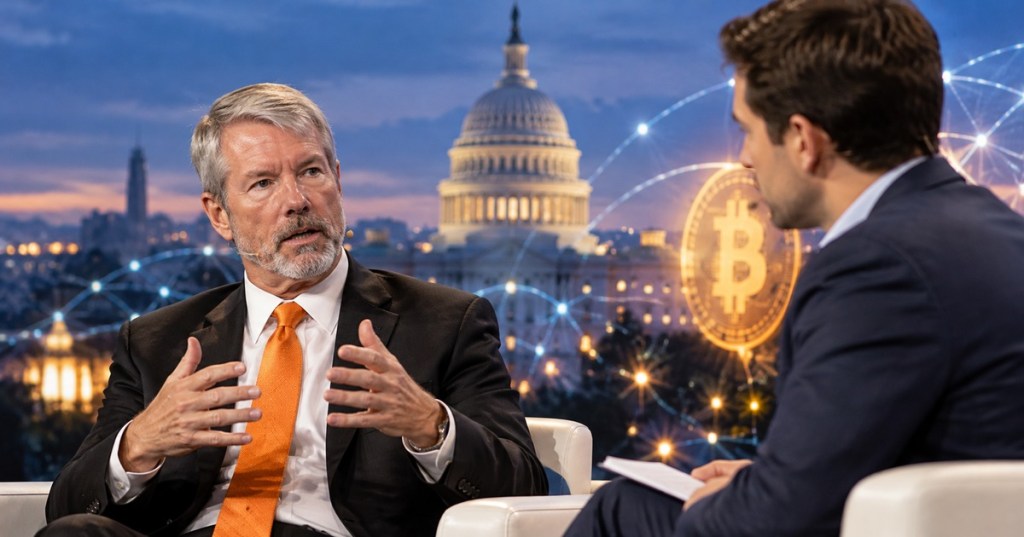
Editorial illustration of Michael Saylor discussing AI agents, Bitcoin and digital capital in Washington

Strategy Executive Chairman Michael Saylor says AI agents will force finance to become as programmable and always-on as the software using it. In a Freedom Tech DC discussion with Bitcoin Policy Institute Executive Director Conner Brown, Saylor argued that AI will automate jobs and business models while making new products easier to build.

His policy answer is cheaper capital formation, more digital-dollar competition, and stronger rights to custody and transfer digital assets. His clearest line was that “freedom starts with the bill of rights.”

Saylor summarized the discussion as a case for digital rights spanning capital formation, Bitcoin banking, tokenized securities and AI-agent finance.

Bitcoin sits at the center of that framework. He said, “Bitcoin is the greatest of the digital commodities,” and argued banks should be able to custody BTC and extend credit against it under workable rules. That fits a policy arc BitcoinVersus.Tech has tracked from the White House digital-assets summit to Strategy’s Bitcoin-focused financial ambitions.

The most forward-looking section concerns autonomous software. AI agents can research, negotiate and buy continuously, while traditional finance still relies on human identities, business hours and manual approvals. “The banks won’t give them a bank account,” Saylor said. He expects agents to favor digital wallets, programmable payments and digitally native assets.

That idea is becoming less theoretical. BitcoinVersus.Tech recently covered Shopify opening checkout to browser-based AI agents. Saylor’s argument goes further: digital intelligence, digital money and digital capital could converge into one economic stack.

Michael Saylor and Conner Brown discuss digital intelligence, Bitcoin, digital capital and the financial infrastructure AI agents may require.

In a follow-up policy paper, Saylor urged regulators to protect rights to create, issue, custody, transfer and use digital assets. His market-growth projections remain forecasts, not guarantees.

Editor’s Note: The interview was recorded September 22, 2026, at Freedom Tech DC in Washington. Quotes above were checked against a speaker-attributed transcript.

Support independent research: 3C9o19EH5HSiwEPyCTmEKzxhNCbo2X6TTb

BitcoinVersus.tech is not a financial advisor. This article is informational.

6 responses to “Michael Saylor Says AI Agents Will Need Digital Money”

  1. […] has continued tracking his evolving thesis, including his recent argument that AI agents will need digital money. For 2026, no single individual has done more to make Bitcoin a central variable in corporate […]

    Like

  2. […] digital money, digital assets and financial rails that operate continuously. BitcoinVersus.Tech documented that argument separately one day […]

    Like

  3. […] a controlled way to pay for data, compute and online services. BitcoinVersus recently covered why AI agents may need digital money, RLUSD moving deeper into institutional custody, and Ripple’s expanding institutional […]

    Like

  4. […] Saylor links the metaphor to Bitcoin’s issuance curve. In his September Binance interview, he said roughly 99% of the eventual 21 million BTC supply should be mined by around 2035, after which the remaining issuance extends across many decades. The “gold rush” conclusion is Saylor’s bullish interpretation. Binance’s interview summary documents the argument. BitcoinVersus.Tech has also covered Saylor’s view that AI agents will need digital money. […]

    Like

  5. […] view also connects with his recent argument that AI agents will eventually need digital money. In both cases, Saylor is focused on financial infrastructure that could sit above Bitcoin rather […]

    Like

  6. […] AI argument connects the interview to a theme BitcoinVersus.Tech covered on October 12, when Saylor said AI agents will need digital money. He expects artificial intelligence to create enormous wealth for some firms while pressuring […]

    Like

Leave a Reply