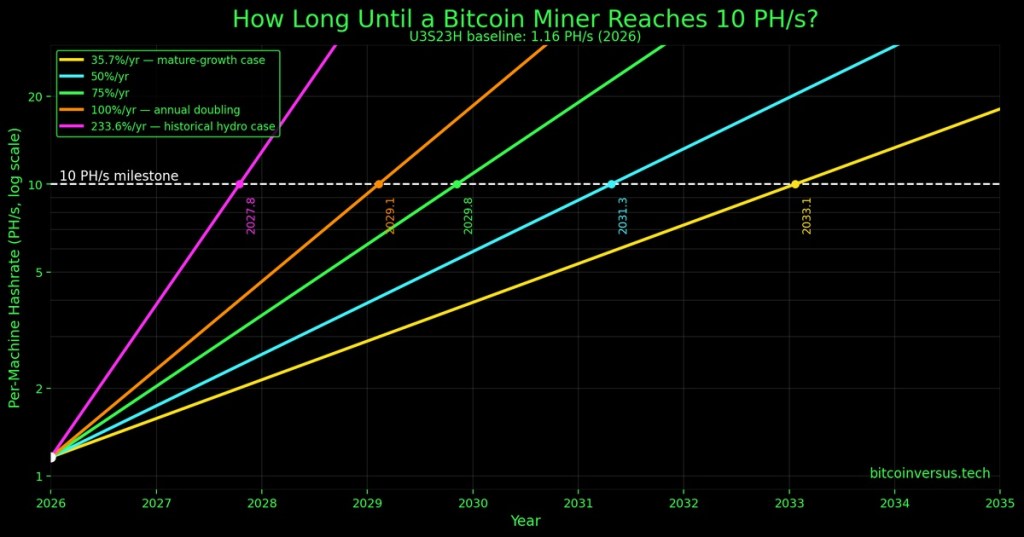
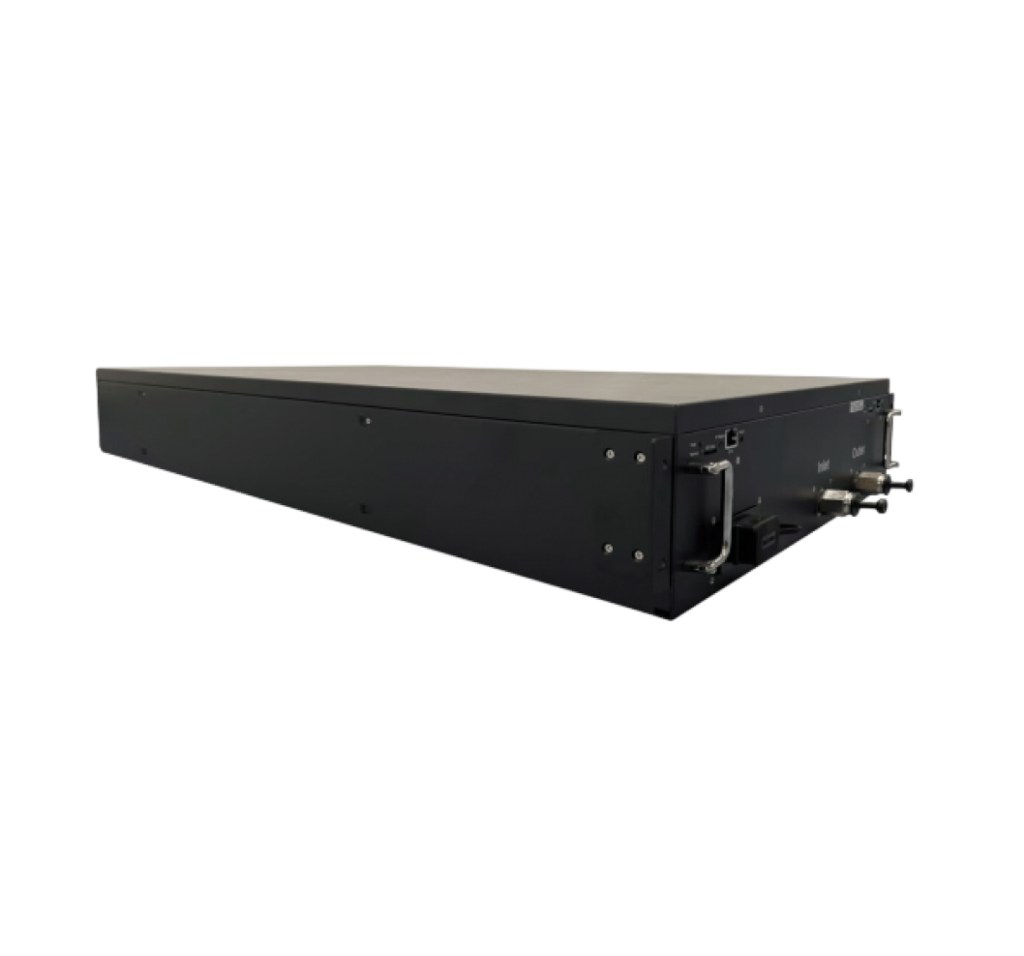
Bitcoin mining has already crossed the petahash-per-machine line. BITMAIN’s U3S23H is rated at 1.16 PH/s, 11,020 W and 9.5 J/TH. From that 2026 baseline, a 10 PH/s miner needs roughly an 8.62× increase in per-machine hashrate.
BitcoinVersus.Tech modeled five compound-growth cases using the same general approach developed in our earlier ASIC hashrate projections. The equation is H(t) = 1.16(1 + g)t, where g is annual hashrate growth.
| Scenario | 10 PH/s |
|---|---|
| 233.6%/yr historical hydro case | 2027.8 |
| 100%/yr annual doubling | 2029.1 |
| 75%/yr | 2029.8 |
| 50%/yr | 2031.3 |
| 35.7%/yr mature-growth case | 2033.1 |
The fastest line is an upper historical extrapolation, not a forecast. A sustained 233.6% annual rate would push one machine past 10 PH/s before 2028, but long-run semiconductor, power-density and cooling limits make that difficult to assume. Hashrate Index has likewise described specialized cooling and data-center compatibility as increasingly important constraints as miner power density rises.
The more useful range is roughly 2029–2033. A yearly doubling reaches the target around 2029; a mature 35.7% path pushes it to 2033. That range also fits the broader questions behind our future-hashrate model and Bitcoin Mining Singularity: raw hashrate can keep rising even as efficiency gains become harder.
BitcoinVersus.Tech Editor’s Note:
We volunteer daily to ensure the credibility of the information on this platform is Verifiably True. If you would like to support to help further secure the integrity of our research initiatives, please donate using the QR code provided

For best QR-code scanning results, please scan this donation code from a desktop or larger screen. Mobile screens may prevent camera recognition.
BitcoinVersus.tech is not a financial advisor. This media platform reports on financial subjects purely for informational purposes.


Leave a Reply