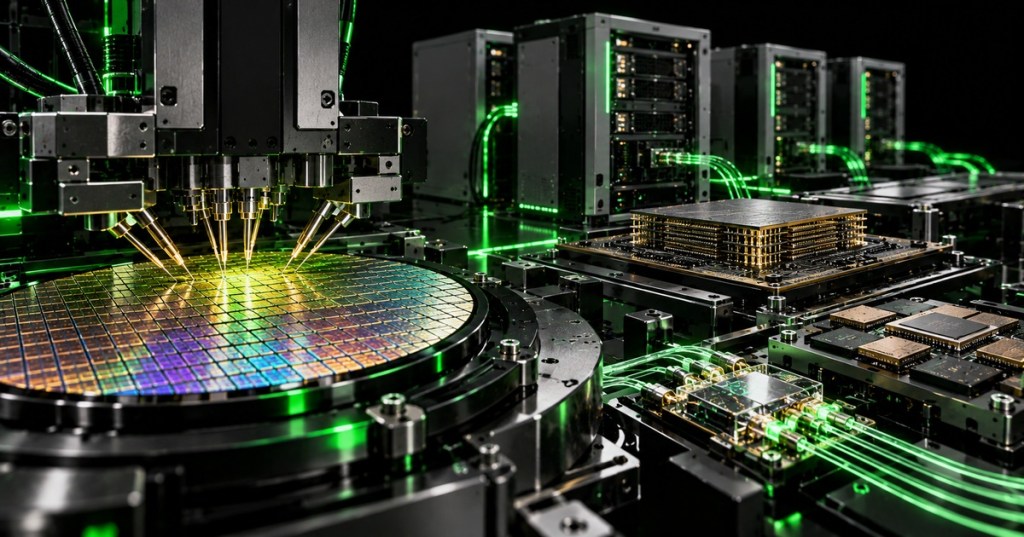
Teradyne is making a $300 million strategic investment in FormFactor as the two semiconductor-equipment companies build a broader testing partnership around AI chips, high-bandwidth memory, advanced packaging and silicon photonics. The deal matters because the AI hardware boom is increasingly turning semiconductor test into a bottleneck of its own.
According to FormFactor’s October 12 announcement, Teradyne will combine its automated test platforms with FormFactor’s probe technologies, interfaces, device characterization and test-engineering capabilities. A subsequent FormFactor SEC filing says Teradyne agreed to purchase 2,234,887 FormFactor shares for approximately $300 million in cash, with closing expected in the fourth quarter of 2026 subject to customary conditions.
Market discussion of the FormFactor–Teradyne collaboration and strategic investment.
Why semiconductor testing is getting harder
AI accelerators are no longer a single-die problem. Modern systems increasingly combine large logic dies, chiplets, stacked HBM, advanced substrates and high-speed optical links. That means more interfaces have to be verified before a device can ship, and failures can become more expensive once multiple known-good dies are assembled into one package.
A 2026 semiconductor-industry deep dive explains how AI accelerators and HBM are increasing automated-test complexity.
Teradyne already says AI demand is driving record semiconductor-test revenue, while its HBM platforms are designed to test thousands of high-speed memory and power connections in parallel. FormFactor sits on the complementary side of that workflow, where probes and interfaces physically connect wafers and devices to the test system.
Investor discussion of Teradyne’s role in AI semiconductor testing; included as market context, not as evidence for the transaction.
The partnership reaches from wafer to data center
The companies say the collaboration will target high-performance compute, HBM, advanced packaging and silicon photonics. Those are the same areas where the rest of the AI hardware stack is becoming denser and more difficult to validate. BitcoinVersus.Tech has already tracked how AI packaging is increasing demand for interconnect materials, how AI optics are selling out years ahead, and how chip-design tools are using AI to catch errors earlier.
FormFactor’s overview shows the company’s role in semiconductor test and measurement across probing and characterization.
The signal
The $300 million equity commitment is stronger than a normal product-integration announcement because Teradyne is putting capital behind the relationship. It suggests the companies expect semiconductor test complexity to remain strategically important as AI hardware moves toward more stacked memory, chiplets and optical interconnects.
The bullish interpretation is that test intensity rises even if raw chip-unit growth eventually slows: more complex devices require more probing, thermal control, interfaces and validation per package. The risk is that semiconductor equipment remains cyclical. If AI-capex growth slows sharply, customers can still delay test-equipment purchases even when each individual chip is harder to validate.
For now, the confirmed development is straightforward: Teradyne is investing about $300 million in FormFactor, and the two companies are explicitly building a more integrated test path for the next generation of AI and high-performance computing hardware.
BitcoinVersus.Tech Editor’s Note:
We volunteer daily to ensure the credibility of the information on this platform is Verifiably True. If you would like to support to help further secure the integrity of our research initiatives, please donate using the QR code provided

For best QR-code scanning results, please scan this donation code from a desktop or larger screen. Mobile screens may prevent camera recognition.


Leave a Reply