Which AI model produces the most output for each watt of GPU power? The strongest apples-to-apples public dataset we found is the ML.ENERGY Leaderboard v3.0, updated September 23, 2026.
For this investigation, BitcoinVersus.Tech ranked the seven best energy-optimal configurations on ML.ENERGY’s Problem Solving with Reasoning workload under its 300 ms median inter-token-latency constraint. The metric is throughput divided by power: tokens/second/watt, which is dimensionally equivalent to tokens per joule. Higher is better.
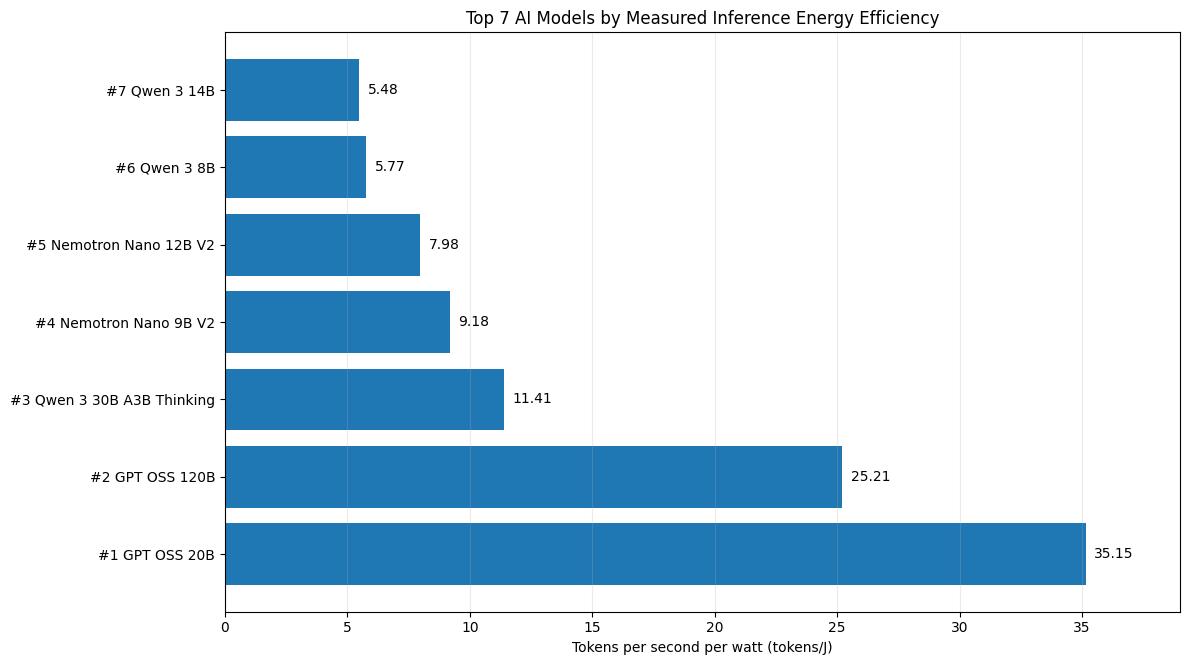
Comparison of the seven highest measured reasoning-inference efficiency results in the qualifying ML.ENERGY v3.0 configurations.
#7 — Qwen 3 14B
5.48 tokens/s/W at 0.1826 J/token on one NVIDIA B200 using BF16. It is the least efficient model in this top-seven group, but still substantially ahead of larger dense models lower on the full leaderboard.
#6 — Qwen 3 8B
5.77 tokens/s/W at 0.1732 J/token on one B200 using BF16. The result is a reminder that a smaller parameter count does not automatically guarantee the best energy efficiency.
#5 — NVIDIA Nemotron Nano 12B V2
7.98 tokens/s/W at 0.1254 J/token on one H100 using BF16.
#4 — NVIDIA Nemotron Nano 9B V2
9.18 tokens/s/W at 0.1089 J/token on one H100 using BF16. The result also shows why our earlier look at the tokens-per-watt race matters more than raw accelerator wattage alone.
NVIDIA has argued that AI infrastructure should increasingly be evaluated by delivered token economics rather than GPU-hour cost alone.
#3 — Qwen 3 30B A3B Thinking
11.41 tokens/s/W at 0.0876 J/token on one B200 using BF16. Its 30 billion total parameters contrast with only 3 billion active parameters in the benchmark, an important clue to its efficiency.
#2 — GPT OSS 120B
25.21 tokens/s/W at 0.0397 J/token on one B200 using MXFP4. Despite 117 billion total parameters, the leaderboard lists only about 5 billion active parameters.
ML.ENERGY researcher Jae-Won Chung explains the measurement and optimization problem behind energy-efficient deep learning.
#1 — GPT OSS 20B
35.15 tokens/s/W at just 0.0284 J/token on one B200 using MXFP4. That is roughly 39% more efficient than GPT OSS 120B and more than six times the measured efficiency of Qwen 3 14B in these qualifying configurations.
Who’s behind these models and chips?
The seven ranked results collapse into three model builders: OpenAI, Alibaba’s Qwen team, and NVIDIA. On the hardware side, every top-seven ML.ENERGY configuration in this investigation ran on an NVIDIA B200 or H100. For the silicon-focused companion ranking, see BitcoinVersus.Tech’s Top 7 AI Accelerators Ranked by Tokens per Second and Joules per Token.
| Ranked models | Model builder | Benchmark GPU | Who is deploying or building around it? |
|---|---|---|---|
| GPT OSS 20B, GPT OSS 120B | OpenAI | NVIDIA B200 | OpenAI lists Azure, Hugging Face, vLLM, Ollama, llama.cpp, LM Studio, Fireworks, Together AI, Baseten, Databricks, Vercel, Cloudflare and OpenRouter among launch deployment partners. Hardware optimization work included NVIDIA, AMD, Cerebras and Groq. |
| Qwen 3 14B, Qwen 3 8B, Qwen 3 30B A3B Thinking | Alibaba / Qwen | NVIDIA B200 | Qwen distributes Qwen3 through Alibaba services plus Hugging Face, ModelScope and Kaggle, with SGLang and vLLM recommended for deployment and Ollama, LM Studio, MLX, llama.cpp and KTransformers for local use. |
| Nemotron Nano 12B V2, Nemotron Nano 9B V2 | NVIDIA | NVIDIA H100 | NVIDIA builds both the model family and the accelerator platform. Nemotron Nano is distributed through NVIDIA NIM/NGC and Hugging Face, with self-hosted and partner-endpoint deployment options. |
That makes NVIDIA the common infrastructure layer across this particular top seven: OpenAI and Qwen occupy five model slots while running on NVIDIA B200s in the benchmark, and NVIDIA occupies the other two slots with its own Nemotron models running on H100s. OpenAI is also moving further down the stack: in August 2026 it disclosed measured results from its first custom inference chip, Jalapeño, including a GPT OSS 120B benchmark. Jalapeño was not the chip used for the ML.ENERGY numbers above, but it shows OpenAI is now building silicon as well as models.
Alibaba’s Qwen team introduced Qwen3 as an open-weight family spanning dense and mixture-of-experts models, including the 30B-A3B model in this ranking.
NVIDIA AI Developer announced NIM deployment support for OpenAI’s GPT OSS 20B and 120B, directly connecting the top two ranked models with NVIDIA GPU infrastructure.
NVIDIA’s official Blackwell video follows the hardware stack from silicon die through deployment in AI data centers.
Alibaba Group shows one downstream Qwen deployment: RayNeo smart wearable hardware powered by Alibaba Cloud’s Qwen model family.
What the ranking actually measures
This is not a pure model-architecture contest. Each result reflects a model + numerical precision + GPU + serving configuration + workload. GPT OSS uses MXFP4 here, while several Qwen and Nemotron entries use BF16, and five of the seven winning configurations run on B200 rather than H100.
ML.ENERGY’s own analysis of the benchmark shows that active parameter count, batching, GPU generation and multi-GPU scaling can all materially change energy per token. That fits the broader trend BitcoinVersus.Tech has tracked around software-driven AI efficiency gains and the possibility that cheaper AI can still increase total power demand.
Bottom line: GPT OSS 20B holds the strongest verified result in this dataset at 35.15 tokens per joule. But data-center operators should track tokens/J, J/token, energy per completed response and model quality together. A model that generates efficiently can still use more total electricity if it needs a much longer reasoning trace to finish the same job.
BitcoinVersus.Tech Editor’s Note:
We volunteer daily to ensure the credibility of the information on this platform is Verifiably True. If you would like to support to help further secure the integrity of our research initiatives, please donate using the QR code provided

For best QR-code scanning results, please scan this donation code from a desktop or larger screen. Mobile screens may prevent camera recognition.


Leave a Reply