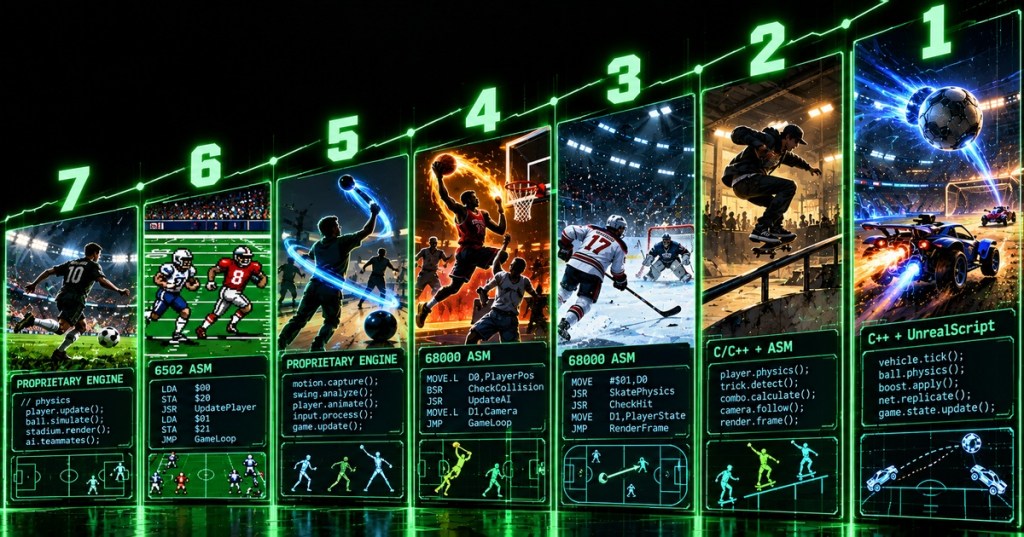
Great sports games do more than simulate a rulebook. They translate timing, momentum, spacing, physics and split-second decisions into code that feels natural in your hands.
This BitcoinVersus.Tech list ranks seven of the most important sports games ever made while also looking at the software underneath them. The ranking is editorial, not a benchmark. Where original source code or tooling is public, we name it. Where a studio kept the production language proprietary, we say that plainly instead of guessing.
The broader trend is worth watching. Modern sports games increasingly sit at the intersection of simulation, animation, physics and graphics technology—the same territory covered in our recent Top 10 graphics countdown, our look at Xbox Labs, and our coverage of AMD FSR 4 moving into more gaming hardware.
7. FIFA 14
FIFA 14 earns a place because it captured the global scale of football while arriving at a major engine transition. On PlayStation 4 and Xbox One, EA introduced the EA SPORTS Ignite engine, combining rendering, animation, locomotion, physics, AI and online systems into one sports-focused platform.
Code stack: EA SPORTS Ignite on PS4/Xbox One. EA publicly documented the engine architecture and systems, but not the exact production language mix used by FIFA 14, so calling the game “written in C++” would go beyond the public evidence.
EA SPORTS’ official FIFA 14 E3 trailer shows the animation, ball control and match presentation that defined the game’s generation.
EA SPORTS FIFA’s official account was part of the enormous 2014 World Cup conversation that helped define FIFA 14’s cultural moment.
6. Tecmo Super Bowl
Tecmo Super Bowl made football immediately readable without making it shallow. Play selection was fast, stars felt different, statistics mattered and the game could turn a single broken tackle into a legend.
Code stack: 6502 assembly on NES. A modern reverse-engineering project produced a byte-for-byte rebuildable 6502 disassembly of the game. That is not Tecmo’s original commented source release, but it exposes the actual machine-level structure behind the ROM—including the main game loop, playbooks, simulation logic and player data.
Original-hardware Tecmo Super Bowl footage shows how much football logic and presentation Tecmo packed into an 8-bit machine.
5. Wii Sports
Wii Sports changed who could play a sports game. Instead of teaching combinations of buttons, Nintendo mapped physical gestures to tennis swings, bowling releases, punches, golf shots and baseball motions. Its simplicity was the engineering achievement.
Code stack: proprietary Nintendo EAD software and Wii development tools. Nintendo’s own development interviews describe the game growing from separate Wii Remote prototypes and identify programmers behind individual sports, but Nintendo did not publicly document a definitive production-language breakdown for Wii Sports.
Nintendo Life revisits why Wii Sports’ motion-control design became one of the most influential sports-game interfaces ever made.
4. NBA Jam
NBA Jam proved a sports game did not have to be realistic to feel authentic. Two-on-two basketball, enormous dunks, simple controls, secret characters and “on fire” streaks turned the sport into arcade language without losing its competitive core.
Code stack: assembly language for Midway’s TMS34010-based arcade hardware. Surviving NBA Jam source files include thousands of lines of .ASM game logic, player sequencing, display routines and attract-mode code. The T-unit’s main processor was a Texas Instruments TMS34010.
The original arcade game shows how Midway used tiny control inputs and aggressively tuned timing to create one of gaming’s most recognizable basketball systems.
3. NHL ’94
NHL ’94 is still the model for readable sports design: skate, pass, shoot, check, switch players. The one-timer added just enough timing depth to produce years of competitive play without burying the player in controls.
Code stack: assembly-level Genesis development targeting the Motorola 68000. Programmer Mark Lesser wrote the Genesis version largely by himself in Maine, and the NHL ’94 reverse-engineering community works directly with the game’s assembly representation. The original production source has not been publicly released, so the precise assembler/toolchain should not be confused with a modern fan disassembly.
Noclip’s 30th-anniversary documentary interviews the people behind NHL ’94 and digs directly into how its one-timer and hockey systems were built.
2. Tony Hawk’s Pro Skater 2
Tony Hawk’s Pro Skater 2 turned skateboarding into one of the cleanest scoring systems ever designed. Every rail, ramp and gap became part of a programmable line: enter trick, maintain balance, link combo, multiply score, land.
Code stack: a hybrid C/C++ codebase with substantial assembly in the original Neversoft technology. A Treyarch postmortem on porting Neversoft’s code describes C and C++ plus assembly in the renderer and physics. The later Game Boy Advance team also specifically described reusing Neversoft C++ source to preserve the original physics and tricks.
A full Tony Hawk’s Pro Skater 2 playthrough demonstrates how consistently the game’s trick, balance and combo systems behave across radically different levels.
1. Rocket League
Rocket League takes the top spot because its rules can be explained in seconds while its skill ceiling still feels almost unlimited. A car, a ball, two goals and a physics model created an esport that rewards positioning, rotation, mechanical control, prediction and teamwork without needing scripted plays.
Code stack: Unreal Engine 3, with C++ and UnrealScript used in Rocket League’s production environment. Psyonix confirmed UE3 as the game’s engine, while a Rocket League gameplay-programmer listing explicitly required experience with both UE3 and the game’s physics-heavy architecture. The legacy version is now headed toward Unreal Engine 6, making preservation of the old physics behavior one of the most interesting engineering challenges in modern sports gaming.
Nintendo’s Rocket League launch trailer captures the game’s defining idea: physics-driven car control turned directly into a competitive sport.
The Code Changed With the Games
The most interesting part of the countdown may be the code progression itself. Tecmo Super Bowl and NBA Jam were built close to the hardware in assembly. Tony Hawk 2 blended higher-level C/C++ with hand-tuned assembly. Rocket League arrived in an era where a commercial engine, native C++ and a scripting layer could support a decade-long competitive platform. Wii Sports shows a different lesson entirely: sometimes the breakthrough is not graphical complexity but translating a new input device into simple, reliable game rules.
That is why the best sports games age differently from ordinary annual releases. Their graphics may date, but the timing loops, physics, AI decisions, animation rules and input models can remain playable for decades.
BitcoinVersus.Tech Editor’s Note:
We volunteer daily to ensure the credibility of the information on this platform is Verifiably True. If you would like to support to help further secure the integrity of our research initiatives, please donate using the QR code provided

For best QR-code scanning results, please scan this donation code from a desktop or larger screen. Mobile screens may prevent camera recognition.
BitcoinVersus.tech is not a financial advisor. This media platform reports on financial subjects purely for informational purposes.


Leave a Reply